
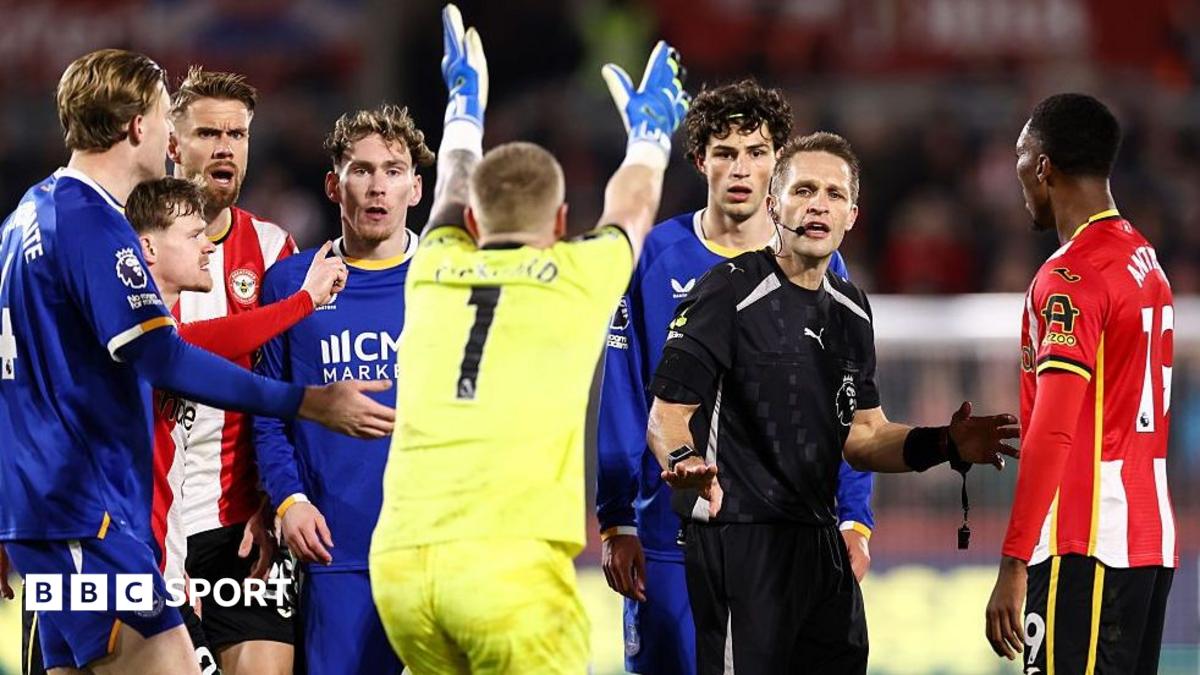
Image source, Getty ImagesImage caption, Referees rely on the opinions of former players to determine a significant part of their annual salary ByFootball issues correspondentIt has become something of a Wednesday morning ritual for fans. At 10am, the Premier League releases the latest votes of its Key Match Incidents Panel.It did not used to be this way.For four seasons, the KMI Panel was a clandestine operation. It was distributed to clubs only, but it would still find its way out into the public domain.This season, it began being released to the public.Yet little is really understood about the KMI Panel. Why does it exist? Is it just protecting referees? And does it really mean anything?For referees, the last question is more important than you might realise. The votes, which ultimately say whether referees have got a decision right or wrong, create a merit table of performance - and this impacts their salary."It depends where you are on the list," former Premier League referee Graham Scott said. "But if you're in the middle, then it might be 25% of your take-home. So it's substantial."For the officials, these are not decisions being taken by their bosses.Their performance reviews are effectively outsourced to a group of former players.The results can be inconsistent and frustrating as much for the referees as they are for the fans.What makes up a Premier League referee's salary?Let's take a look at how a referee's salary works in the Premier League.A Premier League official will earn, on average, about £175,000 per year. The scale will run between £125,000 and £250,000.Think that is unduly high? Referees in Spain's La Liga are the highest paid in the world, according to Marca, with an average yearly salary of £221,000. Premier League officials are about on par with those in the German Bundesliga and Italian Serie A. In England, there is a guaranteed base wage of 50%. This will differ depending on the seniority and experience of an official. Michael Oliver would be at the top of the bracket, a newcomer like Farai Hallam at the other end. The other 50% is based upon a set of variables, with match fees a major part.Each on-field appointment is worth a little over £1000, with a VAR game slightly less. How does this break down in real terms? Last season, Anthony Taylor refereed the most Premier League games, 31, followed by Chris Kavanagh, 30, and Michael Oliver, 29.Kavanagh and Oliver worked as VAR on a handful of occasions, while Taylor did not do any.Stuart Attwell had the most combined appointments at 52, with 25 games as a referee and 27 as a VAR.Finally, there is the subjective element - the KMI Panel.The votes determine the annual bonus payments for all officials. 'Ultimately, the KMI Panel lacks any real credibility'Until 2022, referees' body Pro Ref, or PGMOL as it was known until this summer, used to do its own assessment of its referees' decisions. But clubs grew restless, feeling referees were marking their own homework.And so the KMI Panel was born.It is made up of five members. Three are former players and coaches, plus there is a representative for the Premier League and one for Pro Ref. Their identities remain secret, with the former professionals selected from a pool on rotation. What you won't see on the published version is that each incident is given a difficulty rating, ranging from one to five, which is taken into account when drawing up the referees' merit table.All this really is, of course, is another layer of subjectivity. On top of the referees, VAR, players and coaches. And it causes frustration."People complain about the consistency of referees on field, of VAR interventions, or otherwise," said Scott, who now acts as the refereeing expert for the Athletic. "But then, if you look at the KMI Panel outcomes, they're also inconsistent."It is a view shared by Andy Davies, who retired as a Championship referee last year. "Naturally, there will always be a level of interest given as it provides a significant part of income for the season," Davies said."But ultimately, the KMI Panel lacks any real credibility amongst referees."Split decisions are 'contentious and inconsistent'Image source, Getty ImagesImage caption, Graham Scott was a Premier League referee for 10 years and acted as a VAR for more than 100 matchesReferees are scored on their on-field decision-making. If an error has been corrected by the VAR, it still counts as a mistake for the merit table.Those at the top of the table will be rewarded well, while those at the bottom are not likely to receive much of a bonus payment at all.Let's take a look at the numbers from last season.Michael Oliver was the top referee, getting 93.5% of KMIs correct. John Brooks, Darren England and Simon Hooper were very marginally behind.For other referees, the borderline decisions, ones which are the most subjective and sit in the grey areas, can be an issue. One vote could be the difference between a referee being right or wrong. And a place on the merit table, impacting how much they get paid.Last season, Sam Barrott and Jarred Gillett were both told they made four errors to a 2:3 vote. Attwell, meanwhile, had three of the more high-profile incidents go in his favour to a 3:2 vote."The ones that sit in the margins can be very contentious and inconsistent," said Scott."You think, well, how can that be right? You know, that's not definitive, is it? It could have gone either way."But there seems to be a reluctance to allow that 'seen them given' sort of mentality, neither right nor wrong."Relying on such a small group of people to be so definitive, especially when they vote 3:2, is unhealthy and unhelpful."'The game can afford to invest more in this process'As well as determining the merit table for each referee's salary, what the KMI Panel says can guide how games are refereed.But this causes problems, too.The members of the KMI Panel can be influenced by public opinion, and inconsistency means referees are often having to change the way they approach games, only to be told it is wrong."I have spoken to many referees, even this season," Davies said. "And they have no idea which way the panel is going to fall at times, or which way Pro Ref are going to vote because of how political it can be."Scott used the example of holding when an attacker is offside. In December last year, Brentford's Dango Ouattara was pulled back against Leeds. The penalty was cancelled by the VAR for offside. The KMI Panel voted 5:0 it was correct.Last month, Arsenal were not given a penalty against Hull, when an offside Kai Havertz was pulled back by Nobel Mendy. The KMI Panel voted 5:0 it was incorrect."One minute we're told football expects an offside," Scott said. "Okay, we'll deliver that for you. We do it again, and they say the opposite."Referees get confused on the back of that mixed feedback. It just shows how the system's flawed."The game can afford to invest more in this process, and a properly independent approach."For now, at least, referees have no choice but to rely on the KMI Panel to determine a chunk of their salary. More on this story
Why KMI Panel frustrates referees too - and impacts their salary
Full Article
Original Source
Read the full article at Bbc →KhanList aggregates and links to publicly available news content. We do not host full articles from third-party sources. Always verify important information with original sources.