
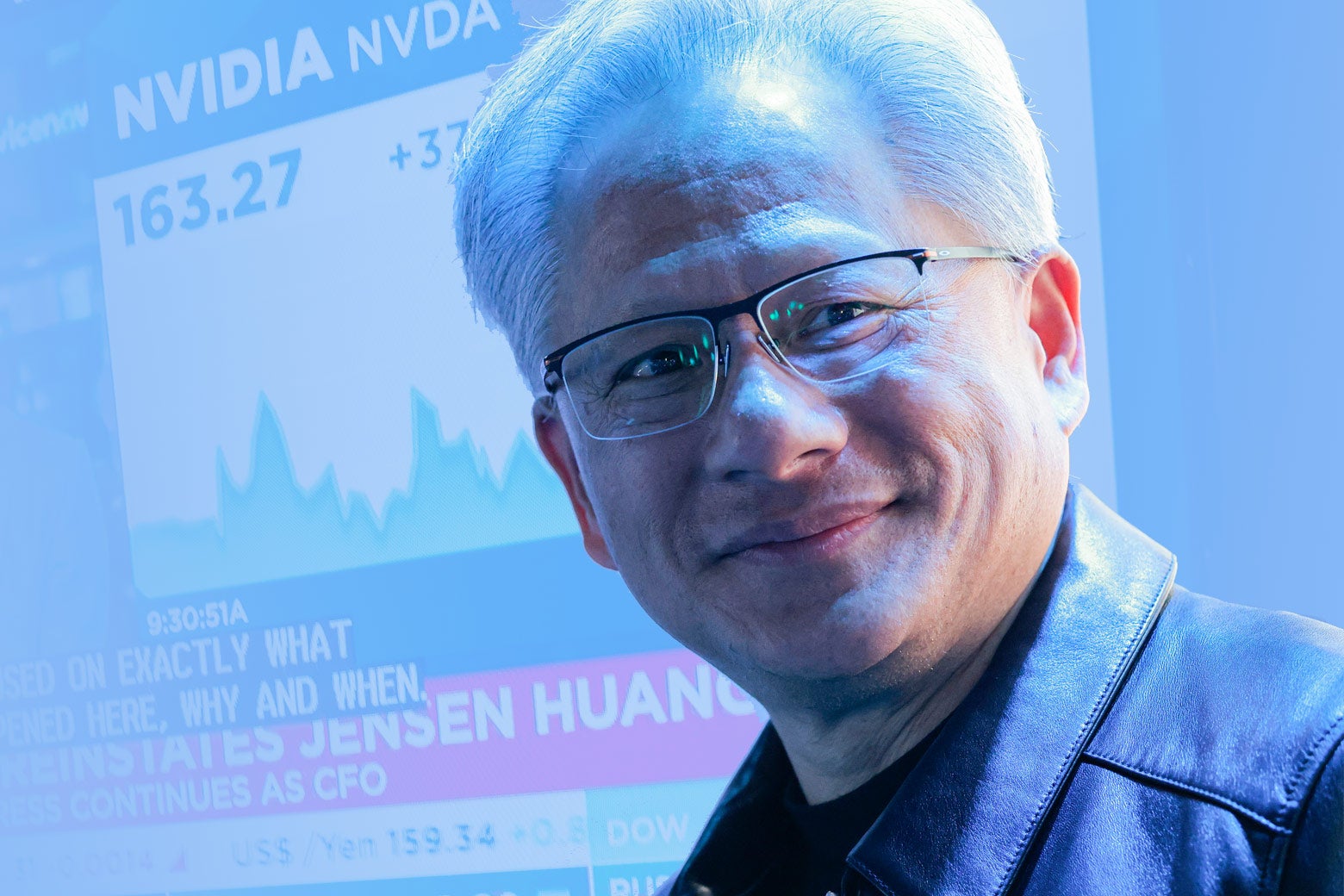
The Industry The stock market’s success rests on one man—and a president eager to bail him out. By Enter your email to receive alerts for this author. Sign in or create an account to better manage your email preferences. Unsubscribe from email alerts Are you sure you want to unsubscribe from email alerts for Nitish Pahwa? Nov 23, 20262:40 PM Photo illustration by Slate. Photo by Heather Diehl/Getty Images and Spencer Platt/Getty Images. Sign up for the Slatest to get the most insightful analysis, criticism, and advice out there, delivered to your inbox daily. Well, that didn’t take long. On Monday morning, just before markets opened, Nvidia’s board of directors announced that it unanimously voted to reinstate Jensen Huang as president, CEO, and director—only 11 days after it had fired him over reports of an inappropriate workplace affair, as well as a potentially compromising romantic and business relationship with a likely Chinese spy named Alice Huang (no relation). “In the process of reaching its decision, the Board received input from senior levels of the United States government,” Nvidia’s announcement reads in part. “Based on that input, the Board is confident that Mr. Huang’s reinstatement poses no national security risk.” This occurred just one day after the New York Times confirmed that Alice Huang had regular contact with an official in China’s Ministry of State Security while she and Nvidia’s Taiwanese-origin CEO were together, and while she was receiving Nvidia chips on behalf of a regime that was not supposed to have access to them. The board said on Monday that an independent committee would continue to investigate the possible Chinese intelligence plot, while Nvidia installs more guardrails over trade law and national security. (The Securities and Exchange Commission is also continuing a probe into Nvidia’s accounting disclosures.) But if anything’s clear now, it’s that Jensen Huang and his pals in the White House are gonna keep running things the way they like—which is just fine by the stock markets, which saw massive relief this morning after all the drubbing it took following Huang’s initial ouster. It’ll also be fine by Big Tech, whose leaders consistently advocated for Huang over the past week even as the Times published stories from subordinates who decried the CEO’s allegedly abusive management style. However, the American people might not be fine with it—especially after registering their displeasure at the ballot box with President Donald Trump’s corruption and the aggressive nature of the A.I. boom. If you’re wondering whether the “input from senior levels of the United States government” in Nvidia’s statement was a euphemism for Trump, the commander in chief all but appeared to confirm that himself on Monday. “I believe my intervention was very important,” Trump said to CNBC when asked if he thought Huang would have been rehired without his intervention. Tech Oversight Project CEO Sacha Haworth wrote in a statement that “this whole ordeal only reinforces what Americans already believe about a broken political system that stands up for Big Tech CEOs and not the American people.” Tech lawyer Eugene Rome points out that Nvidia’s ongoing investigations indicate that “this wasn’t driven by a final answer on the spy affair. Instead and unquestionably, it was driven by the market.” Even Fox Business and New York Post contributor Charles Gasparino called this “a modern-day Watergate.” As Gasparino previously revealed, the primary means by which Huang and his supporters hoped to persuade Nvidia’s board to bring him back was by undermining Alice Huang’s known status as a potential national security risk. Trump—who personally owns millions of dollars’ worth of Nvidia stock, and whose government has demanded 15 percent royalties from Nvidia chip sales to China—helped a lot in this regard, not just by telling Huang to fight for his job but by claiming, in public, “I don’t know that [Alice Huang] was a spy at all.” (Narrator: He’d been briefed months beforehand that she was probably a spy.) Trump repeatedly celebrated Huang’s return to the C-suite on Truth Social, coincidentally after resharing videos that purported to demonstrate how many Chinese fans he has. (He then posted a doctored image of Huang, holding a bra in front of an Nvidia flag, making the same pose as Trump’s viral assassination attempt photo.) In addition to placating the board—which was originally opposed to the idea of reinstalling its CEO of 33 years, having found him to also be a chronic fabulist—this was a matter of appeasing spooked investors across Wall Street. $NVDA remains the primary vendor of high-performance semiconductors and LLM-adaptable chips for the A.I. boom. So, as Nvidia’s business became less certain without its co-founder and leather-jacketed leader at the helm, a steep market sell-off of tech stocks began Yes, other chipmakers (AMD, Sandisk) are out there, and some corporations (Amazon, Google) have developed computing products in-house so as to reduce their reliance on those specialists. Still, Huang’s long-term deals and market dominance were so well established that he managed to basically dictate the geopolitical nature of the A.I. biz, including by persuading Donald “Beat China” Trump to go softer on the U.S.’s great power rival. That included reconfiguring how many premium Nvidia chips to which Chinese researchers and developers had access—and, as it turns out, funneling enough chips to Alice Huang’s Singapore-based company, Megaspeed International, to incidentally open up a backdoor to China. To Silicon Valley, Huang was so singularly important that his position trumped everything else, including its normal hard-edged competitive antipathy toward the world’s second-largest nation. (David Sacks, the venture capitalist and a podcaster who advised Trump on A.I. and China policy, counterintuitively insisted that booting the China-friendly Huang would actually benefit China further.) Naturally, they may have also been worried about their pocketbooks: The stock market grew so bearish after Huang’s exit that even Anthropic’s historic, record-breaking IPO couldn’t revive the Nasdaq’s fortunes. It was Jensen Huang, and Jensen Huang alone, who managed to bring the Nasdaq back around on Monday. But if this is a win for Trump’s wealthiest tech industry friends, it is pointedly not a win for “the People of the United States,” whatever the president may insist on his social network. Americans made plain that they were not convinced by either the economic or China-fighting cases for building data centers everywhere, and their once positive feelings about Silicon Valley are lower than ever. (YouGov polls find that Huang’s scandals have simultaneously increased public knowledge of Nvidia and given it a much more negative reception.) The American people of all ideologies who’ve grown more sick of Trump as well as his tech-oligarch buddies will not benefit from this kind of corporate impunity, especially since their retirement funds are so closely tied to A.I. market performance. New York City Mayor Zohran Mamdani homed in on this element, declaring at a press conference: “I do not think that working people across the country signed up for their pensions being tied to the question of Jensen Huang’s fidelity to his marriage.” Jensen Huang may have pulled off a Sam Altman and returned to a company whose board distrusted him—to the OpenAI CEO’s own delight—but things are not going to be easy for him. Lawmakers in both parties are still determined to investigate Huang and get him to testify. (As Groundwork Collaborative’s Alex Jacquez wrote in a statement to Slate, “Congress, likely on a bipartisan basis, is going to be hauling in Jensen Huang, certainly, but also likely other AI CEOs to get to the bottom of whether or not high-end leading-edge American chips are making their way to China.”) The stock market reactions make it plain that our economy is more rickety than it appears. All the “beat Chinese A.I.” federal messaging has proved to be a fluke. And now, to the world, Huang is primarily known less as a business mastermind than a bro who couldn’t keep it in his pants and had to speak to the ultimate manager (the president of the United States) in order to regain his position. Silicon Valley may have won this one. But it’s still not looking great for the industry in the long haul. Artificial Intelligence Donald Trump Silicon Valley Stock Market
Why Jensen Huang’s Comeback Is Such a Bad Sign for the Economy
Full Article
Original Source
Read the full article at Slate →KhanList aggregates and links to publicly available news content. We do not host full articles from third-party sources. Always verify important information with original sources.