
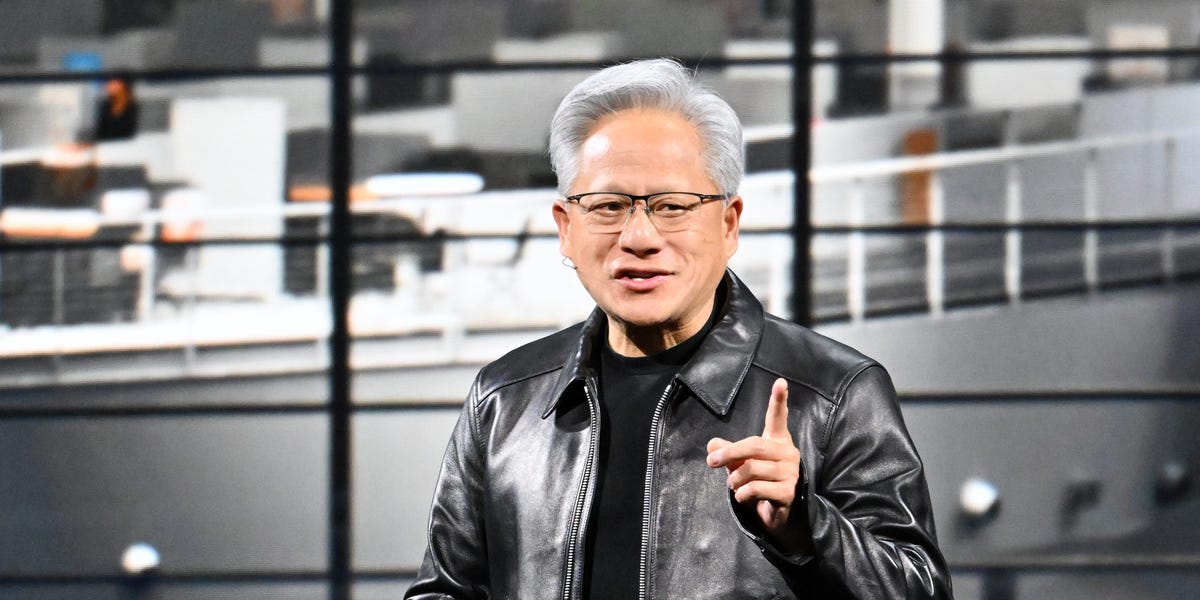
Nvidia CEO Jensen Huang speaking at the Fireworks AI conference in San Francisco on Nov. 3, 2026. Alistair Barr/Business Insider Nvidia CEO Jensen Huang's extramarital affair and the allegations of Chinese espionage surrounding it have rocked Silicon Valley. Amid all the drama, there's an important question: What does this mean for the AI boom?Probably very little, according to Wall Street's reaction on Monday. This extraordinary episode could end up being a storm in a honeypot when it comes to America's massive AI buildout. It might even help.First, some important context. Huang has admitted to being unfaithful to his wife, and Nvidia's board is investigating whether he was targeted by a foreign intelligence operation.US intelligence officials believe Alice Huang, an executive at Nvidia customer Megaspeed, was recruited to spy for China, according to The New York Times and The Wall Street Journal.That's a serious allegation, but it's not an established fact. Business Insider has not independently verified the US government's assessment. And intelligence agencies can be wrong. Their confident claims about weapons of mass destruction in Iraq turned out to be very wrong. (Talk about "artificial" intelligence).Nvidia's board says it has no reason to believe company secrets or national security were compromised.Now, back to the AI boom.Will software developers stop using Claude Code and Codex because Jensen Huang cheated on his wife and his lover might be a Chinese spy? No.Will the 1.2 billion people using ChatGPT every week suddenly stop asking it questions? Of course not. And will businesses abandon their efforts to use AI to save time and money, and increase productivity? Highly unlikely. In fact, Western companies might drop Chinese open-weight models over this scandal, helping US AI companies such as Anthropic and OpenAI.Anyway, the main point is that rampant demand for AI isn't going anywhere because of one CEO's private life."We still foresee significant upside for AI chipmakers and anticipate technological advancements and the need for significantly more computing power in the years ahead," Morningstar senior equity analyst Brian Colello wrote on Monday. "We still anticipate that Nvidia's forecast of $3 trillion to $4 trillion of annual AI infrastructure spending by 2030 will come to fruition, regardless of this news."Nvidia could continue to dominateThe more interesting question is what happens to the supply of the powerful chips needed to run AI.Nvidia dominates this market, and Huang has been instrumental in building that position. His departure could disrupt the company's strategy, relationships, and financing arrangements. Eventual lawmaker probes could be another headache for Nvidia.That uncertainty manifested itself in a 4% drop in Nvidia shares. But the rest of the tech market jumped on Monday, with rival AI chipmaker AMD surging 13%. That's a sign that demand is still strong, but might shift away from Nvidia if Jensen Huang is forced to step down.Beyond that, there's another possibility worth considering.Megaspeed has faced scrutiny over whether its overseas data centers helped Chinese customers access Nvidia chips despite US export restrictions. The scandal could make such arrangements harder, potentially ending Nvidia's ability to sell GPUs in China.That would keep more of Nvidia's supply available for American customers — welcome news for Amazon, Microsoft, Google, and other companies spending enormous sums building AI data centers.There's no guarantee this happens, or that additional supply would lower prices. But with demand for Nvidia's products still enormous, it's a plausible upside for the US.Meanwhile, Huang has spent years lobbying Washington to loosen restrictions on chip sales to China, with limited success. Bernstein chip analyst Stacy Rasgon questioned whether any alleged Chinese influence was necessary, given Huang's longstanding position (as the CEO of a for-profit company) of wanting to sell his products as far and wide as possible."A key worry seems to be that Ms. Huang might have influenced Jensen to lobby the US to allow more sales of Nvidia's products into China," Rasgon wrote in a note to investors on Monday. "This seems superfluous to us as he has been doing that for years anyway and hardly needs encouragement (though not terribly successfully as China sales remain low)."The scandal could also pass. Huang could remain Nvidia's CEO, and there's no indication customers are canceling orders (outside of China where the government is actually blocking GPU sales).Morningstar's Colello expects Nvidia's business to remain strong. He maintained his $310 fair value estimate for the stock, almost double its Monday trading price."We also must consider the possibility of the entire episode fading away for Nvidia," he wrote. "Jensen Huang's position as Nvidia's co-founder and only CEO likely gives him more support with the board than most other executives. US President Donald Trump announced his support when the allegations first arose."The future of AI depends on whether people and businesses keep finding the technology useful, and whether companies can build enough infrastructure to meet demand.Jensen Huang's romantic life changes neither equation. If anything, this affair might leave America with more chips to power its AI ambitions.Sign up for the AI Insider newsletter here. Reach out to me via email at abarr@businessinsider.com Read next Business Insider tells the innovative stories you want to know Business Insider tells the innovative stories you want to know Business Insider tells the innovative stories you want to know Business Insider tells the innovative stories you want to know Alistair Barr is the driving force behind Business Insider's AI Insider franchise, including the AI Insider newsletter. Sign up here. Before that, he was Business Insider's Global Tech Editor and the Big Tech team leader at Bloomberg, following a reporting career at The Wall Street Journal, USA Today, Reuters, and MarketWatch. Alistair covers all things Big Tech, along with startups and venture capital. He writes analysis and columns about topics including AI, cloud computing, data centers, semiconductors, online search, e-commerce, EVs, robotics, and autonomous vehicles. Eugene is Business Insider’s Chief Tech Correspondent, where he leads coverage of Amazon. His reporting spans the company’s retail and logistics operations to AWS, Alexa, and its internal culture.Previously, he worked at CNBC, Fortune Magazine Korea, and Japan's Yomiuri Shimbun. He holds degrees from NYU and Columbia University’s Graduate School of Journalism.In 2022, Eugene reported on internal documents indicating that Amazon allegedly used deceptive tactics to enroll customers in Prime and made cancellation difficult. The Federal Trade Commission sued Amazon the following year, citing his reporting. The case ended in a record $2.5 billion settlement in 2025.His work has received multiple honors, including the SF Press Club’s Bay Area Journalism Award and SPJ NorCal’s Excellence in Journalism Award.Eugene lives in the Bay Area. Contact him via email at ekim@businessinsider.com, or Signal, Telegram, or WhatsApp at 650-942-3061. Use a personal email address, a nonwork WiFi network, and a nonwork device; here's our guide to sharing information securely. China Amazon Google More Microsoft Cloud Computing Data Centers Artificial Intelligence AI Insider
Why Jensen-Gate may actually help the AI boom
Full Article
Original Source
Read the full article at Businessinsider →KhanList aggregates and links to publicly available news content. We do not host full articles from third-party sources. Always verify important information with original sources.