
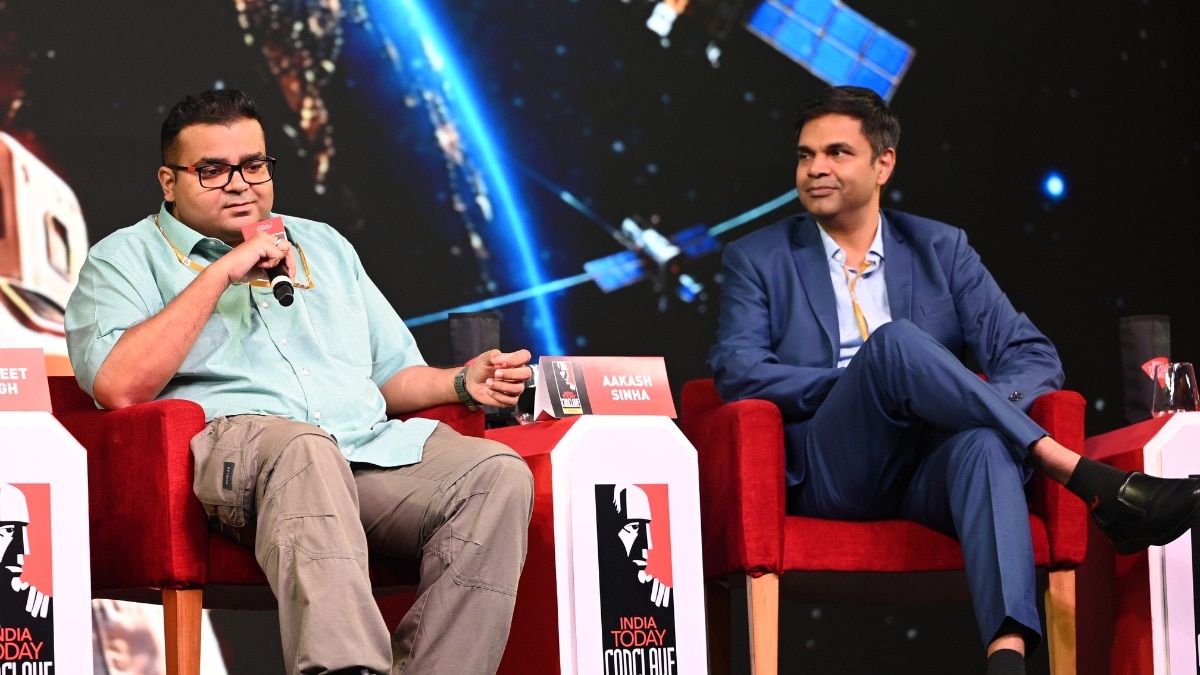
Kepler Aerospace CEO Navneet Singh and Aakash Sinha, founder director of Omnipresent Robot Tech, on the opportunities for new-age space warriorsIn the past seven years since India introduced reforms in the space sector to allow greater private-sector participation, the number of space start-ups in the country has grown from single-digit levels to nearly 400.“Zameen asmaan (a world of difference)” is how Navneet Singh, founder and CEO of the Bengaluru-based Kepler Aerospace, describes the sea change the sector has witnessed. “Before the space reforms happened, private sector was involved in the space business. But they were a vendor ecosystem, not an owner ecosystem. The owner ecosystem has started happening now,” said Singh at the India Today Conclave Mumbai during the discussion, ‘Technology & Innovation: The New Space Warriors’.“Access is a lot easier, and then funding support has now come in from the government Apart from grants, they are also signing a minimum order quantity along with the contract. So, you develop the technology and you’re also assured an order,” added co-panellist Aakash Sinha, founder director & CEO of the Noida-based Omnipresent Robot Technologies, which worked on the navigation software for the Pragyan moon rover for the Chandrayaan-3 mission.Meanwhile, ‘patient capital’ from the private sector is more accessible, with Indian investors recognising that space technologies are a critical area despite long-gestation periods. Yet, there’s still some inertia to shake off. While the Indian private sector is building sub-systems, the country needs to create an ecosystem for manufacturing components. “One has to crawl before they walk and walk before they run. We are at the walking stage. So, the running stage will take a few more years,” said Singh.Singh feels India’s private space sector needs to focus on technologies that can help bridge the gap with the United States and China, which have a greater number of space assets and capability. “For that, we need to look at advanced technologies, interconnected satellites, onboard computer systems and distributed intelligence gathering systems. That’s what I think is the future,” he added. His start-up is working on autonomous swarming satellites.According to Sinha, there’s a need for more government handholding and a higher magnitude of funding for critical technologies. “It’s important that the start-ups get that kind of support, and perhaps when they see government support at that level, I’m sure the private sector will equally match that,” he said.SESSION HIGHLIGHTSNavneet Singh* “It’s a good time to be in the space and defence business and I think it’ll even get better as we go ahead. But this is a booming economy sector that we have to pursue because it is more of a requirement than a desire.”* “ISRO is an enabler in some sense but also a gatekeeper in another. There are certain things that the government would like to keep under their control and there are certain things that are way too expensive to be given out.”* “I just want more orders, a concentrated national push for critical technologies and a push for Indian dominance in the Global South for space technologies. Let’s do these three and we should be golden.”Aakash Sinha* “What has recently changed, especially in the last few years, is that India’s own space aspirations have become much bigger, and now there is genuine thought in government, in military, to become a leader in space tech.”* “We have got a contract from the ministry of defence, where we are building what would be the world’s highest resolution and perhaps the most accurate 3D mapping satellites.”* “The government is doing a great job handholding the start-ups but they need to handhold them longer and give them a clear path.”Subscribe to India Today Magazine- Ends
Why it's boom time for start-ups in the Indian space sector
Full Article
Original Source
Read the full article at Indiatoday →KhanList aggregates and links to publicly available news content. We do not host full articles from third-party sources. Always verify important information with original sources.