
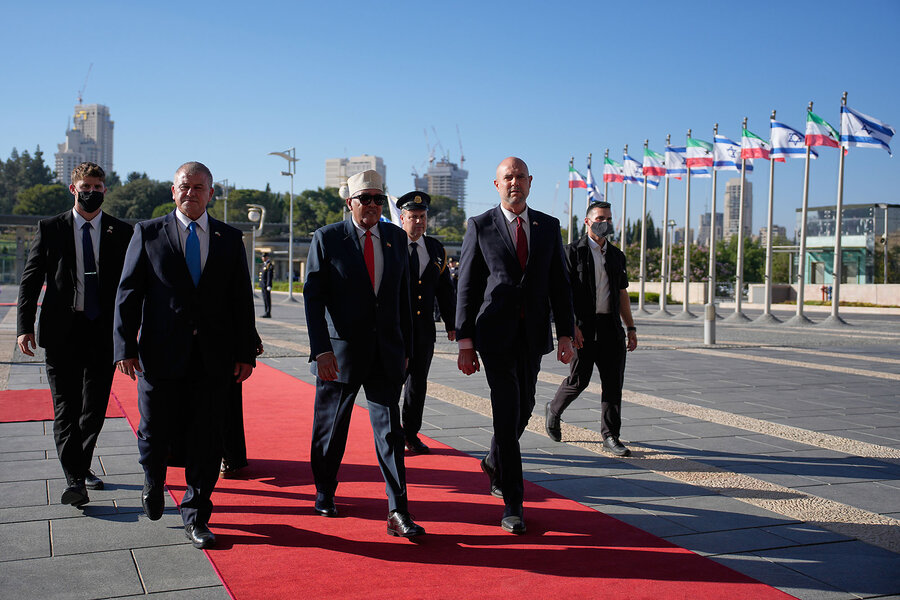
Hargeisa, Somalia | Oct. 22, 2026, 5:00 a.m. ET | 5 min read At a foreign exchange stall in a bustling marketplace here in Somaliland’s capital city, Abiquatar Farah proudly holds out a red banknote. Money generally moves quickly through his hands as visitors exchange their U.S. dollars and Ethiopian birr for brightly colored Somaliland shillings.This Israeli shekel, however, Mr. Farah will never give up. The note is “a memory,” he says, of the day last December when Israel announced that it would recognize this breakaway state in the Horn of Africa as an independent nation – the first country in the world to do so.Somaliland split from Somalia in 1991 following a brutal civil war. From the rubble, it established its own government and military. But without diplomatic recognition, it remains locked out of the global fraternity of nations. So, when Israel made its announcement, Mr. Farah joined the tens of thousands pouring into Hargeisa’s streets in celebration, waving Israel’s blue and white flag alongside Somaliland’s red, white, and green. Sophie NeimanAbiquatar Farah proudly holds out an Israeli 20-shekel note given to him by an Israeli journalist, in Hargeisa, Somalia. July 27, 2026. He says he keeps the note as a reminder of Israel's recognition last year of Somaliland as an independent country. The new friendship, however, is not without complications.Israel is a polarizing ally. Already, several Arab countries have condemned its recognition of Somaliland, as has the African Union. In an already fractious region, this alignment could bring conflict to Somaliland’s doorstep.“There is no risk-free life in the world,” says Somaliland’s President Abdirahman Mohamed Abdullahi, popularly known as Irro, in response. “We have been seeking recognition, and Israel is the only country that recognized us.”“Recognition. Recognition. Recognition.”Little is known about the agreements made between Israel and Somaliland. But both sides have angles to play. At a secretive meeting with Israeli officials last year, the delegation from Somaliland brought three requests: “Recognition. Recognition. Recognition.” So recalls Jama Haji Mohamoud Egal, an adviser to President Abdullahi and an attendee of the talks.For more than three decades, international acknowledgment has been Somaliland’s diplomatic center of gravity. Without it, the self-declared nation is cut off from representation at the United Nations and most global development loans. Its people struggle to apply for visas and travel internationally.For its part, Israel is likely seeking a strategic foothold in the Horn of Africa, experts say.“I don’t think that the Israelis are just trying to support nascent democratic states in Africa,” says Cameron Hudson, an analyst and former director for Africa affairs for the National Security Council. “They are pursuing a set of very hard security interests.” Sophie NeimanSomaliland hopes to make its port at Berbera, operated by a firm based in the United Arab Emirates, a shipping hub in the Horn of Africa region, July 30, 2026. Indeed, Somaliland’s United Arab Emirates-built port in Berbera is located just 160 miles across the Gulf of Aden from Yemen. That provides Israel not only a toehold in one of the world’s busiest shipping routes but also a useful vantage point from which to monitor the activity of Yemen’s Iranian-backed Houthi rebels, who are currently at war with Yemen’s government.In September, Ahmed Dirie, who chairs the executive committee of the Israel and Somaliland Friendship Association, told The Jerusalem Post that the two governments shared an enemy in the Houthis and could collaborate to defeat the group. Meanwhile, Israel has already opened an intelligence base in Somaliland, and its forces are training the state’s police and military, according to Somaliland’s defense minister, Mohamed Yusuf Ali.“We are ready to cooperate [with Israel] in security, in economic cooperation, in international relations, in foreign policy, in regional affairs, in maritime security,” explains President Abdullahi. “We are ready because it’s in our own interest.”A contentious friendshipHowever, any Israeli military presence is rife with risk for Somaliland, whose East African and Middle Eastern neighbors are staunchly opposed to Israel’s wars in Gaza, Iran, and Lebanon. The Houthis have said they consider any Israeli presence in Somaliland a “military target.”Many worry that, in exchange for recognition, Somaliland has been forced to write Israel a blank check. It was “not in a position to negotiate on equal footing,” says Hassan Suudi, managing director of the Institute for Strategic Insights and Research, a Hargeisa-based think tank.For many Somalilanders, coziness with a state found by the United Nations to have committed genocide in Gaza doesn’t sit well. Some of that unease comes from personal experience: Mogadishu’s brutal campaign against Somaliland during the 1980s was later described as a genocide by U.N. investigators. Farah Abdi Warsameh/APPeople protest against Israel's recognition of the breakaway region of Somaliland as an independent country, in Mogadishu, Somalia. Jan. 8, 2026. “I never expected Somaliland to establish relations with a country ... that has been massacring Muslims for more than two years,” says a taxi driver, who asked to remain anonymous out of concern for retaliation as a result of publicly criticizing the government.Indeed, many citizens are on edge here after Interior Minister Abdalle Mohamed Arab declared earlier this year that criticism of Somaliland’s relationship with Israel “will not be tolerated.” The state wants to “crush any narrative that was against the main narrative,” says human rights lawyer Guleid Ahmed Jama. In July, singer Khalid Mohamud Abdillahi, better known as Khalid Kamil, was arrested over an unreleased song expressing sympathy with the plight of Palestinians in Jerusalem.Meanwhile, Israel has much to gain from the optics of having a Muslim ally, says Mr. Hudson, the analyst.In February, a group of government hydrologists from Somaliland flew to Jerusalem to learn about managing water in a parched desert climate. “We were welcomed with Somaliland and Israeli flags,” recalls one of the attendees, who asked to remain anonymous as his cohort was not authorized to speak with the media.During the trip, members of the group toured water treatment facilities as well as cultural sites, including the Al-Aqsa Mosque. While they were in Israel, the United States and Israel bombed Iran. The Somaliland delegation didn’t waver in its response.“We were rooting for Israel,” the hydrologist says. Sophie NeimanSomaliland President Abdirahman Mohamed Abdullahi, pictured in Nairobi, Kenya, in August, says of Israel's recognition of Muslim-dominated Somaliland as an independent country, "There is no risk-free life in the world. ... Israel is the only country that recognized us.” RealpolitikSomaliland’s rulers are hopeful that Israeli support will also open the door to a far bigger prize: U.S. recognition.In September, President Abdullahi traveled to the U.S., where he met with Republican Sen. Ted Cruz of Texas, who has advocated that the Trump administration recognize Somaliland’s independence. “Somaliland has already established itself as a reliable partner for the United States on a range of issues, from countering terrorism to protecting shipping around the Horn of Africa,” Mr. Cruz wrote in a Facebook post after the meeting. “I am committed to securing American recognition of Somaliland’s sovereignty.”That, however, is not the Trump administration’s official position. A State Department report to Congress on Somaliland in June affirmed “the territorial integrity of ... Somalia.” Deepen your worldviewwith Monitor Highlights.Politics with respectGet political stories with respectful analysis.There‘s a world of new ideas in everyBooks newsletter.There‘s more to life, enrich yours withCulture & Learning weekly.Follow humanity‘s discoveries withScience & Nature stories in your inbox.Gain a spiritual perspectivefrom the stories in your inbox.Want to understand the deeper impact of critical events? Learn the Monitor‘s insight.Already a subscriber? Log in to hide ads. According to Mr. Hudson, American recognition is unlikely to happen in the near future simply because the U.S. government has no pressing need for it. Sophie NeimanGoats are seen at an early morning market in Hargeisa, Somalia. July 27, 2026. Israeli support also did not, as hoped, “unleash a chain reaction of countries recognizing Somaliland,” he adds.In Hargeisa, meanwhile, the country that doesn’t exist carries on. ALREADY A SUBSCRIBER? LoginReal news can be honest, hopeful, credible, constructive.The Christian Science Monitor was founded in 1908 to lift the standard of journalism and uplift humanity. We aim to “speak the truth in love.” Our goal is not to tell you what to think, but to give you the essential knowledge and understanding to come to your own intelligent conclusions. Join us in this mission by subscribing.
Why Israeli recognition has been a double-edged sword for Somaliland
Full Article
Original Source
Read the full article at Csmonitor →KhanList aggregates and links to publicly available news content. We do not host full articles from third-party sources. Always verify important information with original sources.