
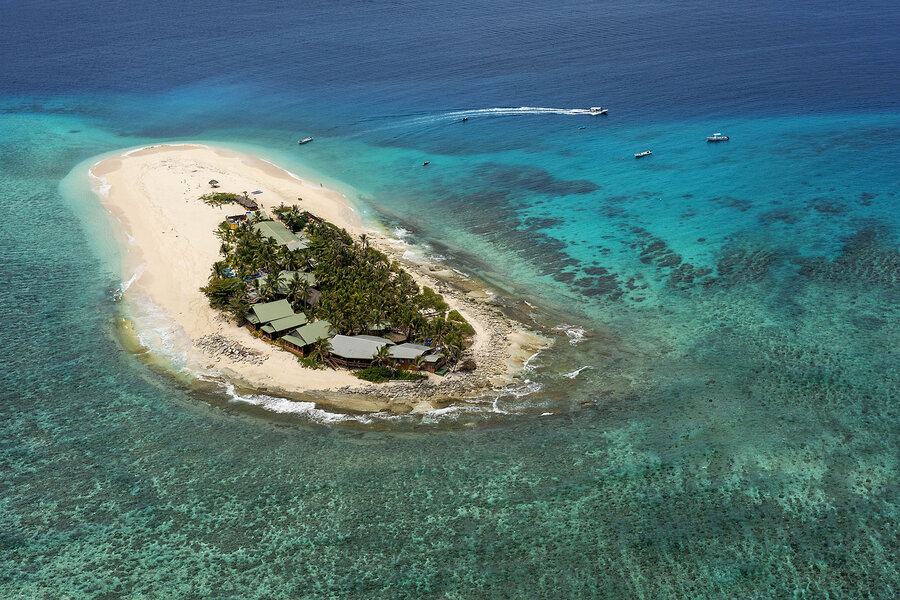
Ratu Ilisoni Vuidreketi remembers a particular palm tree from his childhood: strong and tall, bearing coconuts, and firmly rooted in the solid, verdant ground of Fiji’s largest island, where he grew up. But now, when high tide rolls in, that same tree is awash in salt water from the South Pacific.Today, as Fiji’s ambassador to Washington, Mr. Vuidreketi mentions that dying tree first when he describes the danger of rising sea levels that threaten his island nation.“When I went back, I said, ‘Where’s the coconut tree?’ And then I saw – it’s in the sea!” “That’s just one small example,” he says, standing in a corridor at the United Nations outside a cavernous conference room where all 193 member states approved the body’s first declaration on sea level rise.It outlines legal and financial protections against rising sea levels and represents a rare triumph for multilateral diplomacy at a time when the concept is under siege. The agreement was one of the few issues of consensus during the annual gathering of nations.Although rising seas pose a threat to all countries, low-lying island nations are already seeing the damage. As glaciers and ice sheets melt, causing sea levels to rise, some nations are at risk of being washed away entirely. Their leaders point out that they’re bearing the impact, even though it’s the large, wealthy, industrialized nations whose actions are widely believed to have prompted the climate crisis. “I come as the representative of the 1 billion people living on the front line of one of the biggest challenges of our time,” said Prime Minister Feleti Teo of Tuvalu, addressing the U.N. Rising Sea Levels special session. Caitlin Ochs/ReutersTuvalu’s Prime Minister Feleti Teo addresses the 81st United Nations General Assembly at UN headquarters in New York, Sept. 25, 2026. “Our present reality”“It is not a future threat, but our present reality,” Mr. Teo said, echoing comments of fellow island nation leaders. His country is an archipelago in the South Pacific roughly halfway between Australia and Hawaii. It’s among the nations at highest risk of going underwater this century.“It is already threatening our food security, damaging infrastructure, and putting increasing strain on our economy … our culture, our heritage, and for some countries, like mine, our continued existence [are threatened].”Like Tuvalu, the populations of Fiji and many of the other island nations in the South Pacific also live close to the shoreline.“Our towns and cities, our infrastructure, it all runs through the coasts,” Solo Mara, Fiji’s secretary for foreign affairs and external trade, tells The Christian Science Monitor, noting that coastal building had long been the country’s economic development model.Its tourist industry, built along lagoons and white sand beaches, is among the main economic drivers and source of foreign currency. Now, tourism and Fiji’s roads, bridges, and homes are all under threat, Mr. Mara says.That’s because there has been so much flooding, erosion, and battering by extreme winds, and an increasing number of severe and destructive storms. Some communities are being forced to move further inland or to Fiji’s main island. Mr. Mara describes forced removals of some villages as the most painful adaptation being made by the Fijian government.The first defensive stage in Fiji and other island nations was building seawalls, planting mangroves, and improving drainage systems, but at this stage, that’s not enough for the most vulnerable coastal areas, experts say. Misper Apawu/APPeople lounge on a beach in Praia, Cape Verde, May 7, 2026. “We will be judged [on] if we can implement it”“We are a canary in the coal mine,” Mr. Mara says of the climate changes impacting island nations in the South Pacific and Asia. “Now you are seeing things like this happening in other parts of the world.”Small Island Developing States, known as SIDS, is a coalition of low-lying island nations. They have come together to highlight their shared vulnerability and message. The group is advocating for international action and wants other countries to help fund the adaptations needed to protect the islands and ensure that people can stay there.A decade ago, SIDS used its shared voice to sound the alarm and try to persuade larger and more powerful nations to sign the Paris Agreement, to limit global warming to 1.5 degrees Celsius (2.7 degrees Fahrenheit) by reducing fossil fuel emissions from the use of coal, oil, and gas. But this month, the U.N. said the world seemed poised to pass that marker, and scientists believe every rise in temperature means it will be more difficult to reverse sea level rise.The new U.N. declaration, which SIDS campaigned for, says that countries will be able to exist as sovereign political entities even if their land one day vanishes. That means being able to continue to control their original maritime border and maintain exclusive rights for fishing, energy, or military purposes. Deepen your worldviewwith Monitor Highlights.Politics with respectGet political stories with respectful analysis.There‘s a world of new ideas in everyBooks newsletter.There‘s more to life, enrich yours withCulture & Learning weekly.Follow humanity‘s discoveries withScience & Nature stories in your inbox.Gain a spiritual perspectivefrom the stories in your inbox.Want to understand the deeper impact of critical events? Learn the Monitor‘s insight.Already a subscriber? Log in to hide ads. The declaration also states that developed countries have an obligation to help finance measures to protect coastlines.Addressing his fellow country representatives, Cape Verde’s Finance Minister Olavo Correia said, “Today we are applauded for adopting the resolution; tomorrow we will be judged [on] if we can implement it.” ALREADY A SUBSCRIBER? LoginReal news can be honest, hopeful, credible, constructive.The Christian Science Monitor was founded in 1908 to lift the standard of journalism and uplift humanity. We aim to “speak the truth in love.” Our goal is not to tell you what to think, but to give you the essential knowledge and understanding to come to your own intelligent conclusions. Join us in this mission by subscribing.
Why island nations are the real winners as U.N. wraps up
Full Article
Original Source
Read the full article at Csmonitor →KhanList aggregates and links to publicly available news content. We do not host full articles from third-party sources. Always verify important information with original sources.