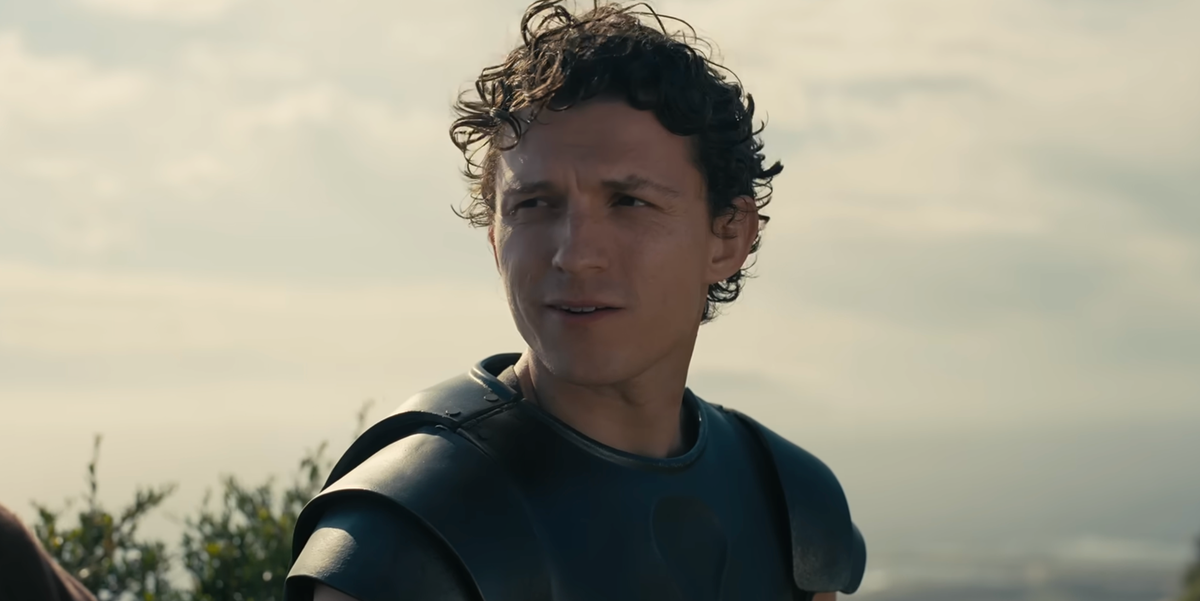
3 min readImagine a world where hospitality to strangers is the law—on pain of divine punishment—and guests are bound to repay it with grace and gratitude. A world where the treatment of outsiders is a test of civilization, and strangers welcomed today may become hosts tomorrow. It's not that bigots wouldn't exist—it’s just that they'd all have been turned into pigs. What a different world that would be.Well, Christopher Nolan calls it "Zeus's Law", and it's one of the central themes running throughout The Odyssey.It's why Menelaus is so welcoming when Telemachus (Tom Holland) travels to Sparta looking for news of his father. Why Polyphemus, the Cyclops, loses his one good eye. Why Odysseus's men get turned into swine. And, most importantly, it's why Penelope (Anne Hathaway) can't simply kick out the approximately 108 princely vultures circling her since rumors of Odysseus's death at Troy.The reason these things happen? Each either obeys or defies "Zeus's Law"—which boils down to a fairly simple principle in twenty-first--century terms: don't be a dick to strangers.More formally, "Zeus's Law" was the network of sacred obligations placed under the god's authority in ancient Greek religion and mythology. It wasn't a written statute, comparable to a modern legal code, but a divine moral order governing hospitality, supplication, oaths, kingship, justice, and the treatment of strangers.In Nolan's take on the epic, the central tenet is xenia—the sacred rule of treating strangers with generosity, food, and shelter.As the director himself told the Los Angeles Times: “It is the golden rule, the idea that you treat people the way you want to be treated. Partly it’s because a humble person may be a god in disguise, but it also allows society to function. People need to travel, to trade, and everyone is at the mercy of strangers.”But xenia cuts both ways: a guest can break the code too, by overstaying their welcome or abusing their host's generosity, which angers the gods just as much as poor hosting does.“Its abuse has terrible consequences," added Nolan. "There is a price to be paid for vengeance and violence is the most straightforward expression of that.”Melinda Sue Gordon/Universal PicturesTelemachus (Tom Holland) knows why it’s important to channel good xenia.Good vs. Bad XeniaThe gods reward those who honor xenia and punish those who don't. Here’s where we see xenia, both good and bad, pop up in Nolan’s The Odyssey.Good xenia: King Menelaus (Jon Bernthal) welcomes Telemachus, feeds him, shares information, and sends him off loaded with gifts—textbook good xenia. He's already living proof of divine favor by the time Telemachus arrives: restored to his throne, reunited with Helen, twenty years after Paris's abduction of her sparked the war that led to Paris's death.Bad xenia: The Cyclops Polyphemus eats his guests instead of feeding them—and pays for it with his one good eye. Not even being Poseidon's son can save him.Good xenia: The swineherd Eumaeus (John Leguizamo) is another exemplar. When Odysseus finally returns disguised as a sick beggar, Eumaeus cares for him and asks for nothing in return.Bad xenia: Guests can misbehave, too. On Circe's island, Odysseus's men demand her hospitality and gorge themselves on her food—so she turns them into pigs, in what might be the best scene in the movie.Good xenia: Right at the start of the story, Telemachus welcomes a mysterious stranger into his home, feeds the visitor, and waits until they’ve eaten before even asking their name. That stranger is Athena in disguise—and his hospitality earns him her help with finding his father.Bad xenia: Among the suitors, Antinous (Robert Pattinson) is the worst offender—when the disguised Odysseus begs him for food, Antinous refuses and throws a stool at him instead. It's no coincidence he's one of the first suitors Odysseus kills when the massacre begins.The message is clear: don't be a dick and the gods will smile upon you.
Why Is Zeus’s Law So Important Anyway?
Full Article
Original Source
Read the full article at Esquire →KhanList aggregates and links to publicly available news content. We do not host full articles from third-party sources. Always verify important information with original sources.