
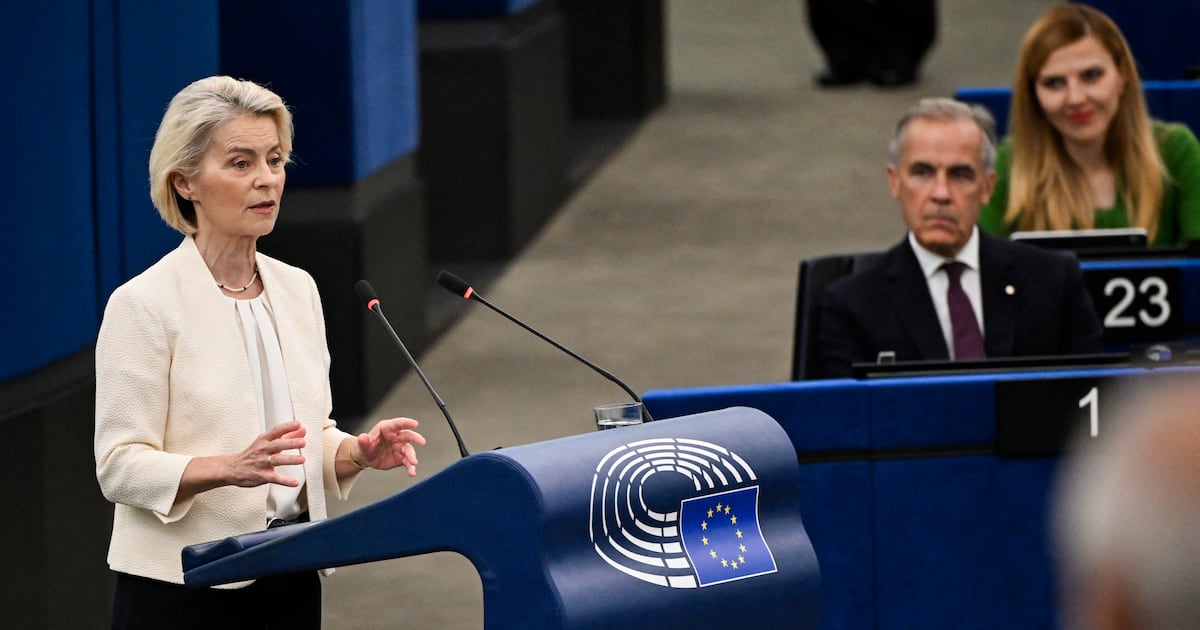
The door is open to Canada becoming the first “associate” member of the European Union. The only snag is such a thing doesn’t actually exist. In her annual State of the Union speech, European Commission president Ursula von der Leyen announced Brussels wanted to bring its relationship with Canada to the “highest level possible” and suggested that could mean inviting the country “to be the first associate member of the EU”. The hour-long speech covered heaps of geopolitics, but von der Leyen did not once mention the United States, the EU’s biggest economic trading partner and for decades its security guarantor. The commission president talked about how Europe’s “old assumptions and relationships have frayed” in a “hostile” world. READ MOREEnter Canada’s prime minister, Mark Carney. One consequence of US president Donald Trump alienating Washington’s long-standing allies has been a sort of sheltering in numbers by spurned western leaders, bringing the UK, Canada, Norway and EU states closer together over the last year and a half. Carney was in the European Parliament’s chamber to hear von der Leyen’s big speech. He’s giving his own address to MEPs there on Thursday. “We share one ocean, one set of values, one way of seeing the world. And we will now build our shared future as well – thank you for being here,” von der Leyen told him. [ EU chief opens door for Canada to become first associate memberOpens in new window ]In practice this will probably amount to a series of agreements locking in deeper co-operation on trade, defence, artificial intelligence, the Arctic, tech policy and other areas. It is understood envoys representing the EU and Ottawa have already quietly started work to tee up a joint statement next month setting out some of this.Canada's prime minister Mark Carney smiles as he listens to the European Commission president on Wednesday. Photograph: Jean-Christophe Verhaegen/AFP/Getty Images Commission officials briefed national diplomats in Brussels about these efforts last week. There was no mention of framing this as “associate” membership for Canada, however. The EU and Canada inked a free trade deal in 2017, Ceta, which has provisionally been in force since then. However, 10 EU states, including France, Italy and Ireland, still have to formally ratify that agreement in their parliaments, which makes bold talk of a special new associate status seem premature. German chancellor Friedrich Merz coined the term “associate membership” earlier this year, but he was referring to Ukraine and other candidate countries in the Balkans who have applied to join the EU bloc. Berlin floated the concept of staggered integration for countries on the lengthy road to EU accession, to smooth that transition by giving ministers and leaders a seat at the table during EU discussions, but without voting power. Importantly, and principally to allay fears in some capitals about enlarging the EU again, Merz proposed progress towards full membership could be paused if governments backtracked on democratic values or the rule of law. [ Europe is entering a new phase. Ireland may lose outOpens in new window ]There’s no serious prospect that Canada will apply to join the EU proper. Establishing a halfway “associate” status would surely require a change to the union’s treaties, which would mean tricky votes in national parliaments and a referendum in Ireland at least. The talk of associate membership status for Canada is likely to be a flash of this particular geopolitical moment, where Trump’s trade war has Canada feeling politically closer to its European friends across the Atlantic than its nearest neighbour.
Why is the EU courting Canada? Trump might have something to do with it
Full Article
Original Source
Read the full article at Irishtimes →KhanList aggregates and links to publicly available news content. We do not host full articles from third-party sources. Always verify important information with original sources.