
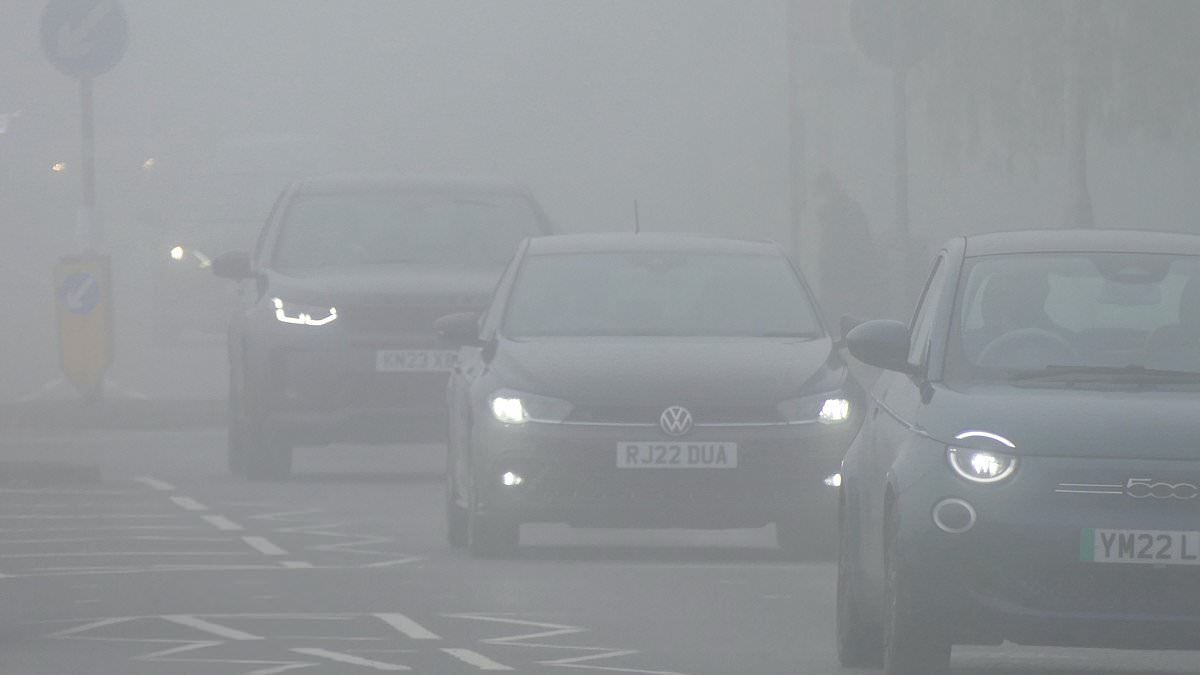
The Met Office has issued a rare yellow warning for fog, with low-visibility conditions triggering rush-hour chaos across the UK.The warning, lasting from 6pm on Sunday until 11am this morning, covers most of southern England, all of the Midlands, as well as pockets of Wales and Northern Ireland.It comes after more than 30 vehicles were involved in a crash on the M20 on Saturday, leaving two people seriously injured, as dense fog descended on the roads.So, why has it been so foggy in the UK?Despite what many social media users have been claiming, the foggy conditions aren't caused by fireworks or bonfires.Instead, Niamh Murray, Met Office operational meteorologist, says that autumn skies, long nights, and light winds have created a 'perfect recipe' for fog. 'With autumn and winter and getting fog during this time of year, we get much longer nights, and that allows temperatures to sort of fall away,' she said.'We get a longer period of cooling, and also the temperatures are much lower, so they're much closer to the temperature that we need for the air to become saturated and therefore form fog.' The Met Office has issued a rare yellow warning for fog, with low-visibility conditions triggering rush-hour chaos across the UK. Pictured: Vehicles drive through thick fog in Berkshire Drivers have reported being stranded in thick fog, with visibility falling below 50 metres in some places Fog is essentially a cloud that forms at ground level, creating a buildup of tiny water droplets suspended in the air.When visibility falls below 328ft (100m), meteorologists classify this as fog rather than as mist.This low-lying cloud can be caused by lots of different factors, but one of the most common is 'radiation fog'.Luckily, this has nothing to do with radioactive materials, but instead refers to a process in which the land cools overnight due to thermal radiation.As air near the surface cools, its ability to hold moisture reduces and water condenses into fog.Typically, this type of fog is dissipated as the ground warms, but cold, still conditions have made it unusually persistent.Ms Murray says: 'Another thing that we need to form fog is quite light winds, not absolutely no winds.'We just have the perfect recipe at the moment: light winds, clear skies, long nights, to allow that fog to develop. And particularly if we see the negative numbers, it can quite stubborn to clear the next day.' More than 30 vehicles were involved in a crash on the M20 on Saturday (pictured), leaving two people seriously injured, after dense fog descended on the roads Experts say that autumn skies, long nights, and light winds have created a 'perfect recipe' for fog. Pictured: Ely Cathedral in deep fog Fog may be particularly stubborn in rural parts of the Midlands, Wales and East Anglia, where temperatures will drop near to freezing, with air frost possible.Visibility could be down to 50m or less in some places, the Met Office warned, with delays to bus and train services possible and a chance of delays or cancellations to flights.Despite the dangers posed by low-lying cloud, extreme weather alerts for fog are exceptionally rare.This is because, unlike areas of wind and rain, the densest patches of fog can be highly localised, often affecting only small patches.Likewise, fog is extremely difficult to accurately forecast even with the help of some of the world's most powerful supercomputers.Dr Caleb Miller, a meteorologist from the University of Reading, told the Daily Mail: 'Fog is difficult to forecast accurately because it often depends on very local conditions.'For example, you might have fog in a valley but not on a hill a hundred metres away. Also, fog can be very sensitive to the precise temperature or wind speeds.'That means tiny differences in local pressure, wind speed, cloud cover and moisture can determine how water vapour condenses into droplets, changing where the thickest fog forms. The Met Office has issued a rare yellow fog warning, which is in effect from 6pm on Sunday until 11am this morningDr Miller says that we are now 'at roughly the start of what I think of as "fog season" in this region, where we are more likely to see fog generally.'However, the current forecasts suggest that the worst of the dense fog should soon pass.Jason Kelly, Met Office Chief Meteorologist, told the Daily Mail: 'We're expecting another night of fog patches across areas of England, Wales and Northern Ireland for which National Severe Weather Warnings has been issued.'Isolated patches of fog and freezing fog are likely elsewhere. Tonight should be the last night of dense fog, with increasing cloud and wind expected to limit further fog problems over the coming days.'Over the weekend, Bonfire Night revellers were left staring into thick fog as fireworks and drone displays disappeared from view.At one display in Exeter, videos show little more than dim flashes through the murk as a disappointed crowd watches below.Disgruntled spectators took to social media to complain, with some questioning why the event had gone ahead and others claiming delays had worsened the visibility.One wrote: 'Whole thing felt very poorly planned to be honest imagine having a drone show and no one can see a single drone.'The fog has also caused travel chaos and dangerous conditions on roads.Cars and lorries crashed on the M20 in Kent between junction eight for Hollingbourne and junction nine for Ashford at around 6.40pm on Saturday.The crash, which took place on the London-bound carriageway, saw one of the injured taken to a London hospital and another treated locally.Bonfire Night revellers were left staring into thick fog as fireworks and drone displays disappeared from view Other drivers were injured but not seriously, with 11 people in total treated for their injuries.Police, paramedics and firefighters were on the motorway after the collision in the thick fog and what was believed to be smoke from a nearby fireworks display.Meanwhile, social media users have shared alarming videos of their journeys through extremely low visibility.One UK driver shared a video on TikTok, saying: 'I have never seen fog like this in London what on earth is this.'While the Met Office's yellow warning remains in place, the weather agency cautions that people should expect slower journeys, delays to bus and train services, and some chance of flight cancellations.The Met Office advises: 'Give yourself the best chance of avoiding delays by checking road conditions if driving, leaving extra journey time, or amending plans if necessary.'Make sure you know how to switch on your fog lights, and check they are working before setting off on your journey.'
Why is it so foggy in the UK? Scientists reveal how clear autumn skies, light winds, and long nights have created a 'perfect recipe' for fog
Full Article
Original Source
Read the full article at Dailymail →KhanList aggregates and links to publicly available news content. We do not host full articles from third-party sources. Always verify important information with original sources.