
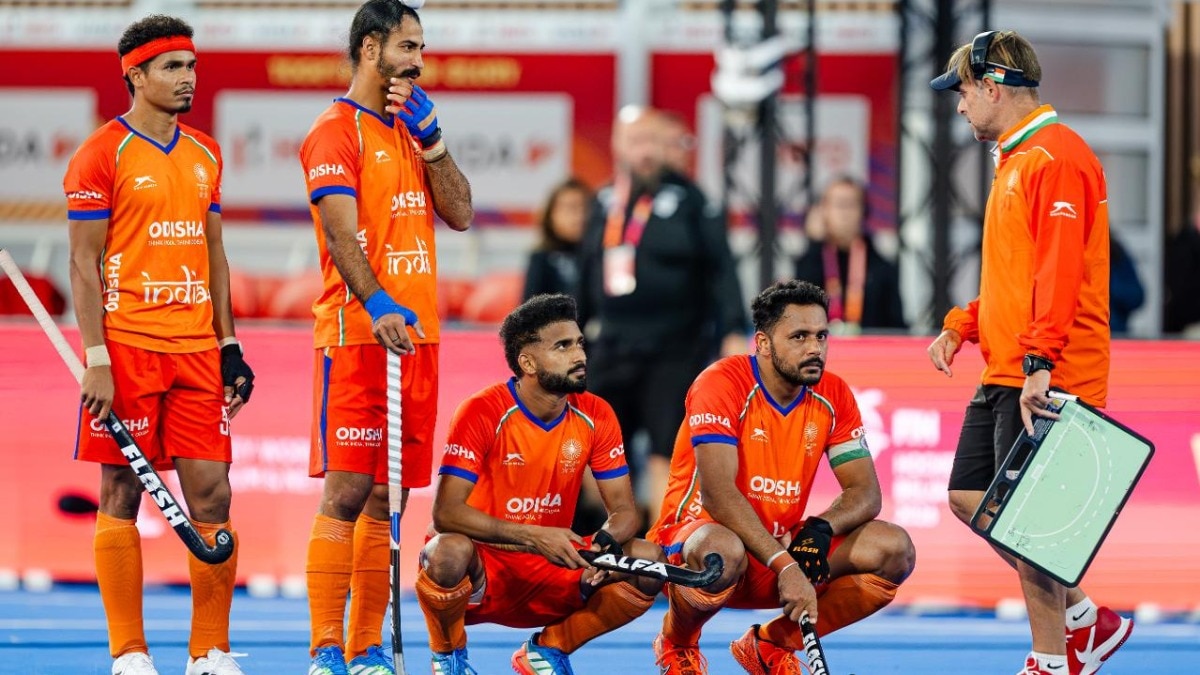
A broken domestic structure and rot at the top make India's World Cup failure no surprise at all. With Hockey India left trying to chase the IPL model, they have forced the domestic system to crumble, directly leading to the national team's struggles on the grand stage.India finished 8th in the men's Hockey World Cup (Courtesy: Hockey India)Indian hockey doesn’t have a crisis at the World Cup; it has a crisis of delusion. Finishing eighth isn’t an upset - it’s the exact mathematical reality of a system that is not only hollowed out but crumbling. Yet, the irony is starkly underlined by the women’s team, who quietly outperformed all low expectations to finish fifth with zero administrative backing or hype, proving once again that grit alone cannot permanently mask a collapsing foundation.My argument is this: did we really expect anything different? On what logic and reasoning do we claim that results should have been different? The layman’s argument is that we won consecutive Olympic medals after breaking the agonizing 41-year medal drought between 1980 and Tokyo 2020, we are a continental powerhouse, and so reaching the last four of the World Cup was a given. First of all, in sport, nothing is given.Whatever little hangover we have of the eight Olympic gold medals - won in an era where we played and the rest of the world was still finding their feet - looks good statistically and nothing more. History always needs to be studied in proper perspective, otherwise, it loses relevance. In India, a lack of success in Olympic sports creates false impressions. When failure happens, analysis goes out of the window. The usual pattern of ‘misses,’ ‘ageing,’ ‘not prepared,’ and ‘overhyped’ becomes the script. India struggled to beat any of the higher-ranked teams (Courtesy: Hockey India) Digging deep, understanding the roots of hockey as a sport, and analysing why we succeeded when we succeeded is never taken into view. If cricket found massive success in the Indian Premier League (IPL) as a commercial engine, every other sport feels compelled to take the exact same path, irrespective of whether they command the same following. Try telling a hockey player that their sport is not mass-based, and it will be seen as a betrayal, sparking an argument that could last hours. In reality, it is an argument that cannot hold beyond the time taken to state the honest truth: Hockey has no mass following. It is one of India’s niche sports.And that is the crux of our failure at the World Cup. Even if we had reached the last four, hockey wouldn’t have magically transformed into a mass-based sport overnight. Nor will it become one in the next fifty years, at least not with the kind of administration that presently runs it. We rely entirely on a four-year window of a World Championship, Olympic Games, or Asian Games to find some sense of identity in this sport. We are caught in a vicious performance trap: the commercial survival of the sport is entirely dependent on its performance at the world level. We believe that if the national team wins a medal, sponsors will flood in and the domestic league will thrive. But we need to break out of this trap.In a nation like India, running a hockey league organically is a massive task because let’s be brutally honest, sponsors often come in because of political pressure, not pure commercial viability. Expecting owners to buy teams and sustain multi-crore losses over a five-year period in a franchise model is economically suicidal. They don’t get anything back from hockey the way cricket enhances a corporate house’s social reputation or provides the elite club ticket that an IPL ownership guarantees.This brings us to the Hockey India League (HIL). In going for an expensive franchise model for a sport where barely 40 elite players exist in the entire system, Hockey India is chasing a shadow. Is the highly commercialized, IPL-style format even right for our ecosystem? A home-and-away format is an exceptionally expensive proposition. While we struggle to find stable money and franchise owners, we insist on launching operations in massive metros like Delhi, where reaching a stadium for a 7 PM match is a two-hour commuting nightmare for the average fan.The brains running the sport should be utilized to create a self-sustaining hockey league played heavily in Tier-1 and Tier-2 cities. These are the regions where the sport still retains a cultural pulse, and more importantly, where local fans actually have easy, practical access to stadiums.To understand how far behind we are, we only have to look at Europe, where club ecosystems are continually expanding in scale, team density, and financial stability. While European club players easily log 20 to 30 high-stakes, competitive matches a season, elite competitions like the Dutch Hoofdklasse and the Belgian Hockey League keep their doors wide open to global talent.Across the top Dutch and Belgian divisions, dozens of foreign marquee men players - representing Australia, Argentina, Germany, Spain, and in the women’s Chinese and Japanese - are integrated into nearly every club roster, playing high-stakes matches week in and week out. For instance, Argentina’s lethal penalty-corner expert Tomas Domene has terrorized defences as a top scorer in the Belgian league simply because the structure allows world-class cross-pollination.Conversely, India’s domestic structure is shrinking. While European leagues thrive on organic club loyalty, our national team trains in absolute isolation, locked away in an 8-or-9-month camp in Bengaluru. This centralized, cloistered approach has cost Indian hockey dearly, effectively destroying its organic grassroots fan base. Even looking toward Australia, their domestic structure - the Hockey One League - operates efficiently with just 7 to 8 regional teams, focusing on high-performance pathways without pretending to be a multi-billion-dollar IPL clone.Legendary Australian coach Ric Charlesworth has long observed the untapped structural potential of our region, noting that he would love to see an Indian Ocean or Southern Hemisphere league, noting that India could potentially be the economic engine of the game much like it is in cricket if structured properly.Post-Independence, the sport was a thriving six-month festival across the country. Institutional teams played before packed stadiums, across Punjab, UP, West Bengal, Andhra Pradesh, Tamil Nadu, Karnataka, Delhi, Maharashtra, and Haryana. Players were visible, there was constant competition for places, and youngsters gave national incumbents a fight in front of selectors.But over the last decade and a half, tournaments held under HI and the erstwhile IHF have lost ground. In the race to create a franchise league, we dismantled the only foundation we had. Iconic venues like Shivaji Stadium in Central Delhi, which hosted the Junior Asia Cup, Asia Cup and was the regular home of the prestigious Nehru Cup, are now barren. Today, office goers from nearby buildings just come to sit in the sun-drenched gallery, smoke, and drink tea, while the stadium waits to be demolished for an office complex.Hockey India’s Secretary General Shri Bhola Nath Singh presented mementos to legendary former India cricket captain Shri Rahul Dravid and Bollywood star Shri Abhishek Bachchan who were Special Guests at the FIH Hockey World Cup in Amstelveen on Saturday, when the Indian men’s pic.twitter.com/n8oj12itwz— Hockey India (@TheHockeyIndia) August 23, 2026This systematic destruction started with K.P.S. Gill, continued under Narinder Batra, and persists today under Dilip Tirkey. Batra focused on becoming FIH President and pushing the HIL, forgetting that deep roots require domestic patronage. For a true revival, you need a visionary Hockey India administration - not the one managing things at the moment.We have a president in Dilip Tirkey who is mostly stationed in Bhubaneswar, a secretary driven by self-importance who flies to irrelevant meetings, and an Executive Director, RK Srivastava, accompanying him, racking up flyer miles. Even when the President explicitly directed HI officials to stay in India and work on the domestic league, they enjoyed the paid vacation during the World Cup in Holland and Belgium.On behalf of Hockey India, Secretary General Shri Bhola Nath Singh received a special recognition award at the National Associations Summit today in Wavre, Belgium - where he was honoured by the FIH Vice President Mr. Alberto ‘Coco’ Budeisky.This award celebrates India’s pic.twitter.com/nGb191ltWb— Hockey India (@TheHockeyIndia) August 26, 2026When administrators disregard directives to enjoy European perks while the sport bleeds at home, accountability is dead. Instead of clicking embarrassing selfies with Bollywood stars and cricketers, HI officials should have been meeting with European club owners to learn how to organically revive the sport back home.India’s issues lie at the very bottom of the pyramid - the schools, colleges, and universities. If the bottom doesn’t produce and nourish players, the top cannot survive. The path forward demands that Hockey India decentralize its training program, ending the prolonged Bengaluru camps so players can return to play domestic tournaments for their states and institutions, assembling for national duty only before major tournaments under remote fitness monitoring.Furthermore, we must ensure our top 8–10 players and juniors are permitted to play in European club leagues, allowing them to rub shoulders with the world’s best in Belgium and the Netherlands and return sharper, fitter, and tactically evolved.Finally, instead of pouring every top dollar into a financially unsustainable HIL for 60 players, funds must be redirected to Tier-1 and Tier-2 city leagues and a Champions National League for the top eight finishers of the National Championships, giving women’s and men’s hockey a constant, high-intensity domestic calendar it desperately requires.Hockey needs to be club and institution-based. Name any great Indian player from the past - they all forged their mettle in domestic tournaments. If we continue to chase the IPL mirage while our grassroots wither, Indian hockey won't just miss World Cup semi-finals - it will lock itself into permanent irrelevance. The path forward is not out of reach. It simply requires a leadership brave enough to retrace the steps back to dusty local grounds, dismantle the cloistered Bengaluru illusion, and build a domestic ecosystem where the game actually thrives.- EndsPublished On: Sep 1, 2026 08:01 IST
Why Indian hockey's crisis begins at the grassroots and bleeds to the top
Full Article
Original Source
Read the full article at Indiatoday →KhanList aggregates and links to publicly available news content. We do not host full articles from third-party sources. Always verify important information with original sources.