
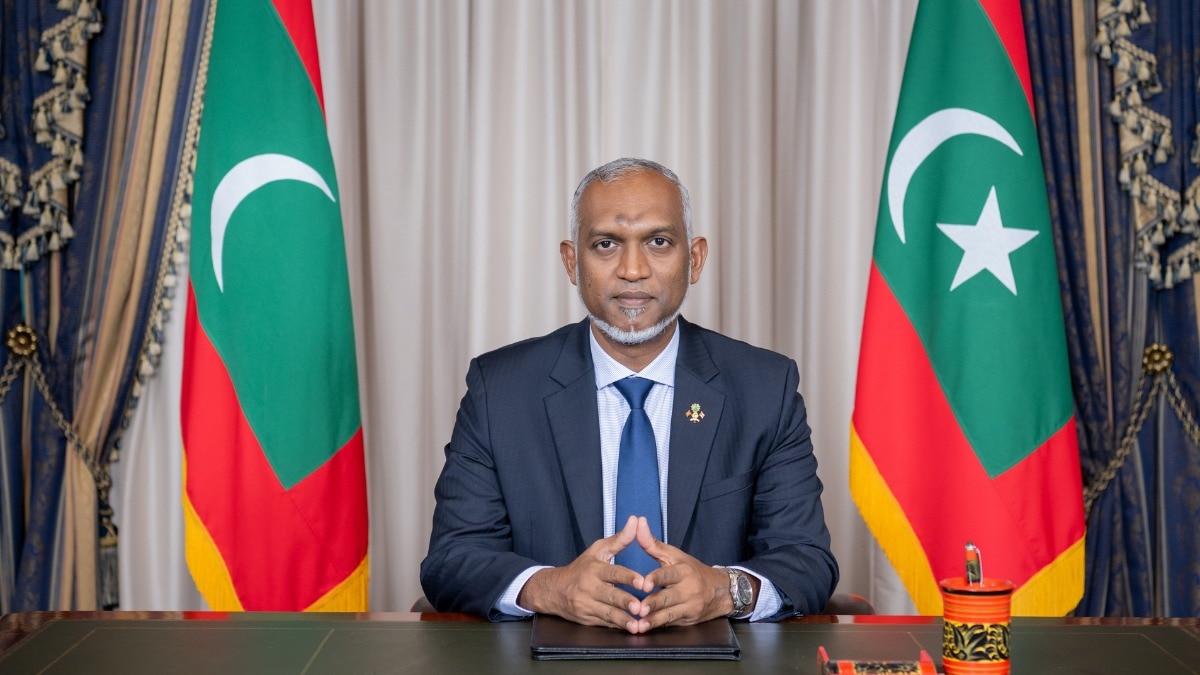
The arrival of three Indian maritime training ships in Mal on October 21 might, at first glance, appear routine. Naval visits are among the quieter rituals of diplomacy: ships dock, uniforms exchange courtesies, officers deliver speeches, photographs are taken. Yet timing has a way of revealing the strategic significance of otherwise ordinary events.The visit by INS Tir, INS Sujata and Indian Coast Guard Ship (ICGS) Sarathi coincided with Maldivian President Mohamed Muizzu’s trip to Pakistan from October 20 to 22, where the two sides sought to expand cooperation across a range of sectors, including defence and maritime security. Together, the two developments sharpen a question that has increasingly occupied New Delhi’s strategic planners: how does India sustain influence in a neighbouring island state that is steadily broadening its external partnerships?The three vessels, part of the Indian Navy’s First Training Squadron, arrived in the Maldives as part of a long-range training deployment. Welcomed by the Maldives National Defence Force (MNDF), they are participating in a programme that includes meetings with senior military officials, training exchanges at the Girifushi Training Centre, cross-deck visits and a series of joint activities.Indian naval officials argue that these interactions are about more than symbolism. Their purpose is to preserve the institutional muscle memory that underpins India-Maldives security cooperation. Regular engagement helps maintain links with Maldivian defence and coast guard personnel, while supporting cooperation in maritime surveillance, search-and-rescue operations, humanitarian assistance and broader regional security initiatives. Yet the context surrounding the visit matters. During Muizzu’s Pakistan visit, the two countries exchanged 20 memorandums of understanding spanning defence, maritime security, cybersecurity, policing, healthcare and education. The details of the security-related agreements remain sparse, making it premature to conclude that a major strategic realignment is under way or that an expanded Pakistani military footprint in the Maldives is imminent. Still, the outreach reflects an increasingly visible pattern in Maldivian foreign policy.Since assuming office, Muizzu has pursued a deliberate expansion of the Maldives’ diplomatic and economic partnerships. The most consequential aspect of that strategy has been the deepening of ties with China. During his first state visit to Beijing in January 2024, the two countries elevated relations to a Comprehensive Strategic Cooperative Partnership, and signed 20 agreements covering infrastructure, trade, the blue economy, the digital economy, and Belt and Road cooperation. The relationship was reinforced during a subsequent visit to China in August 2025.For Beijing, the Maldives offers a strategically located foothold in the Indian Ocean, astride some of the world’s most important sea lanes. For Mal, China provides a source of investment, financing and infrastructure support that reduces dependence on any single partner. The relationship is grounded in mutual utility rather than sentiment.None of this automatically translates into a loss for India. But it does demand attention. The Maldives occupies a location of disproportionate strategic significance. Situated close to critical Indian Ocean shipping routes and near India’s southern maritime approaches, it occupies a geography that no serious Indian security planner can afford to ignore. Pakistan-Maldives security cooperation would become strategically consequential only if it evolves beyond diplomatic declarations into sustained intelligence-sharing, military training arrangements or operational coordination. The significance will ultimately lie in implementation, not in the number of agreements signed.Military observers view Muizzu’s outreach as part of a broader effort to diversify partnerships and assert greater strategic autonomy. The Maldives, like many smaller states navigating an increasingly competitive geopolitical environment, appears intent on expanding its room for manoeuvre rather than placing all its bets on a single power.That balancing instinct partly explains the trajectory of India-Maldives relations under Muizzu. The relationship entered a difficult phase after his election, particularly following his demand that Indian military personnel stationed in the archipelago be withdrawn. “His presidency initially strained ties with India, particularly over the withdrawal of Indian military personnel in 2024,” an observer notes. “Relations have since stabilised, with Prime Minister Narendra Modi’s July 2025 visit to Mal helping restore momentum to bilateral engagement.”That observation captures the central challenge facing New Delhi. It must avoid allowing differences over regional alignments to undermine practical cooperation. Geography still favours India. So do longstanding defence relationships. So does India’s demonstrated ability to provide timely assistance in moments of crisis. But proximity and history are advantages, not guarantees. They cannot substitute for sustained diplomacy or sensitivity to Maldivian priorities.This is where the significance of the First Training Squadron’s visit becomes clearer. The deployment aligns with India’s MAHASAGAR vision, or Mutual and Holistic Advancement for Security and Growth Across Regions. Its value lies less in spectacle than in continuity. Such engagements keep lines of communication open, reinforce professional networks and convert historical goodwill into practical cooperation.As another military observer puts it, “Pakistan’s outreach need not be viewed as an automatic setback for India. The Maldives can maintain relations with multiple partners without necessarily abandoning its established relationship with New Delhi. The critical question is whether new arrangements alter the operational security environment in the Indian Ocean.”That distinction is worth remembering. Too often, South Asian strategic discourse reduces diplomacy to a scorecard of gains and losses. Smaller states, however, rarely see the world in such binary terms. The Maldives is not choosing among India, China and Pakistan so much as attempting to maximise its options among all three.For India, the more productive response is not alarmism but engagement. Experts argue that New Delhi should continue investing in maritime capacity-building, coast guard cooperation and development partnerships, while closely tracking the implementation of the Maldives-Pakistan agreements. Preserving trust in Mal is likely to prove more valuable than treating every Pakistani diplomatic success as a zero-sum defeat.The arrival of INS Tir, INS Sujata and ICGS Sarathi is therefore more than a routine port call. It is a reminder of a basic truth in regional geopolitics: influence is rarely secured through a single visit, agreement or headline. It is accumulated through consistent presence, sustained attention and dependable partnerships. As the Maldives broadens its diplomatic horizons, India’s task is not merely to remain present, but to remain relevant, reliable and responsive to the archipelago’s evolving security and development needs.Subscribe to India Today Magazine- Ends
Why India must watch President Muizzu's Pakistan outreach
Full Article
Original Source
Read the full article at Indiatoday →KhanList aggregates and links to publicly available news content. We do not host full articles from third-party sources. Always verify important information with original sources.