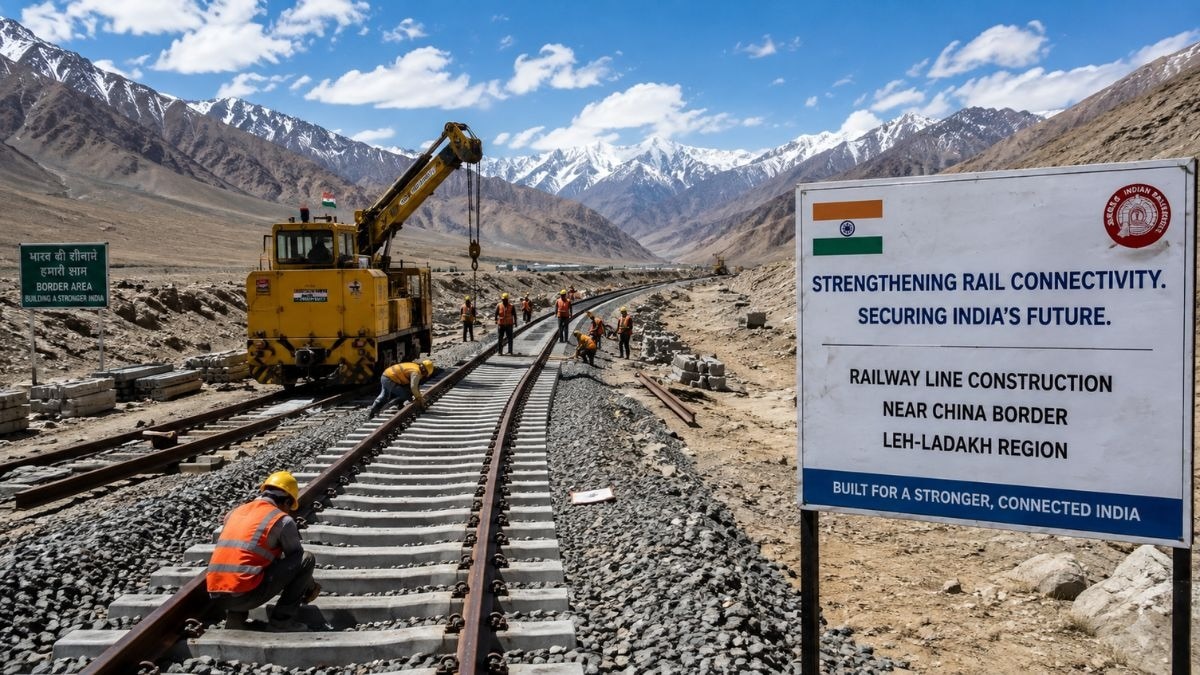
The government is giving fresh momentum to the Chalsa-Naxalbari railway line in Bengal to secure the India-China-Bhutan Doklam tri-junction and Siliguri CorridorNine years since the Doklam military standoff highlighted the importance of rapid troop movement capability in the eastern Himalayas, India is giving fresh momentum to a key railway project near the India-China-Bhutan tri-junction.The West Bengal government's decision to fast-track land acquisition for the Chalsa-Naxalbari railway line reflects the Union government’s firm focus on strengthening border infrastructure even as China continues to deepen military footprint along the Line of Actual Control (LAC), the de facto border between the two countries.The BJP government in Bengal has approved the acquisition of nearly 380 hectares of land for the 20-km-long railway stretch, a project that had remained stalled for years due to land acquisition hurdles. Sanctioned in 2011-12, the project is now back on track and, when completed, expected to improve connectivity towards the strategically sensitive Doklam sector and the Siliguri Corridor, popularly known as India's ‘Chicken's Neck’.The narrow Siliguri Corridor is one of India's most critical strategic regions. It is the only land link between the northeastern states and the rest of India, and lies close to the India-China-Bhutan tri-junction. Any threat to this corridor would have serious national security implications, thereby making faster transport links to the region a top priority for military planners. Observers believe the Doklam face-off had clearly indicated China’s aim to build a road from the Chumbi Valley in the Tibet Autonomous Region across the Torsa Nallah to the Bhutanese Chela post in order to gain the Jampheri Ridge (located on the Doklam Plateau) and threaten the Siliguri Corridor.Despite the unresolved boundary dispute with Bhutan, China has steadily expanded its infrastructure across the Doklam Plateau and nearby areas over the past several years. Satellite imagery and independent assessments have documented the construction of roads, military camps, observation posts, permanent buildings and support facilities in territory claimed by Bhutan, reflecting Beijing's long-term effort to strengthen its presence in the strategically important tri-junction. While Bhutan and China continue boundary negotiations, the steady pace of Chinese infrastructure development has reinforced concerns that Beijing is attempting to gradually alter the situation on the ground, making the disputed plateau one of the most sensitive flashpoints in the eastern Himalayas.The renewed push for the Chalsa-Naxalbari railway project comes as India places greater emphasis on military logistics. Defence planners increasingly believe that in any future conflict, the ability to move troops, weapons and supplies quickly could prove just as important as battlefield capability. Better roads and railway lines reduce deployment time and help sustain armed forces during prolonged operations in high-altitude terrain.China, meanwhile, has spent years developing one of the world's most extensive military infrastructure networks across the Tibetan region. Since the 2020 military standoff with India in eastern Ladakh, Beijing has accelerated construction all along the frontier. Its investments include hundreds of kilometres of all-weather highways along the LAC, new railway corridors linking Tibet with border regions, dual-use airports and airfields, permanent military villages near disputed areas, underground ammunition depots, hardened aircraft shelters, fibre-optic communication networks, integrated air defence systems, bridges across the Pangong Tso and logistics hubs capable of supporting rapid troop mobilisation.Together, these projects have significantly strengthened China's ability to move soldiers and heavy military equipment across the Tibetan Plateau. Military analysts say Chinese forces can now reinforce several sectors opposite India far more quickly than they could during the 73-day-long Doklam standoff in 2017.India has also accelerated border infrastructure development, although experts acknowledge that important gaps remain. The Border Roads Organisation (BRO) has completed several strategic roads, bridges and tunnels across the Himalayan region while the railways is advancing frontier projects, including the Sevoke-Rangpo line that will improve connectivity to Sikkim. India has constructed approximately 2,089 km of roads along the China border over a reported five-year stretch evaluated by the ministry of defence. This is part of a broader total of 3,595 km of strategic frontier roads built across the country.Despite this progress, railway connectivity remains one of the biggest operational disadvantages. Unlike China, which can transport heavy military equipment rapidly through its extensive railway network across Tibet, India still depends largely on road transport for many forward areas near the LAC. Mountain roads are vulnerable to landslides, harsh weather and difficult terrain, making railway expansion an important long-term strategic objective.The Chalsa-Naxalbari railway line is expected to help narrow this gap. Although only 20 km long, it forms part of a broader vision to extend rail connectivity closer to the eastern Himalayan frontier. Defence planners believe such projects will strengthen India's ability to reinforce troops more rapidly during emergencies while improving logistics for sustained deployments.Doklam remains one of the most sensitive flashpoints along the India-China frontier. In 2017, Indian and Chinese troops remained locked in a weeks-long military standoff after Chinese construction teams attempted to extend a road towards the Jampheri Ridge. India intervened in support of Bhutan, arguing that any change to the status quo in the area could directly threaten the Siliguri Corridor.Although the immediate crisis ended through diplomatic negotiations, satellite imagery and independent assessments indicate that China has continued expanding its infrastructure across the Doklam Plateau and adjoining areas. New roads, military camps, observation posts and permanent facilities have steadily increased Beijing's presence in the region.For Indian military planners, these developments underline the need for faster access to the eastern sector. Improved rail connectivity can reduce mobilisation time, strengthen logistics and enable troops and equipment to reach operational areas more quickly if tensions escalate. Officials view the revival of the Chalsa-Naxalbari project as more than the completion of a long-delayed railway line. It reflects stronger coordination now between the Centre and the West Bengal government on strategic infrastructure projects that had remained stalled for years.Military experts describe strategic railways as force multipliers. In modern warfare, reliable infrastructure is essential not only for moving soldiers but also for sustaining ammunition, fuel, heavy equipment and supplies throughout prolonged operations. A robust logistics network often determines how effectively armed forces can respond during a crisis.India's approach to border infrastructure has undergone a significant shift over the past decade. For many years, New Delhi avoided building extensive transport networks close to the frontier over concerns that they could also benefit an invading force. That doctrine has now been decisively abandoned. Today, policymakers view strong border infrastructure as a key pillar of credible deterrence. The ability to move forces quickly, maintain supply lines and respond rapidly to emerging threats is now central to India's border strategy.As China continues to expand its military infrastructure across Tibet at an unprecedented pace, India is responding by strengthening its own network of roads, tunnels, bridges and strategic railway lines. The revival of the Chalsa-Naxalbari railway project is part of that broader effort. It represents India's determination to ensure that, in any future Himalayan crisis, logistics become a strategic strength rather than a vulnerability.Subscribe to India Today Magazine- EndsPublished By: Akshita JollyPublished On: Aug 5, 2026 17:35 IST
Why India is giving China's Doklam strategy a rail infra response
Full Article
Original Source
Read the full article at Indiatoday →KhanList aggregates and links to publicly available news content. We do not host full articles from third-party sources. Always verify important information with original sources.