
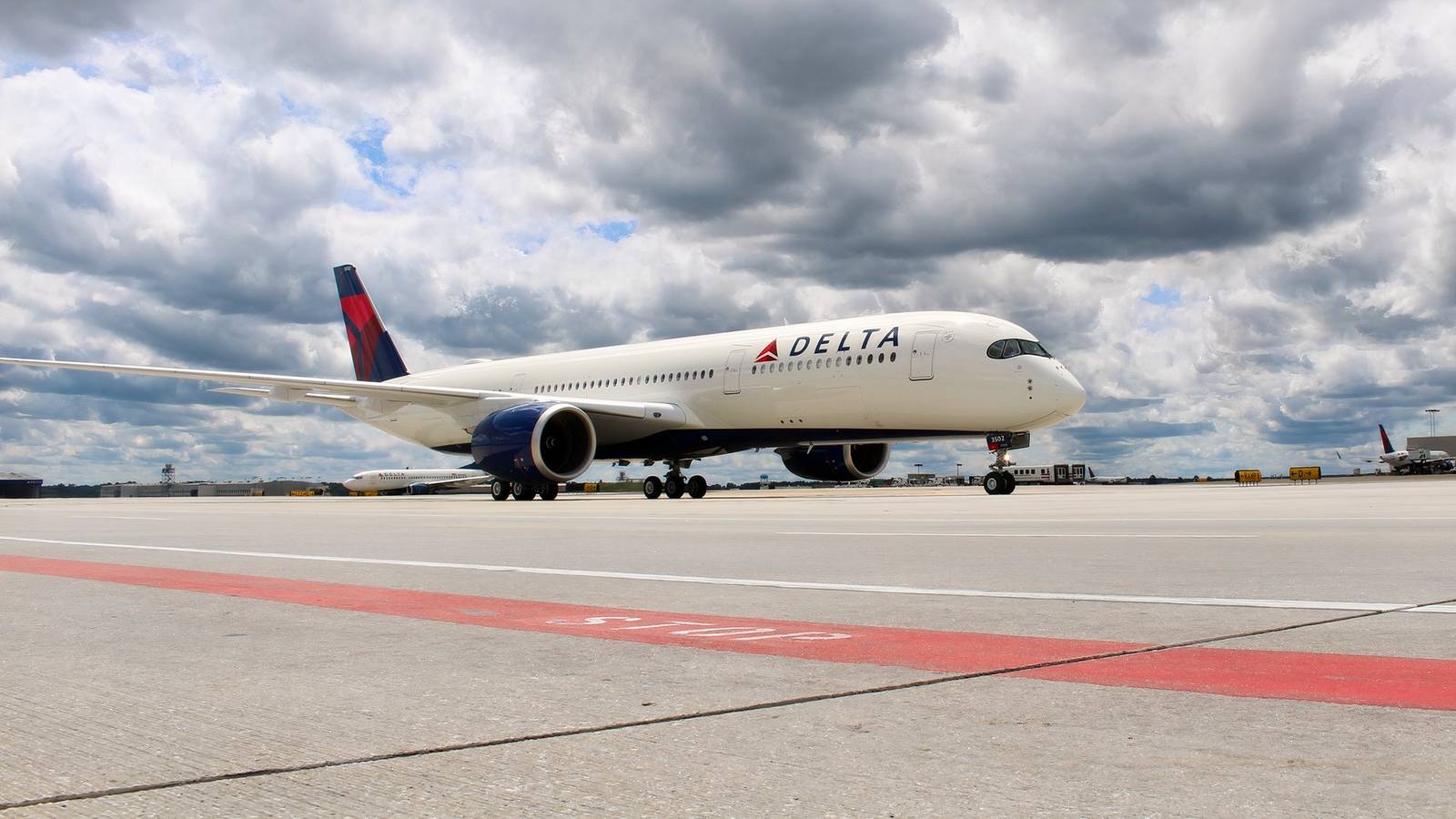
Published Aug 22, 2026, 7:59 PM EDT Aaron is an aviation enthusiast and world traveler with a deep interest in aerospace history and technology. He has traveled around the world numerous times, often incorporating visits to aviation museums and historic aircraft collections into his journeys. A native of New Zealand, he is an expert in aviation and maintains a broad interest in a variety of other subjects. Not only has Delta Air Lines not ordered any Boeing 787 Dreamliner aircraft, but it has also canceled orders. When Delta merged with Northwest Airlines in 2008, it inherited the former's order for 18 Boeing 787-8 variant aircraft. Delta formally canceled that order in 2016. Since the 2010s, Delta has only purchased Airbus A330 family and A350 widebody aircraft. For Delta, Airbus aircraft are the ones that worked for it at that time and place, but this may not be the case anymore, with rumors circulating of a possible Delta order for Boeing 787-10 Dreamliners. Here is what to know about why Delta has not ordered the Dreamliner, and why that may yet change. Boeing Vs. Airbus Flagship Aircraft Credit: Shutterstock The Boeing 787 Dreamliner and the Airbus A350 are the world's two newest clean-sheet aircraft, and they compete directly. They both offer substantial fuel savings over previous-generation aircraft. The 787 was built to replace the older, shorter-range 767, especially the smaller 787-8. While Boeing initially received many orders for its 787-8, the type is almost out of production with a backlog of 28 examples remaining. Instead, airlines have switched focus to the longer-ranged and higher-capacity Boeing 787-9 and, to a lesser extent, the stretched even higher-capacity, but shorter-ranged 787-10. The Dreamliner family has attracted 2,199 firm orders, placing it comfortably ahead of the A350 and its order book of 1,428 aircraft. Both are competitive, modern long-haul aircraft, although most airlines with long-haul fleets have ordered the Boeing 787. In the United States, American Airlines, United Airlines, and Hawaiian Airlines have ordered it, but not Delta. For a while, Delta was the only US-based airline to order the Airbus A350, although United has since joined and placed an order for the A350, with the first examples expected in 2030. Collapse In Boeing Confidence Credit: Shutterstock One reason Delta didn't order the Boeing 787 is that it saw a deterioration in Boeing's aircraft quality. For decades, Boeing had a reputation for having some of the best engineering in the world, but after the merger with McDonnell Douglas, the argument goes that Boeing inherited some of that company's preference for short-term fixes and maximizing short-term profits. The 787 also had well-reported developmental issues, particularly with its lithium-ion batteries. This is part of the reason given why Boeing made the ill-fated decision to upgrade its 1960s-era Boeing 737 instead of making a clean-sheet narrowbody replacement. Boeing considered a clean-sheet replacement in response to the A320neo but chose the quicker, cheaper option. This led to installing the infamous MCAS (Maneuvering Characteristics Augmentation System, the MAX crashes, and the rest is history. Delta Widebody Fleet Airbus A330 Airbus A330-900neo Airbus A350-900 Airbus A350-1000 Boeing 767 Reportedly, Delta noticed the change in Boeing before the MAX crisis of 2019 and chose Airbus instead. As history has it, the Boeing 787 Dreamliner has turned out to be an excellent airplane, although some quality-related questions have been raised and some whistleblowers have come forward following the MAX crashes. At the same time, the A350 has also proven to be a reliable, high-quality aircraft. Quest For Commonality Credit: Shutterstock All airlines want to maximize commonality in their fleets to reduce maintenance and operating costs. Extreme examples of this include Southwest, Ryanair, and Alaska Airlines (before it acquired Hawaiian), which operate all Boeing 737 fleets. Meanwhile, easyJet only operates A320-family aircraft, and Emirates only operated Boeing 777 and Airbus A380 aircraft until it received its first A350s in late 2024. This quest for commonality is also evident at Delta's rival, American. American's widebody fleet consists entirely of Boeing 787 and 777 aircraft. By ordering the Airbus A350 and A330neo, Delta created a two-aircraft widebody fleet that shared a common type rating. Pilots trained to fly one aircraft can also fly the other. This lets Delta simplify training, scheduling, and crew management. Aircraft Transition training to A350 Airbus A320 11 days Airbus A330 8 days Airbus A340 11 days Airbus A380 8days Another benefit is that the A330 shares some maintenance and system commonality with the A350, and this also allows Delta to reduce costs. On another note, Delta purchased most of the world's Boeing 717 regional jets and is now one of only two operators of the type with Hawaiian. Delta was able to do this profitably with the largely unpopular aircraft, partly because it already operated large fleets of its MD-80 and MD-90 relatives. This meant Delta had logistical support largely already set up for the 717. Airbus' Aircraft Were The Right Size For Delta's Needs Credit: Shutterstock Another factor was that the Airbus A350 and A330neo were just the perfect aircraft Delta needed to right-size its fleet. US-based airlines have long turned away from ultra-large widebody aircraft. None ordered the Boeing 747-8i or the Airbus A380. American only purchased 20 Boeing 777-300ERs, and United only placed a very late order for the 777-300ER when it could get them at a bargain price. No US airline has ordered the upcoming Boeing 777X. United has said it's too big for its needs as it (along with other US airlines) operates from over half a dozen dispersed hubs. But while the Boeing 777 may be too big for Delta, the Boeing 787-9 was a bit small to replace its aging 747-400s and older 777s. The Airbus A350-900 was considered just the right size for Delta. Extra-large aircraft with US carriers Airbus A380 Never ordered Boeing 747-400 Retired 2017 Boeing 747-8 Intercontinental Never ordered Boeing 777-300ER Only ordered by United and American Boeing 777X Not ordered Meanwhile, the A330neo (specifically A330-900neo) was the ideal size to replace many of its aging Boeing 767 aircraft on medium-to-long-haul routes. Delta's decision to buy Airbus aircraft came at a time when It had the luxury of waiting and taking its time to decide which aircraft to order. It also came at a time when the Boeing 787 program was delayed and had issues with things like its batteries. Delta, being characteristically risk-adverse, saw Airbus as the safer bet. A Change May Be Around The Corner Credit: Shutterstock Simple Flying recently reported that Delta Air Lines placed an order for the Dreamliner. An insider at Delta says a deal for the Boeing 787-10 could be imminent. If this happens, it would be a major shift from Delta's policy of purchasing only Airbus widebodies since the 2010s. For now, the Delta Boeing 787-10 order remains speculative. At the heart of the debate is what will replace Delta's aging fleet of Boeing 767s. The Boeing 767-300ER variant is expected to retire by 2030. These aircraft are being phased out gradually and will not be replaced by a single aircraft type. For example, the Airbus A321neo has the range to replace some of these aircraft on some routes. The standard variant has a range of 3,500 nautical miles, while the A321XLR achieves an impressive 4,700 nautical mile range. Boeing 787 Family 787-8 Dreamliner 787-9 Dreamliner 787-10 Dreamliner Length 186 feet 206 feet 224 feet Range 7,305 nautical miles 7,565 nautical miles 6,330 nautical miles Typical two-class capacity 248 296 336 The Airbus A330neo and A350 can also replace the Boeing 767 on other routes. The Boeing 787-10 is the largest but also the shortest-range member of the Dreamliner family. Even so, its 6,330-nautical-mile range is greater than any 767 variant. That could make it a great option for some higher-density, medium-range transatlantic routes. Nothing Set In Stone As United Orders Airbus Widebodies Credit: Shutterstock Delta chose Airbus for several reasons. Delta had more confidence in Airbus, while Airbus offered the perfect aircraft for Delta's needs. Another factor at the time may have been Delta's strained relationship with Boeing. One flashpoint in their relationship was the Bombardier CSeries (later Airbus A220). Delta was the first major airline to place a large order for the Bombardier CSeries, and this provided cash-strapped Bombardier with the cash it needed to continue the program and bring it into service. In return, Delta was able to get the aircraft at bargain prices. Boeing responded by launching a dumping complaint against Bombardier and the deal. Delta remains the largest operator of the A220 today, and Airbus has an assembly line for the aircraft in Alabama. Still, this is all history, and nothing is set in stone. Relationships can mend, new requirements can arise, and calculations can change. Delta is a rare holdout against the Boeing 787 Dreamliner, but this may not last forever. Time will tell if an order is around the corner or if Delta will stick with Airbus. United has gone the other way. United does not have Airbus widebodies and has never operated them, but it has ordered 45 Airbus A350s.
Why In The World Does Delta Air Lines Fly The Airbus A350 & Not The Boeing 787?
Full Article
Original Source
Read the full article at Simpleflying →KhanList aggregates and links to publicly available news content. We do not host full articles from third-party sources. Always verify important information with original sources.