
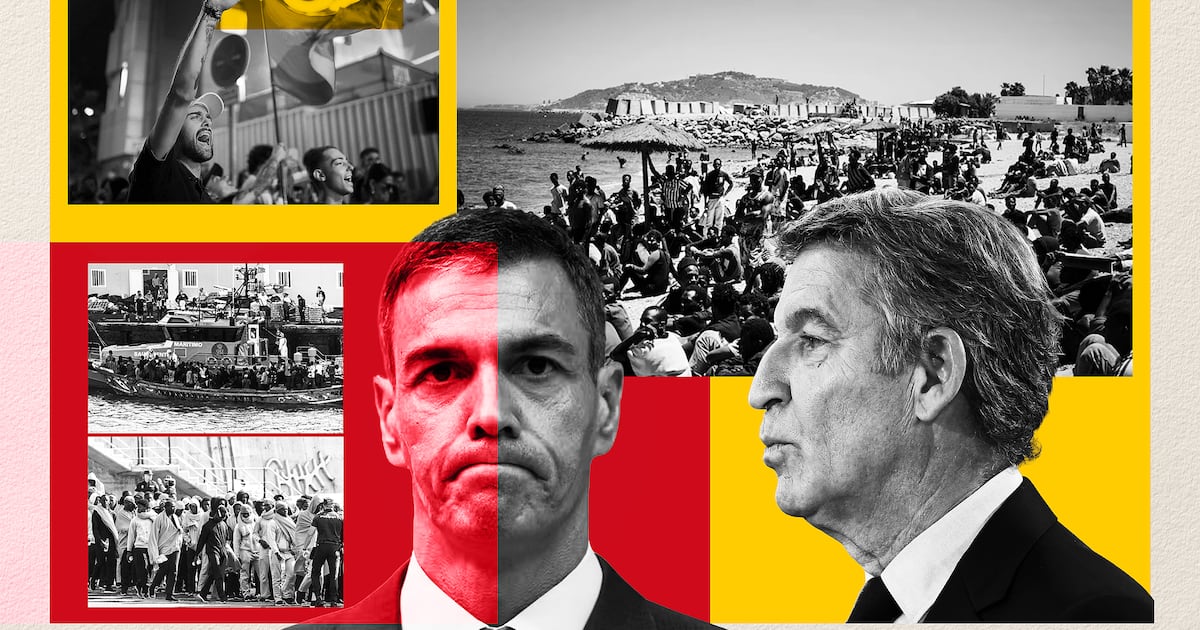
On Tuesday, more than 2,100 migrants arrived by boat on the small Spanish island of El Hierro. It was a record number of same-day arrivals to the Canary Islands and among those on board the 15 boats that had travelled from west Africa was a four-day-old infant born during the voyage and the body of a migrant who had died at sea.About 12,000 migrants have reached El Hierro this month alone, the equivalent of the island’s entire population. While some new arrivals are being transferred to neighbouring islands and the Spanish mainland, the local authorities are struggling to manage the influx and this week the Canary Islands’ government requested the military’s assistance in managing the situation, which it described as “unsustainable”.This migrant crisis has unfolded as Spaniards prepare to vote on Sunday in a general election in which immigration has played a major role for the first time, with parties on the left and right taking staunchly opposing stances on the issue.“People cannot invade a country,” the leader of the conservative People’s Party (PP), Alberto Núñez Feijóo, said during a visit to El Hierro last week. “A person who arrives in an unlawful way cannot have rights.”READ MOREBy contrast, the Socialist prime minister Pedro Sánchez has praised the “humanity” of the people of El Hierro, many of whom have turned out, he said, to help “with dignity the human beings who are arriving”.The PP has been leading the Socialists in polls. With the far-right Vox party expected to come third, a right-wing coalition government looks the most likely outcome. If so, it would be the first time that the ultra-right has governed in Spain in half a century of democracy.Some of the migrants who reached El Hierro earlier this month. Photograph: Antonio Sempere/AFP via Getty Images After housing and the economy, immigration is Spaniards’ biggest concern, according to the CIS national research centre. However, it has only emerged as a priority issue relatively recently.That is in great part due to the arrival of large numbers of migrants in the last few years. More than two million people, mainly from Latin America and Morocco, arrived in the country in 2023 and 2024 alone. However, a change in electoral strategy by Vox, whose support has risen substantially, to about 18 per cent of the vote according to some polls, has also played a role.Unusually for a European radical-right force, Vox first came to prominence not because of its stance on immigration but on the back of its fierce unionist opposition to the Catalan independence movement a decade ago. But the weakening of the separatist movement has meant the territorial issue has faded, prompting Vox to turn its focus to immigration.Spain's prime minister and Spanish Socialist Party leader, Pedro Sánchez, waves a Catalan flag during an election campaign rally in Barcelona in November. Photogrph: Josep Lago/AFP via Getty Images “Until 2024, immigration wasn’t Vox’s main concern,” says Guillermo Fernández Vázquez, a political scientist and author of a book about the European far right.“But now, when Vox talks about the economy it talks about immigration, when it talks about social policy it talks about immigration, when it talks about international policy it talks about immigration,” he says. “It’s the central theme which connects everything for them.”Although the PP is less fixated on the issue, Vox has pushed the conservatives into a more hardline position. Both parties attacked the government over the sudden arrival in the Spanish city of Ceuta, in north Africa, of more than 70,000 migrants who had crossed from Morocco in July. Most of those migrants have returned over the border, but the incident kept immigration at the centre of political debate.The PP and Vox have also opposed the government’s mass regularisation of migrants, which has seen more than a million undocumented people apply to enter the social security system this year.[ Who orchestrated the Ceuta migrant crossing?Opens in new window ]The prime minister justifies a migration policy which runs counter to that of most of the rest of Europe with a humanitarian argument.“Good politics is recognising the rights of those who don’t have any,” Sánchez said on the campaign trial.He has also pointed to statistics showing that since the Covid-19 pandemic the foreign workforce has driven half of Spain’s GDP growth, which has outstripped that of all the other major European economies.Other issues have also played a role on the campaign trail, such as the country’s rental crisis and corruption scandals which have hurt Sánchez’s Socialists. Both sides have questioned the democratic credentials of their opponents in dramatic terms. Vox’s Abascal has warned that if Sánchez were to win, these could be “the last elections in which we freely decide our future”.With politicians in the PP and Vox suggesting that the government could manipulate Sunday’s election result, Sánchez has hit back, accusing them both of “practising preventive Trumpism”.The Main CandidatesPedro SánchezSpanish prime minister Pedro Sánchez. Photograph: Jorge Guerrero/AFP via Getty Images The Socialist, who has been Spain’s prime minister since 2018, has earned a reputation as Europe’s most forthright left-wing leader due to his support for feminism, the LGBTQ+ community, green energy and advocation of humane immigration policies.He has also stridently criticised Israel’s actions in Gaza and engaged in a verbal spat with US president Donald Trump over defence spending and the Iran conflict. However, he has struggled to keep together his unruly parliamentary alliance – made up of Catalan and Basque nationalists and other parties on the left – and has not managed to approve a budget since 2022. With the Socialists bogged down by corruption scandals and his transport minister resigning after two deadly rail accidents this year, his party has been trailing the conservatives in polls. Alberto Núñez FeijóoPeople’s Party leader Alberto Núnez Feijóo. Photograph: Oscar Del Pozo/AFP via Getty Images The leader of the conservative People’s Party was president of his native Galicia for 13 years and now looks poised to become prime minister. At 65, he would be the oldest politician to take up the post since the return to democracy half a century ago. Lacking Sánchez’s charisma, he has cultivated an image of calm managerial competence. He won the 2023 election but was unable to form a majority. This time, polls suggest Núnez Feijóo will not fall short, although he probably would have to enter a coalition with Vox to govern and questions remain regarding how a politician who presents himself as a moderate would deal with that challenge.Santiago AbascalVox party leader Santiago Abascal. Photograph: Oscar Del Pozo/AFP via Getty Images Vox is expected to make the most gains on Sunday, with some polls suggesting it could double its parliamentary seats.Its leader, Abascal, has cast himself as the “common sense” candidate, focusing on three main proposals: clamping down on immigrant arrivals, introducing a “Spaniards first” policy regarding public services, and a broad deregulation that would seek to cut government spending and liberate private enterprise. The party’s hardline policies and belligerent rhetoric have drawn warnings from the left about allowing the ultra-right into government for the first time since the dictatorship of Francisco Franco.Ada Colau Former Barcelona mayor Ada Colau. Photograph: Su Cassiano/AFP via Getty Images The former mayor of Barcelona is leading an alliance of parties to the left of Sánchez’s Socialists. Many of the forces within Colau’s Frente Amplio, or Broad Front, have been in coalition with Sánchez during this legislature. However, Colau, a former housing activist, has put the government’s failure to tackle the rental crisis at the centre of her campaign, along with gender equality and higher taxes for large companies and big earners.Divisions on the left, which have seen the struggling Podemos run separately from the Broad Front, have underlined how remote its chances are of forming a new parliamentary majority.[ Migrant arrivals in Spain’s Canary Islands break single-day recordOpens in new window ]
Why immigration has become the issue that could decide Spain’s election
Full Article
Original Source
Read the full article at Irishtimes →KhanList aggregates and links to publicly available news content. We do not host full articles from third-party sources. Always verify important information with original sources.