
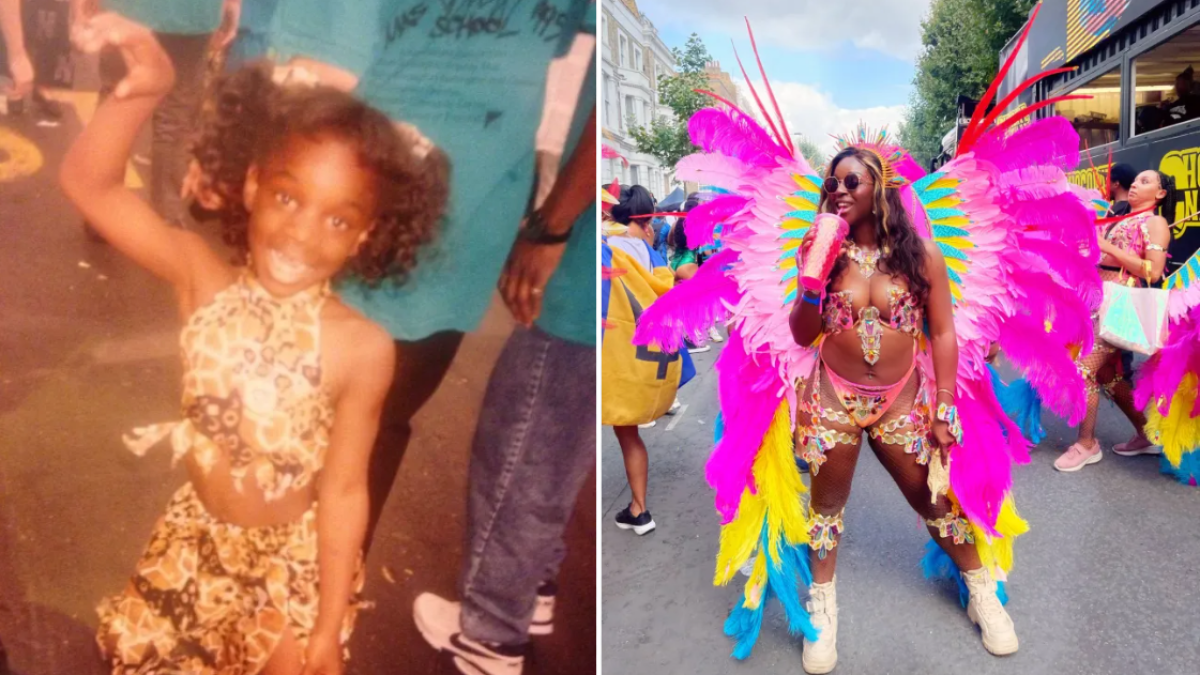
Notting Hill Carnival, Europe’s biggest street party and celebration of Caribbean culture, which brings millions to west London, celebrates its 60th anniversary this weekend, and many of those involved – from masqueraders and food stall owners to organisers and band leaders – will be marking their own carnival milestones too. For award-winning soca music artist and Notting Hill Carnival costume designer Ms Desire, born Louise Sterling-Jackman, the festivities will mark 30 years of taking part. “My earliest memory of carnival I was probably like five or six,” she tells me. “It was the first year that I actually got to play mas [join a masquerade band in costume] because my mum used to go to carnival all the time, and I used to have to just stay at the sides and watch.” Desire wore a Flintstones-themed costume her mother stayed up all night to make. And her experience of transitioning from spectator to an active participant sparked a lifelong love affair with carnival. “I loved it. It was like a feeling of, ‘oh yeah, I’ve arrived,’” she recalls. “Then ever since that, I’ve just been going every single year.” Desire, front centre, with masqueraders in the costumes she designed Desire said she feels a “sense of pride” participating as an adult, especially hearing the music playing from the mas band trucks. While various kinds of music of black origin blast from sizeable sound system speakers dotted around the streets within the carnival cordon, the music policy on the parade route is almost strictly soca – a typically high-energy genre of music that originated in Trinidad and Tobago and evolved as different Caribbean islands developed their own versions. This element is especially important to Desire, who is the reigning UK Groovy Soca Monarch after winning last year’s carnival music competition and returned to music this year with the release of her song “Bad All By Myself”. “It’s not every day that you get to hear all your favourite soca music on a massive truck with the bass and the speakers like that,” she says. This year, soca from smaller islands is set to take centre stage, with Desire, who has Bajan and Jamaican heritage, particularly looking forward to hearing songs by Grenadian, Dominican and St Lucian artists, known for their own styles of the genre – Jab, Bouyon and Dennery Segment, respectively. Just as there are different styles of soca, the days of Notting Hill Carnival have distinct identities. Saturday is when the sounds of steel pan ring out from Emslie Horniman’s Pleasance Park as the UK National Panorama Steelband Competition takes place. Sunday kicks off from 6am with J’Ouvert, followed by the children’s day parade, dutty (dirty)/fun mas, and sound systems. And the festivities reach their climax with Monday’s adult’s parade, characterised by pretty mas, when masqueraders adorned in bejewelled costumes, feathers and bright colours, as well as some traditional garments, fill the roads. After spending years adapting costumes made by other designers to suit her own style, Desire decided to launch her own section within a mas band. Through Infinite Mas, she’s made costumes adorned with colourful gems and feathers for hundreds over the span of a decade. Desire started creating costumes for herself and other masqueraders at the carnival a decade ago The section is housed within a large mas band called Chocolate Nation. While many bands opt for paint and powder as an homage to historic masquerade roots – originally enslaved Africans used mud and oil to mock their enslavers and conceal their identities – it provides its masqueraders with liquid chocolate to pour over one another at a specific point on the route. This moment is a highlight for Desire. “Every year we have a chocolate countdown, and we count down with Puffy [an internationally renowned DJ from Barbados] from 10, and then everyone sprays the chocolate and throws it around. It’s great. I love it.” But while the carnival is a source of joy, Desire cannot forget it’s rooted in resistance, linked to the activism of the Mangrove Nine and came to be following the racist murder of Kelso Cochrane. It’s why as a member of the Carnival Village Trust Board, she’s had to “push back all the time” in response to critics who want to move the event from Notting Hill. Naysayers from local residents who moved into the area after the carnival was established, local councillors and even Reform UK’s Nigel Farage have called for the event to be moved from its W1 postcode and relocated to Hyde Park, citing concerns over crowd sizes. Attendance figures have risen from around 500 in 1966 to over two million. But organisers have remained defiant because of the importance of community access and the historical origins. “We have to argue the facts… it stemmed from Notting Hill. There is so much historical context of why we have to keep it at Notting Hill, and we fight to keep it there, and we’re proud that it’s still there. Through Infinite Mas, Desire creates costumes for scores of Notting Hill masqueraders “To know it comes from a place of struggle to now see how beautiful the celebration is, it’s just amazing. It’s literally a feeling that can bring me to tears, and it happens a lot during carnival. There’s a lot of moments that I just sit and stand in it [and think], ‘Wow, I’m actually a part of this culture.’ If I died and came back, I would want to come back West Indian every single time.” She is committed to safeguarding the carnival for future generations, including her own children, aged three and 10 months, who she is confident will follow in her footsteps. “I would definitely expose them to it, the same way my mum exposed me to it.”
‘Why I’m fighting to keep Notting Hill Carnival where it belongs’
Full Article
Original Source
Read the full article at Inews →KhanList aggregates and links to publicly available news content. We do not host full articles from third-party sources. Always verify important information with original sources.