
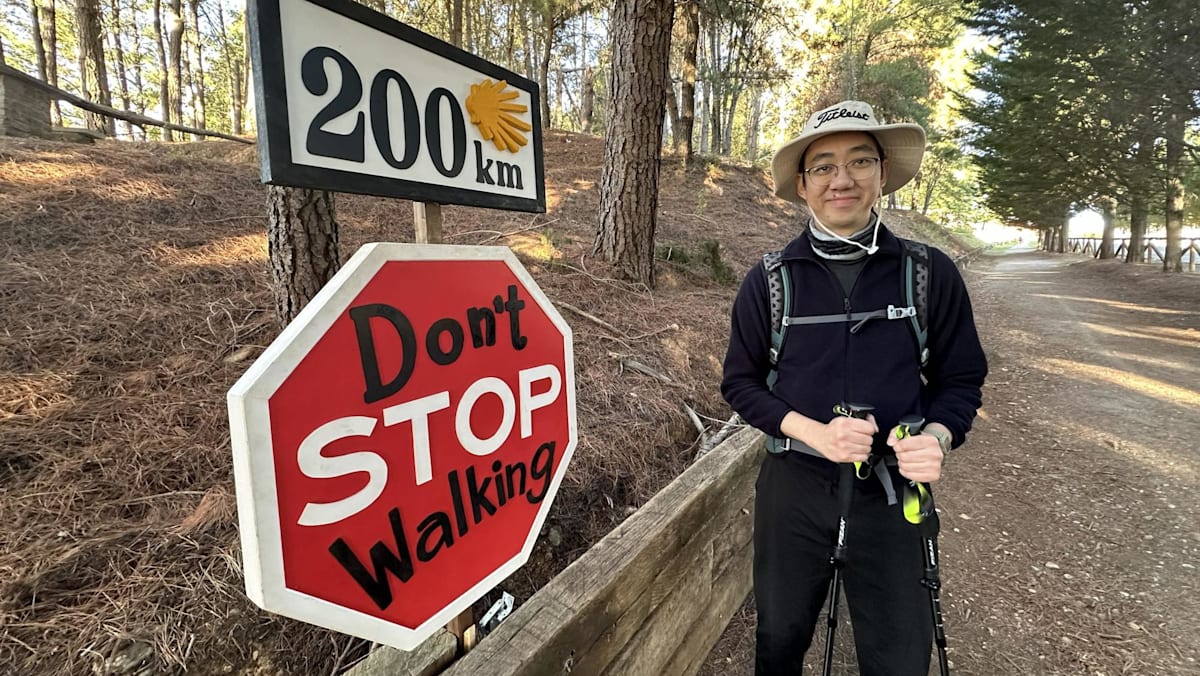
I was a broken man by the time I arrived at the Cathedral of Santiago de Compostela, the final destination for those who undertake the Camino de Santiago pilgrimage. I had a swollen, elephantine right ankle; a hot, searing pain under my left foot; a pair of stiffened thighs; and two bruised big toes already turning into the shade of brinjal. Every part of my body was screaming for mercy, begging me to stop walking. I did stop – after walking for nine days across 210km. I collapsed on the plaza, hiking poles strewn this way and that, and basked in the weak October sun with the granite cold on my sore back. My pilgrimage had ended. I had finally arrived.The Camino de Santiago, or the Way of St James, is a network of historic pilgrimage routes that stretch across Europe and converge at the Cathedral of Santiago de Compostela in Galicia, northwestern Spain. The pilgrimage tradition began in the 9th century, when the tomb believed to be that of St James, one of Jesus' 12 apostles, was reportedly discovered in the region. A chapel was soon erected on the site, and a settlement grew up around it, eventually becoming the city of Santiago de Compostela. As word spread, pilgrims began to arrive, first mainly from the Iberian Peninsula and later from across Europe, and they have continued to make the journey for more than a thousand years. A doll atop a marker along the route. The doll belongs to the writer’s wife who couldn’t join him for the pilgrimage due to prior commitments. (Photo: Will Chin) I completed the Camino de Santiago in October 2026. However, my journey began two years earlier after I suffered what felt like a panic attack. It was a brief yet harrowing episode, complete with heart palpitations, and partial and momentary blindness, followed by weeks of crushing inertia at work. While the self-assessments available online disregarded stroke and depression as probable causes, they did hint at a potential burnout.Maybe it was a mid-career crisis that finally boiled over, or maybe it was turning 40 and all the alarm bells going off at once. I decided, then and there, to take a career break and do something wholly out of my comfort zone.As a person without a religion, I chose to walk the final 210km of the Camino de Santiago for three reasons.The first reason was practical. Sarria, about 115km from Santiago de Compostela, was the most popular starting point. By starting farther away in Ponferrada, I hoped to enjoy quieter stretches of the route before joining the crowds nearer to Santiago. The second reason was symbolic. In 2023, I completed the Kumano Kodo in Japan, which along with the Camino de Santiago is one of several UNESCO World Heritage pilgrimage routes. Registering for and completing both the Kumano Kodo and the Camino de Santiago would place me among only 18,000 so-called "Dual Pilgrims" worldwide, or people who have been certified to have completed both pilgrimages.The third reason was existential. I believed that by living a simple, almost ascetic life for two weeks – by focusing solely on walking, eating, drinking, and sleeping – I would somehow discover answers to all of life’s problems.The preparations began in earnest after I left my job in early 2026. I trained in the gym, purchased the necessary equipment, and spent too much time on Reddit doing research and reading the advice of other pilgrims. The writer found support along the way from other pilgrims. (Photo: Will Chin) On Oct 17, I arrived at Ponferrada, the starting point of my Camino. The plan was simple: to walk between 20km and 30km every day until I reached Santiago de Compostela. That’s 40,000 to 50,000 steps a day for nine days straight.Like every plan that later goes sideways, the first day of my Camino was idyllic if not perfect. The air was cold and crisp, the sun was warm but never stinging, and the route took me through sleepy villages, tranquil farmlands, and historic old towns. The highlight was meeting fellow pilgrims around the dinner table for the first time, each with different reasons for partaking in the same adventure.However, by day two, things quickly headed south. For one, it involved a 30km hike, the last 8km of which was an uphill climb to O Cebreiro, a village atop a 1,300m hill.This stage was the first straw on the proverbial camel’s back. Even though I packed enough clothes for the season, I forgot about O Cebreiro being on a higher elevation. At night, the temperature plunged, and even the dawning light brought scant warmth to the near-freezing air.Also, by the end of the second day, my body felt calcified. There were pains in muscles I didn’t even know existed. The 24km hike downhill afterwards unlocked even deeper depths of agony in my knees and thighs, and no amount of balms, massages, medicated patches, and paracetamol could quell the mounting pains.The toughest challenge, however, was a mental one. Most pilgrims I met, young and old, had already been walking for weeks at that point. They had developed sun-scorched skins, thick ropes of muscles taut against their legs, and the uncanny ability to turn any pain into humour or a dull, monotonous hum. Every time a pilgrim passed me on the trail, I resented myself for being less fast, less fit, and less capable. I felt that I was losing even though it was not a competition and no one was keeping time.The change for me came at Triacastela, a small village with a surprisingly well-stocked pharmacy. I purchased a pack of ibuprofen and listened to my body more. If it wanted to slow down, I slowed down; if it wanted to stop, I stopped; if I needed painkillers, I took the recommended dosage. These helped me manage the pain, allowing me to push through even more demanding stages in the days to come. The writer learned that 'failure' was a normal part of every Camino. (Photo: Will Chin) My fellow pilgrims, too, encouraged me at every step. Jordi, a young Spaniard, texted every day in broken English to check in on me; Nicole, a Taiwanese woman, and her husband accompanied me to my accommodation when I was in too much pain to even joke about the foods we missed back home; and Dana, a 72-year-old Texan, showed by example that if he could do it, so could I.Many pilgrims also taught me that "failure" was a natural part of every Camino. Martin and Michelle, a couple from the UK, had to abandon their previous attempt because she suffered a bad fall and couldn’t continue; Gretchen, a retired schoolteacher from the US, broke her shin during her first attempt; and Betsy, a retiree from the US, was on her third Camino because her first attempt was cut short when her husband passed away while on the trail with her.In truth, being slow, being ill-prepared, and being in pain were but minor struggles in the greater scheme of things. Through their stories, I learnt one thing: there was no perfect Camino; there was only your own personal Camino.From then on, falling behind fellow pilgrims became easier to bear. Instead of resentment, I would say “Buen Camino!” and bid them good luck as they marched ahead. Instead of fixating on how far I was lagging behind, I cheered myself by counting the kilometres I had already walked. Besides, sooner or later, most if not all pilgrims will reach Santiago de Compostela, in this Camino or the next. Some do so faster than others, and it is only a matter of time. Perseverance (and painkillers) will get you to the end. (Photo: Will Chin) In the end, the Camino de Santiago didn’t solve my mid-career crisis. I still don’t know what I want to do with my life, but at least I know that, with perseverance (and sometimes ibuprofen), I will find my way somehow.As these thoughts flooded my head before the Cathedral of Santiago de Compostela, a shadowy figure stepped in to block my view. It belonged to Dan, a rotund man from the UK with unkempt hair and beard. We had met and walked together many times along the Camino, and he had shared lots of sage advice, having attempted it over eight times. With damp socks and undergarments dangling from his belt and a can of beer in his fist, he offered me an open hand. “Congratulations, Mr Singapore,” he said with a smile, addressing me with the nickname he chose for me. “You did it, man. You are here now.”You are right, Dan. I sure am. I am in pain, but I am all right.
Why I walked over 200km across Spain in 9 days after burning out at work
Full Article
Original Source
Read the full article at Cnalifestyle →KhanList aggregates and links to publicly available news content. We do not host full articles from third-party sources. Always verify important information with original sources.