
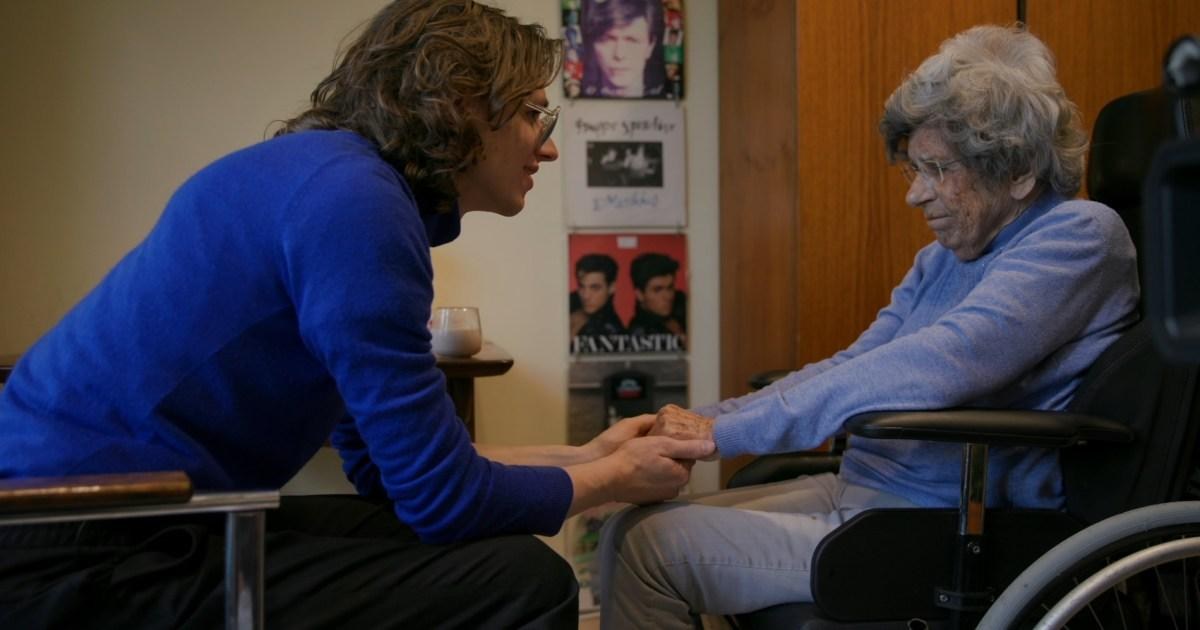
Rather than partying and drinking away his early adulthood, Teun decided to experience living in a care home for himself (Picture: Supplied) When he was 21, Teun Toebes, moved his belongings into a 21-square-metre room on a closed dementia ward in a nursing home – and stayed living that way for over three years. The Dutch nurse tried to bring some normality to his new life – continuing to go to university, having his own double bed and a few plants in his room, while every Friday he invited fellow residents around for a drink. Unsurprisingly, life on the ward felt ‘really heavy,’ admits Teun. ‘People would watch movement programs on the television while sitting in a chair the whole day, living from meal to meal. They were losing the purpose in their days, the feeling that they belong to society. ‘The residents were simply a care plan, instead of a human or individual. I would ask myself: “Is this how I will end up at the end of my life? Is this what my future looks like?”’ Most of Teun’s colleagues said they wouldn’t want to move into the system they were working in (Picture: Supplied) So what made a healthy young man want to move into a place full of people living with alzheimer’s? As a dementia nurse, Teun says that he had been ‘deeply worried’ about how people with the condition were treated when they went into care. ‘When I asked my colleagues whether they wanted to end up in the system we were working in, most of them said, “Hell no!”’,’ the 27-year-old tells Metro over Zoom. So, in August 2020, he moved into a closed dementia care home in Voorhoeve, Utrecht. The staff welcomed him, saying that he wouldn’t need to be subjected to the ordinary rules and regulations residents had to abide by. Ask Metro Use AI to go deeper into the stories you care about – powered by Metro and trusted publications. ‘They told me it was important that I tell an honest story about life in a home, and they trusted me to live there without any rules. I wanted to bring the humanity back so I would go to dinner or bars with housemates. ‘The doors were locked but I could come and go as I pleased, and wasn’t expected to eat three times a day like the housemates. ‘Sometimes I did, sometimes I didn’t. I was living to a different rhythm, so I couldn’t eat breakfast, sit in the living room for two hours and then have lunch.’ Teun would share some meal times with fellow residents (Picture: Supplied) ‘When I came back from being out, I was able to bring new life and stories back into the nursing home, and make people feel part of the experiences I had.’ Understandably, some staff had mixed feelings about Teun’s presence and worried he was there to judge them. ‘The hardest part was my relation with some of the staff members. They were my colleagues, so any criticism was of the stye we created, not a personal attack. ‘My aim was not to make friends with everyone but to deeply understand and get first hand experience of living in a nursing home.’ In the second home he stayed in, Teun ruffled features when he started suggesting that the doors stayed unlocked so residents could come and go freely. ‘Of course, that caused tensions,’ he says, but insists he wanted the residents to have more freedom, because his stay in the homes made him realise that segregation from everyday life was the hardest aspect of living in residential care. Quickly, Teun made friendships in the homes (Picture: Supplied) ’As soon as you move into a nursing home, you can’t visit your friends. You can’t go to the supermarket you always went to. Your relationship with society changes rapidly.’ Of course, locking people in their accommodation is considered to be for a patient’s own safety – however, Teun argues that it can actually increase the risk to their wellbeing. ‘If people can’t walk anymore, they will sit the whole day in a chair. They lose all their muscles within a few days, and then the risk of falling is even bigger,’ he points out. ‘A nursing home is not a golden birdcage where we can keep people safe – it should be an extension of a normal and good life.’ It was during his Friday drinks’ evenings that Teun managed to strike up a friendship with one of the residents, a man called Ad. ‘When he moved to the nursing home, he was feeling quite depressed and was always in his room. He told me he felt no joy, that he felt locked up,’ he explains. While intitally many friends visited Teun, gradually people contacted him less and less (Picture: Supplied) ‘But during the time we were living together, we developed one of the best friendships. Ad came to my room to ask me to watch soccer with him or to drink a beer, and we shared beautiful stories. ‘When my friends came, he was always the first one coming to my room to join because he also liked the social contact. And while Ad didn’t remember my name, he always remembered the feeling.’ Asked how nursing-home life affected his love life, Teun turns the question around. ‘Have you ever asked a resident from a care home about their romantic life? When it’s me locked up, we see it as a sacrifice. But when older people are living in the same system, we find it normal.’ Teun says that at first his friends would visit often, but eventually faded away, because ‘it is very confronting for people to see a nursing home,’ he explains. For many residents, Teun says, it was as if people had already said goodbye: ‘It was a social death.’ One care home resident, Rob, had early-onset dementia and had been one of Europe’s leading cardiologists. ‘He said, “since I received the diagnosis, none of my colleagues ever asked me: how are you doing?” Of all the challenges he faced with his diagnosis, the loss of social connection was the most painful,’ recalls Teun. The dementia nuse calls care homes a ‘dead environment’, and says we need to change this (Picture: Supplied) Inside, hospital beds, utilitarian chairs and institutional linen added to the oppressive atmosphere. His housemate Eugenie had grown up in Indonesia surrounded by greenery, but the home was full of artificial plants because staff feared residents might eat real ones. ‘When Eugenie walked into my room, she said, “Whoa, what a beautiful palm you have!” And then she started to water it.’ ‘With good intentions we have created a dead environment. We can’t expect people to be lively in a dead environment.’ During one heatwave, Teun remembers one housemate, Muriel, feeling miserable because residents were automatically kept indoors when temperatures reached 30°C. ‘She had been born in Curacao, a tropical island, and she wasn’t allowed to go out in the last phase of her life because we had a heat protocol. But she told me: “I love the heat. It’s part of who I am. It’s part where I grew up, where I’m rooted.” ‘So many residents of care homes no longer feel the weather. I remember one day I just went out and cycled through it because I hadn’t felt the rain for so long.’ After staying in his first home for two years, Teun, along with filmmaker Jonathan de Jong, started travelling the world documenting better approaches to dementia care for the 2023 documentary Human Forever and book Human Forever: Searching the World for a Better Life with Dementia. They visited an intergenerational school in Cleveland, dementia-prevention programmes in South Korea and communities in South Africa where families cared for relatives at home. There, they met Arlene, whose siblings paid her each month so she could stay home and care for their father. ‘Is it dementia, or the stigma around it, that is devastating lives?’ questions Teun (Picture: Supplied) ‘The win-win was that she developed a better relationship with her father, and that he wasn’t excluded from the community, so he was still able to see his neighbours and go to church every week.’ One Danish facility stood out to Teun because it felt like a home, with plants, pets and a real fireplace. ‘A lady was allowed to bring her own cat, which would lie on her neck, and resulted in her not needing sleeping pills to fall asleep, as her pet brought her a feeling of security,’ he explains. Teun does not believe these examples should simply be copied, however. He wants a cultural shift in which dementia and elderly care are treated as everyone’s responsibility, not just the health system, something he hopes will be reflected in the UK’s Casey Commission on adult social care, which is due to report next summer. ‘I want people to know that when it comes to fixing social care, it is nuanced, and complicated. And it is not only about amount of resources but what we do with resources we have. ‘In the UK, you have this quote that dementia is the UK’s biggest killer. I agree with the fact that dementia can change parts of your life, and dementia can be really painful, and it can change your role in society. ‘But we also should be honest and ask: is dementia devastating life, or is the stigma around dementia devastating lives?’ he asks. ‘The reality is that nursing home care is at its core palliative care. None of my housemates survived the place, because that’s not the aim of a nursing home – but it should be to have a good and normal life as possible.’ Arrow MORE: I was 12 when I got lost in the manosphere for two years – here’s what I learned Arrow MORE: I’ve been in two air crashes and died three times – but somehow lived to tell the tale Arrow MORE: I lived like a prepper for 72 hours – here’s what it’s really like
Why I lived in a nursing home in my twenties
Full Article
Original Source
Read the full article at Metro →KhanList aggregates and links to publicly available news content. We do not host full articles from third-party sources. Always verify important information with original sources.