
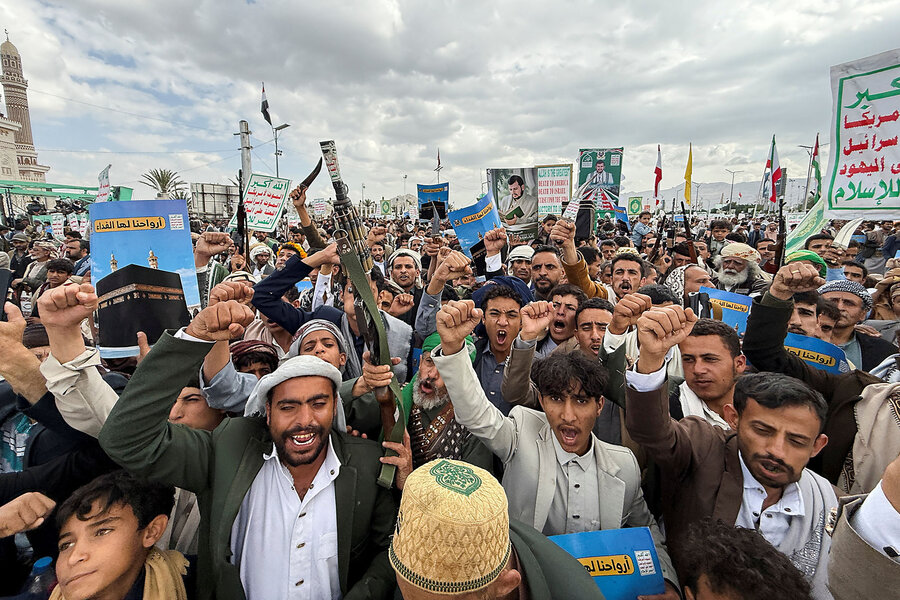
Basel, Switzerland | Sept. 19, 2026, 5:00 a.m. ET | 5 min read A lightning advance by the Houthis along Yemen’s Red Sea coast has sent a message to Washington.By tightening its grip on the Bab el-Mandeb strait, the Iran-backed group has turned a long-running civil war into a wider contest over maritime security with implications for global energy markets.Observers say the escalation underscores the Houthis’ regional ambitions and is unlikely to be resolved without some broader accommodation with Iran. Until then, Tehran and its allies have leverage over not one, but two of the global economy’s most vulnerable choke points – Hormuz and the Bab el-Mandeb, where outright control of the waterways matters less than the ability to threaten passage. And the Houthis’ military offensive in Yemen is ongoing.What do the Houthis want?The civil war in Yemen began when Houthi forces seized control of the capital, Sanaa, in 2014. They are still fighting to expand their control over the country. With their latest moves, the Houthis have now captured nearly all of Yemen’s Red Sea coast, including strategic islands in the Bab el-Mandeb strait. 2026 Planet Labs PBC/ReutersA satellite image shows Perim Island in the Bab el-Mandeb Strait off the southwestern coast of Yemen, Sept. 13, 2026. Yemen's Iran-aligned Houthis reached the strategic island on Sept. 11, according to multiple Yemeni government sources. “The most alarming thing is the ambition of the Houthis to control Bab el-Mandeb,” says Gregory Gause, an associate fellow at the Middle East Institute in Washington. The narrow strait linking the Red Sea to the Gulf of Aden is one of the world’s busiest maritime shipping routes, accounting for about 7% of the global petroleum trade.The Houthis claim they will not target international shipping. But they have already declared a naval blockade against Saudi Arabia, which intervened in Yemen’s civil war early on by supporting the country’s internationally recognized government. A U.N.-brokered truce between Yemen’s warring parties halted most of the heavy fighting in 2022.But in recent days, the Houthis have launched drones and missiles at Saudi cities, military bases, and oil facilities. Riyadh has responded with hundreds of airstrikes. A Houthi spokesperson this week claimed the group had shot down a Saudi F-15 fighter jet with a surface-to-air missile. “They are changing the balance of power against their Yemeni opponents and strengthening their ability to pressure Saudi Arabia, their principal regional adversary,” writes Maged Al-Madhaji of the Sana’a Center for Strategic Studies in an email. He adds that the Houthis want to convert recent military gains into political recognition and present themselves as “an indispensable party to any arrangements for Red Sea Security.”Ideologically, the Houthis identify with Iran’s “axis of resistance,” framing their movement as anti-American and anti-Israel.What does Iran gain from the Houthi offensive?Houthi control of Bab el-Mandeb gives the Islamic Republic new leverage with the United States. “The timing and priority of this offensive serve an Iranian strategic need,” says Mr. Al-Madhaji, because Iran can now threaten the straits of Hormuz and Bab el-Mandeb.Analysts say the timing of Houthi strikes against shipping and energy infrastructure is calibrated to maximize pressure on Washington ahead of U.S midterm elections. The Trump administration has failed to end the war with Iran. A recent high-level meeting between Iranian and Gulf Arab states about the future of the Strait of Hormuz was derailed by the Houthis’ offensive in Yemen.With the U.S. military blockade in Hormuz constraining Iranian oil exports, Tehran has a strong incentive to shift some of that economic pain. “The reaction to that was always going to be kinetic,” says Michael Ratney, a former U.S. ambassador to Saudi Arabia and a senior adviser at the Center for Strategic and International Studies in Washington.“If Houthi attacks disrupt Saudi exports,” he says, “oil prices go up globally. People feel that in the United States. And it eventually puts pressure on Washington to come to some agreement [with Iran].” Ansar Allah Media Office/APIn an image taken from video, Houthi fighters chant and raise their fists beside what the group claimed was the wreckage of a downed Saudi F-15 fighter jet, in the Marib governorate of Yemen, Sept. 16, 2026. What’s at stake for U.S. partners in the Gulf region?Military gains by the Houthis in Yemen present an immediate challenge for Saudi Arabia, especially in light of the ongoing war with Iran. “There has been for quite some time a debate within the top echelons of the Saudi system about whether they can rely on the United States or whether they should just look elsewhere,” says Brian Katulis, a senior fellow at the Middle East Institute. “The whole reason a country like Saudi Arabia invests for decades in a partnership with the United States is for a moment like this,” says Mr. Ratney, “where you would expect to turn to this partner that you’ve worked with for so long for help.”On Thursday, the Trump administration said it approved a potential sale of F-35 stealth fighter jets to Saudi Arabia. But President Donald Trump appears unlikely to support direct military engagement against the Houthis. He declared victory over the group in May 2025, when the U.S. concluded a seven-week bombing campaign in Yemen.What can the U.S. do to secure these vital waterways for the global energy trade?More than six months since Mr. Trump, along with Israel, started the war against Iran, there is still no simple military fix for the disruption of trade through the straits of Hormuz and Bab el-Mandeb.“We’ve been sleepwalking for months into a global energy crisis,” says Mr. Katulis.U.S. naval escorts can protect ships, and airstrikes could degrade Houthi capabilities, but analysts stress that using military force without a broader strategy, greater regional support, or a durable peace agreement with Iran will not solve the underlying problem.Tim Lenderking, a former U.S. envoy to Yemen, says the Trump administration could do more to help both Saudi Arabia and the government in Yemen by providing intelligence, surveillance and reconnaissance, and military advice. He says it might also be time to appoint a dedicated U.S. envoy for Yemen again. Washington has “taken its eye off a problem set that many of us warned would come back and bite us,” says Mr. Lenderking, who served during the Biden administration.Air power alone is no solution, analysts say. “The Saudis cannot bring the Houthis to heel with an air campaign,” says Dr. Gause, of the Middle East Institute. “Neither can America. America tried it in the Biden administration; they tried it in the Trump administration. It didn’t work.”There are diplomatic options for dealing with the Houthis’ blockade of Bab el-Mandeb, says Dr. Gause. And they would start by ending the war with Iran. Deepen your worldviewwith Monitor Highlights.Politics with respectGet political stories with respectful analysis.There‘s a world of new ideas in everyBooks newsletter.There‘s more to life, enrich yours withCulture & Learning weekly.Follow humanity‘s discoveries withScience & Nature stories in your inbox.Gain a spiritual perspectivefrom the stories in your inbox.Want to understand the deeper impact of critical events? Learn the Monitor‘s insight.Already a subscriber? Log in to hide ads. “The Trump administration just has to ... get its head around the idea that it’s lost this war. It has to make a deal,” he says. “Iran is the only country that has any leverage whatsoever on the Houthis.”Mr. Ratney, the former ambassador, agrees. “Unless you can solve the Iran piece, I think it becomes very difficult to solve these other parts,” he says. “Ultimately, what’s going to end this is some kind of a diplomatic arrangement. My prediction is that diplomacy will not be U.S. diplomacy. It’ll be Gulf states dealing directly with the Iranians.” ALREADY A SUBSCRIBER? LoginReal news can be honest, hopeful, credible, constructive.The Christian Science Monitor was founded in 1908 to lift the standard of journalism and uplift humanity. We aim to “speak the truth in love.” Our goal is not to tell you what to think, but to give you the essential knowledge and understanding to come to your own intelligent conclusions. Join us in this mission by subscribing.
Why Houthi offensive in Yemen has implications for Mideast and global trade
Full Article
Original Source
Read the full article at Csmonitor →KhanList aggregates and links to publicly available news content. We do not host full articles from third-party sources. Always verify important information with original sources.