
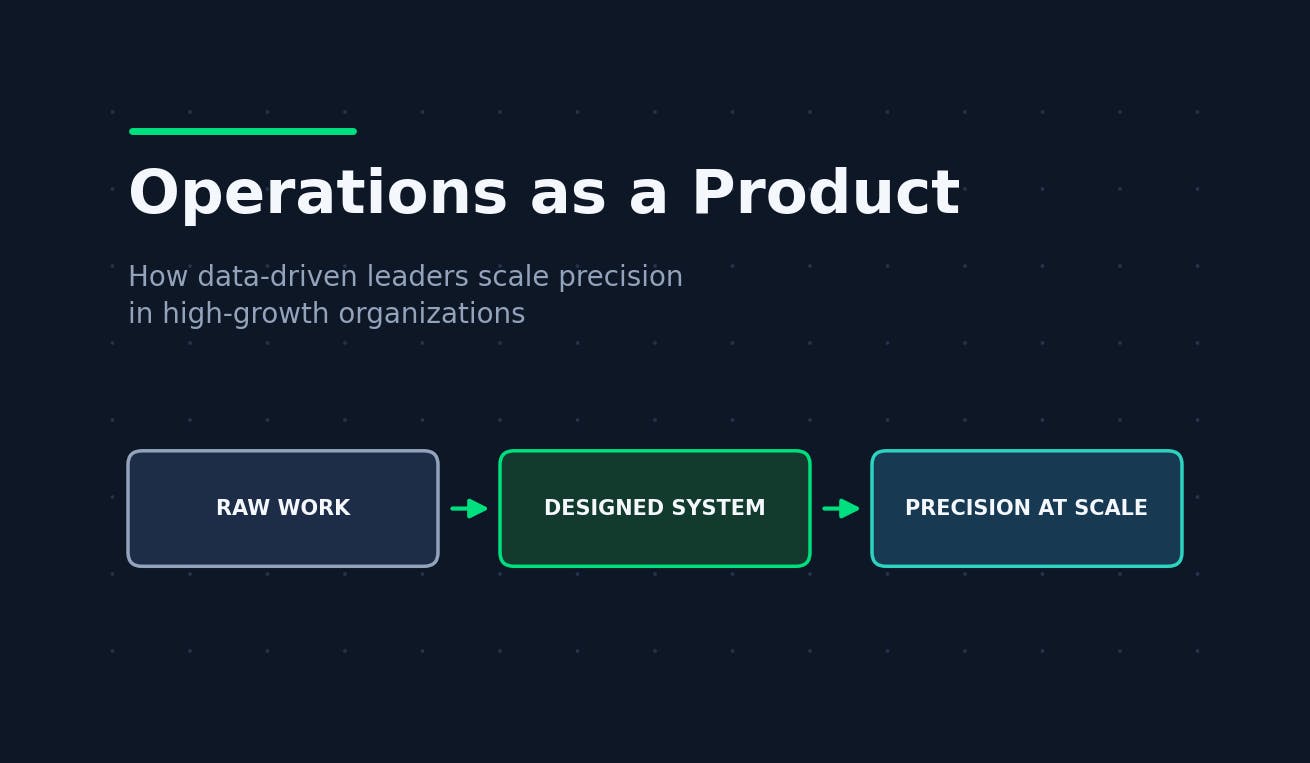
Most high-growth companies do not break because of strategy. They break because of operations.I have spent my career building operational and data systems inside fast-growing companies, and I keep watching the same story play out. At the early stage, teams move fast by relying on individuals. Decisions get made through context, intuition, and sitting close enough to overhear the right conversation. That works, right up until scale introduces complexity. Processes drift apart. Metrics stop meaning the same thing to everyone. Execution slows down, not because people got worse at their jobs, but because the system around them stopped supporting them.The shift from growth to scale is not about adding more tools or more people. It is about treating operations the way you would treat a product: something you design, maintain, and improve on purpose.In this article, I want to walk through how to design operational systems that scale with the business, where these systems fall apart in practice, and how to build them so you keep your speed while gaining precision.In high-growth environments, inefficiency rarely shows up as a dramatic failure. It shows up as small inconsistencies that compound.A revenue number is slightly different across two dashboards. Two teams interpret the same metric differently. A process that works beautifully for one product line falls over for another. Decisions take longer because nobody fully trusts the underlying data.None of these are isolated issues. They are signals that the operational system is no longer keeping up with the organization.The instinctive response is to add more process. In my experience, that usually makes things worse. More process without structure just creates more overhead without adding any clarity.The better move is to design operations intentionally, the same way you would design anything else your company ships.Operations Is a System, Not a Pile of TasksOperational maturity starts with a shift in perspective. Instead of thinking about workflows as a collection of separate activities, think of each one as a system with three parts: what goes in, what happens to it, and what comes out.Take revenue forecasting. The inputs are the pipeline data and historical deals. The transformation is the set of rules and judgment calls that turn that raw data into a forecast. The output is a number that leadership uses to make decisions.That framing sounds almost too simple, but it forces a kind of clarity most teams never reach. You have to explicitly define what information enters the system, how it gets processed, and what decisions it is supposed to enable. Once you can describe a workflow that way, you can spot where it is fragile, where it depends on one person's memory, and where two teams are quietly doing the same work differently.This applies to everything from forecasting to customer onboarding to hiring.Alignment Before OptimizationData is often treated as a reporting layer, something you look at after the work is done. In scalable systems, data is the foundation of decision-making itself.And the first challenge is not building dashboards. It is agreeing on definitions.The most common failure mode I see is metric fragmentation. Different teams define the same metric in slightly different ways. Finance counts revenue when the contract is signed. Sales counts it when the deal closes. The product team counts an "active user" as anyone who logged in this month, while marketing counts anyone who opened an email. Over time, those small differences turn into conflicting narratives, and eventually into arguments in the executive meeting about whose number is right.The guardrail is simple to describe and hard to enforce: one definition per metric, written down, owned by someone, and used by everyone. When a team wants a different cut of the data, they can have it, but it gets a different name.This is not a tooling problem. It is a discipline problem. Without a single source of truth, every optimization effort you attempt is built on unstable ground.Standardize the Handoffs, Not the WorkProcesses need to be consistent enough to scale but flexible enough to adapt. Over-standardize and you slow everyone down. Under-standardize and you get chaos.The balance, I have found, comes from defining clear interfaces between teams rather than dictating rigid workflows inside them.Here is what that means in practice. When sales hands a new customer to onboarding, the handoff should have a defined shape: these five pieces of information, in this format, every time. How sales gathers that information is their business. How onboarding uses it is theirs. The contract lives at the boundary.Software engineers will recognize this pattern immediately, because it is exactly how good APIs work. Each service agrees on what it will send and receive, and stays free to change everything behind that boundary. The same principle works remarkably well for humans and teams.When the handoffs are standardized, teams can operate independently without losing alignment. That is the whole trick.Scaling Teams Means Scaling Decision-MakingOne of the biggest bottlenecks in a growing organization is centralized decision-making. As teams expand, leaders simply cannot be in every decision. The system has to enable distributed decision-making without losing consistency.The way to do that is to turn recurring judgment calls into explicit rules.Imagine a team that approves customer discounts. Instead of every request going to a director, you write the logic down: small discounts get approved automatically, large ones go to a manager for review, and anything unusual or risky gets escalated. Now ninety percent of decisions happen instantly, at the edge, and leadership only sees the cases that actually need judgment.When decisions are encoded as rules and frameworks, they become repeatable and scalable. When they are not, teams fall back on ad hoc judgment, which introduces variability, inconsistency, and delay.Where Systems Break in PracticeMost operational systems do not fail because they were poorly designed. They fail because nobody maintains them as the organization evolves.Three failure modes show up over and over.The first is drift. Metrics, processes, and assumptions change over time, but the system does not get updated. What was once accurate quietly becomes misleading, and people keep trusting it anyway.The second is fragmentation. Different teams build their own versions of the system. You end up with three spreadsheets, two dashboards, and five definitions of the same thing.The third is over-engineering. The system becomes so elaborate that using it feels like a tax, so people route around it entirely. A process nobody follows is worse than no process at all, because it gives you false confidence.Notice that none of these are technical failures. They are organizational ones.Keep the Rules Easy to ChangeTo keep a system adaptable, the rules need to be separate from the machinery that runs them.When thresholds, approval limits, and criteria are baked deep into tools and habits, every change becomes a project. Someone has to rewrite the documentation, retrain the team, and update the tooling, so changes happen rarely and reluctantly.The alternative is to keep the rules somewhere visible and easy to edit: a settings page, a shared document, a config that the operations team owns. When the discount threshold needs to move from ten percent to fifteen, that should be a five-minute change, not a quarter-long initiative.Teams that work this way experiment faster, because trying a new rule is cheap and reversing it is even cheaper.Measure Outcomes, Not ActivityOperational systems should be judged by outcomes, not activity.It is easy to track process metrics like throughput and cycle time, and they are useful. But they are incomplete. A team can hit every internal metric while the business gets nothing out of it.The real measure is impact on business performance: efficiency gained, cost reduced, customers served better. Every operational improvement should trace back to one of those. If you cannot draw the line from the system to a business outcome, you are probably optimizing the wrong thing.Build Feedback LoopsNo system is static. As the organization grows, inputs change, priorities shift, and new constraints appear.Feedback loops are what keep the system honest. In practice, that means regular reviews where you ask whether the metrics still mean what they meant, whether the handoffs still match how teams actually work, and whether the rules still produce good decisions. When the answer is no, you adjust.The goal is not to build a perfect system. It is to build one that can evolve.Closing ThoughtsScaling operations is not about adding structure for its own sake. It is about creating systems that let teams move faster with more confidence.The most effective organizations I have worked with treat operations as a product. They define clear interfaces, enforce consistency where it matters, and allow flexibility where it is needed. The result is not just efficiency. It is precision at scale.As a company grows, the complexity it faces compounds. The systems it runs on have to evolve at the same pace. Otherwise, growth becomes the very thing that slows it down.
Why High-Growth Companies Should Treat Operations as a Product
Full Article
Original Source
Read the full article at Hackernoon →KhanList aggregates and links to publicly available news content. We do not host full articles from third-party sources. Always verify important information with original sources.