
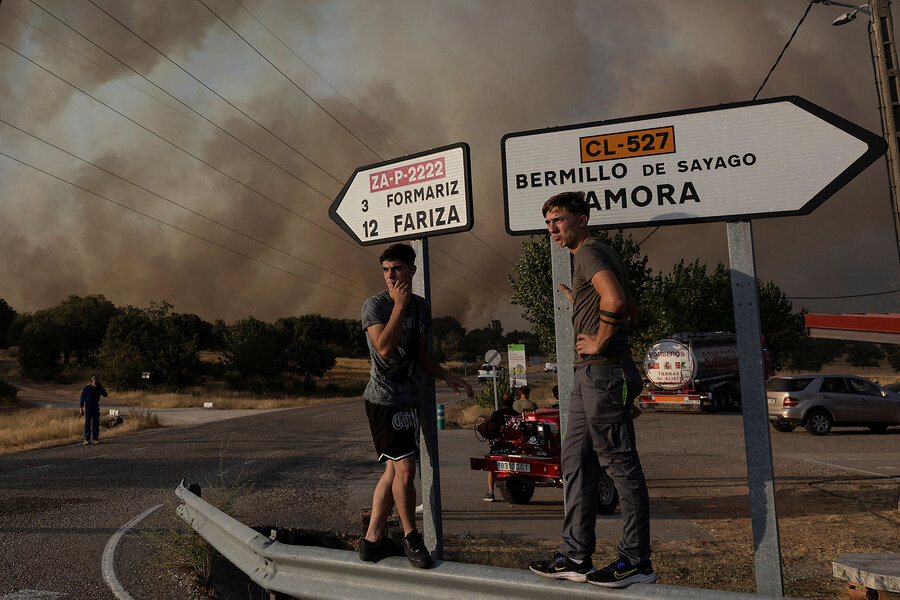
Searing heat, wildfires, dwindling water levels: Europe is suddenly facing a “climate emergency” scientists and green-energy advocates have been warning about for years. But the climate is not the only thing changing.Europe’s climate policy is also showing signs of change. And the need for governments to respond to the record heat waves buffeting the continent appears likely to reinforce that shift.The altered approach might best be called “green realpolitik.” Why We Wrote This European countries are determined to press ahead with greener energy policies as extreme heat, drought and energy shortages hit the continent. But a new “green realpolitik” is slowing them down. While the extreme heat and drought might suggest a need to move more quickly toward green energy, political realities mean the opposite is in fact the case.Europe’s world-leading commitment to replacing carbon fuels with sources such as wind, solar and nuclear power is not about to be shelved.But economic and political pressures, both domestic and international, have been prodding policymakers to rethink the path and the pace of getting there.And now, they’ve received a humbling reminder: The planet is already warming, and Europe is heating up at about twice the rate of other continents. Even the most ambitious official climate benchmarks – such as Britain’s aim to generate all its electricity from renewables by 2030, or the European Union’s “net-zero” emission target of 2050 – aren’t going to help cope with this summer’s record-high temperatures.A fifth heat wave since May has hit the continent this week.Temperatures are projected to rise above 100 degrees Fahrenheit (37.7 degrees Celsius) in a number of areas in the United Kingdom and mainland Europe. A drought has been declared in roughly 70% of England, and the EU has announced drought alerts in nearly half its 27 member states. People cool off at a water spigot near the Colosseum in Rome during a heat wave, Aug. 3. 2026. Europe has endured multiple heat waves this summer, and temperatures are again expected to rise soon. The shortage of rain across much of Europe is taxing water supplies and risking new wildfires. On Wednesday, British Prime Minister Andy Burnham convened the government’s COBRA emergency response committee, usually tasked with major security threats, to address the effects of the heat.Across Europe, other governments have taken a range of emergency measures: coordinating air support for firefighting, restricting energy usage, adjusting school or work schedules to deal with the effects of the heat, and safeguarding strained water supplies.They’ve also been debating longer-term responses, which is where “green realpolitik” has been coming into play.Their main domestic political challenge is from far-right populist parties, outpacing long-dominant mainstream parties in opinion polls in a number of European countries.Outright climate-change denial has nothing like the drawing power it has in the United States, where President Donald Trump has often dismissed the issue as a “hoax.” More than 80% of Europeans tell pollsters they believe global warming is a serious matter, and that figure is likely to rise further after the heat waves of recent weeks.But the populist leaders have echoed Mr. Trump’s narrative, saying that EU policies promoting green energy are a “woke” distraction from immediate steps to deal with the heat, and a waste of public money at a time of slowing growth and rising energy prices.They want fewer windmills and more air conditioning – an amenity few Europeans have embraced or needed in years past.In France, Marine Le Pen’s far-right National Rally is promising a nationwide rollout of air conditioning if she wins next year’s presidential election. Left-of-center and green party politicians have long worried that a spike in air conditioning use will be a drain on energy resources and a potential source of more emissions.In Britain, the political dividing line has been over further drilling of the depleted gas deposits in the North Sea.That, not “net-zero” targets, is what Nigel Farage, head of the populist-right Reform UK, says Britain needs. Conservative Party leader Kemi Badenoch, determined to win back voters who have moved to Reform UK, said recently that she would stop anyone who endorsed the net-zero goal from becoming a Conservative candidate for Parliament. Chris J Ratcliffe/Reuters Miatta Fahnbulleh, Britain's secretary of state for energy security and net zero, arrives for a Cabinet meeting at 10 Downing Street in London, July 21, 2026. Even before this summer’s heat, the EU had begun loosening a number of its emissions targets and delaying the phaseout of gas and diesel vehicles, in an apparent effort to blunt the far right’s use of green policies as a campaign issue.And while the spike in oil and gas prices from Mr. Trump’s Iran war initially boosted support for policies to promote green energy alternatives, the immediate focus of European leaders has shifted to the cost-of-living implications of the carbon-based energy Europe does still use.In Britain, Mr. Burnham has now hinted he might green-light two North Sea drilling licenses granted under the previous Conservative government, saying he’ll be “pragmatic” on the issue.His energy secretary, noting that 4 out of 5 Britons back a move to renewable energy, said that “to keep that number,” the government had to prioritize energy “affordability.”The fundamental direction of travel, they and other European leaders emphasize, hasn’t changed. They’re determined to end reliance on carbon-based energy.Yet their “green realpolitik” is about retaining popular support in the move away from carbon. This summer’s heat has further sharpened that priority, and also brought home the complexity of managing it.There’s perhaps no better example than Hungary. About half the country’s electricity comes from nuclear power, a noncarbon source the EU has been urging member states to use as a complement to wind and solar energy. But this month, Hungary’s Paks nuclear facility had to be shut down.There was no technical malfunction.The problem was a shortage of a critically important input: water to cool the reactor, and the long-trusted source was the Danube River. Already affected by low rainfall and drought, it was now reduced to record-low levels by Europe’s record-high heat.
Why heat, wildfires, and drought are slowing Europe’s move to green energy
Full Article
Original Source
Read the full article at Csmonitor →KhanList aggregates and links to publicly available news content. We do not host full articles from third-party sources. Always verify important information with original sources.