
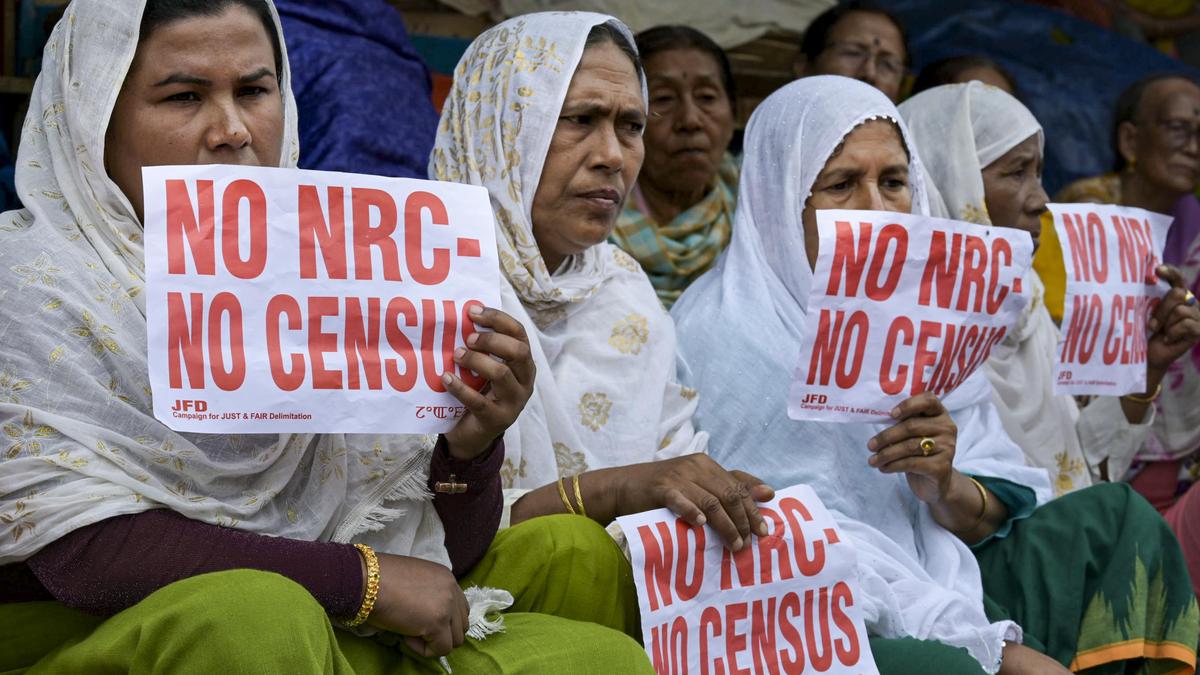
The story so far: On August 31, the Centre deferred the Census operations in Manipur amid demands to first conduct the State’s National Register of Citizens (NRC) exercise with 1951 as the base year. The decision followed Union Home Minister Amit Shah’s meeting with Manipur Governor Ajay Kumar Bhalla and Chief Minister Yumnam Khemchand Singh in New Delhi. The message conveyed was that Manipur can ill-afford fresh tension amid the ongoing Kuki-Meitei and Kuki-Naga conflicts, with elections to the State’s 60-member Assembly less than a year away.What led to the Census deferment?The decennial Census operation in poll-bound Manipur was scheduled to start on September 1. Data collection for the exercise, which will precede delimitation, began in the State in January. A few months later, several community-based and civil society organisations (CSOs) began opposing the scheduled headcount, demanding that the State’s NRC be prepared first. The Meiteis, who are in the majority in Imphal Valley, opposed the Census 2027 exercise.The Meitei Pangals (Muslims), largely inhabiting the valley, joined the NRC-before-Census bandwagon, as did the Nagas, who dominate at least five of the State’s 10 hill districts. The Kuki community, led by the Kuki-Zo Council, supported the Census operation. Their leaders said an impartial headcount would dispel false claims about Kuki population growth and the perception that they were “illegal migrants”, and ensure a fair delimitation process based on verified population numbers. The Kukis also said updating the NRC before the Census was premature and biased, fearing that the community members might face unfair exclusion if 1951 was used as the base year.However, the other communities intensified their pro-NRC protests. Shutdowns and boycotts of all the Central and State government offices followed. A citizens’ group, Campaign for Just and Fair Delimitation, threatened to intensify its protest. Leaders of 14 CSOs met with the Governor before travelling to New Delhi to meet with the Union Home Secretary, Registrar General of India, and the High-Level Committee on Demographic Change to explain why Manipur needed the NRC to find a permanent solution to the ethnic conflict that has scarred the State since May 3, 2023.Has the Census been deferred earlier?Yes, twice regionally and once nationally. The first deferment was in 1981 for Assam, which was in the mid-stage of a mass movement (1979-1985) against undocumented immigration. The exercise was paused as the agitators feared that conducting a Census amidst unresolved citizenship disputes would legitimise illegal settlers on the voters’ list. Normal Census operations were resumed after the Assam Accord was signed in August 1985. The second deferment was in 1991 for Jammu and Kashmir due to the rise of extremist activities and the mass exodus of Kashmiri Hindu (Pandit) people from the Kashmir Valley following widespread violence, destabilising local demographics. The 2021 Census cycle was postponed nationally due to the COVID-19 pandemic and rescheduled to 2026-27.What is the argument of the pro-NRC groups?In a memorandum submitted to the Governor on July 1, the 14 CSOs said an NRC was necessary to identify “illegal migrants” who migrated to Manipur from Bangladesh, Burma (Myanmar), and Mizoram to “pose a threat” to the State’s “original inhabitants”. They claimed that the Inpuis, Kabuis, Liangmais, Maos, Marams, Meiteis, Poumais, Rongmeis, Tangkhuls, and Zemes were the original inhabitants. They said the population of Meitei Pangals, descendants of Muslims from present-day Bangladesh who migrated to the State since 1606 and settled by marrying Manipuri women, increased to 2,39,886 (Census 2011) from 4,881 in 1881 with an “unexpected” growth rate of 4,814% during the past 130 years. The population of the Meiteis and the original tribes increased by 880% and 897%, respectively, during this period, they said.Claiming large-scale migration into Manipur’s hills from Bangladesh, Myanmar, and Mizoram since the 15th century, the CSOs said the total population in the hills jumped to 5,49,599 in 2011 from 25,384 in 1881, recording a growth rate of 2,165%, “which is more than half of each of the Meiteis and the original tribes”. They said protecting their ancestral land from “infiltrators” and keeping their socio-cultural environment intact became a “headache” for most original inhabitants, given the demographic scenario. The CSOs said those who fail to establish a link between people in the 1951 Census and those in the (demanded) NRC should be declared “non-citizens of Manipur” and duly detected and deported. The Nagas feel the NRC would facilitate the detection of “illegal migrants” from Myanmar, who they claim largely settled in ancestral Naga lands.How is the NRC demand linked to Manipur’s ethnic conflict?The Manipur government has consistently backed the NRC. Its formal demand gained traction after the Manipur Legislative Assembly adopted a unanimous resolution on August 5, 2022, seeking the establishment of a State Population Commission and the implementation of the NRC. One of the triggers was the military coup in Myanmar in February 2021, following which several hundred people crossed over to Manipur through porous borders.Most of those who took refuge were Kuki-Chin, ethnically related to the Kukis of Manipur and the Mizos of Mizoram. Many in Manipur blame the illegal influx for the ongoing ethnic conflict, first between the Kukis and Mizos and then between the Kukis and Nagas, which has claimed almost 300 lives since May 2023 and displaced more than 62,000 people. Although the State government or any other agency has not conducted any survey of “illegal immigrants”, Meiteis and Nagas believe the Kuki population has jumped exponentially in the hill districts. While non-tribal Meiteis feel the Census could reduce their representation in the Assembly from the current 40 seats, the Nagas believe the scale could tip in favour of the Kukis in the hills. The 20 Assembly seats in the hills are divided equally between the Kukis and the Nagas. The latter, however, say the hill areas should have had at least three more Assembly seats based on the 2011 population.Is an error-free NRC guaranteed?The NRC, requiring the transfer of data from Census slips, was born out of independent India’s first census in 1951. All States were mandated to compile an NRC, but it was done only in Assam. The intention behind that exercise in Assam was to prepare a village-based inventory of residents in view of the resistance from the State—then undivided—to house post-Partition refugees.The fear of the indigenous people of being outnumbered by “illegal immigrants” during and after the 1971 Bangladesh War led to the Assam Agitation from 1979 to 1985. A demand during the agitation was to eject undocumented foreigners by updating the 1951 NRC.The exercise, supervised by the Supreme Court, began in 2014, and the complete draft was published on August 31, 2019. This draft excluded 19.06 lakh out of the 3.3 crore people who had applied for inclusion. The Assam NRC process, however, remains incomplete because the Registrar General of India has not issued any notification declaring it as final.Organisations such as the All Assam Students’ Union claim the NRC 2019 was manipulated to pass a majority of an estimated 41 lakh illegal immigrants as citizens. The Bharatiya Janata Party-led Assam government remains adamant that the NRC was erroneous, with at least 20% of the enlisted names in districts bordering Bangladesh requiring re-verification. Assam’s updated NRC has been in limbo, with cases against it pending in the Supreme Court.
Why has the Manipur Census operation been deferred?
Full Article
Original Source
Read the full article at Thehindu →KhanList aggregates and links to publicly available news content. We do not host full articles from third-party sources. Always verify important information with original sources.