
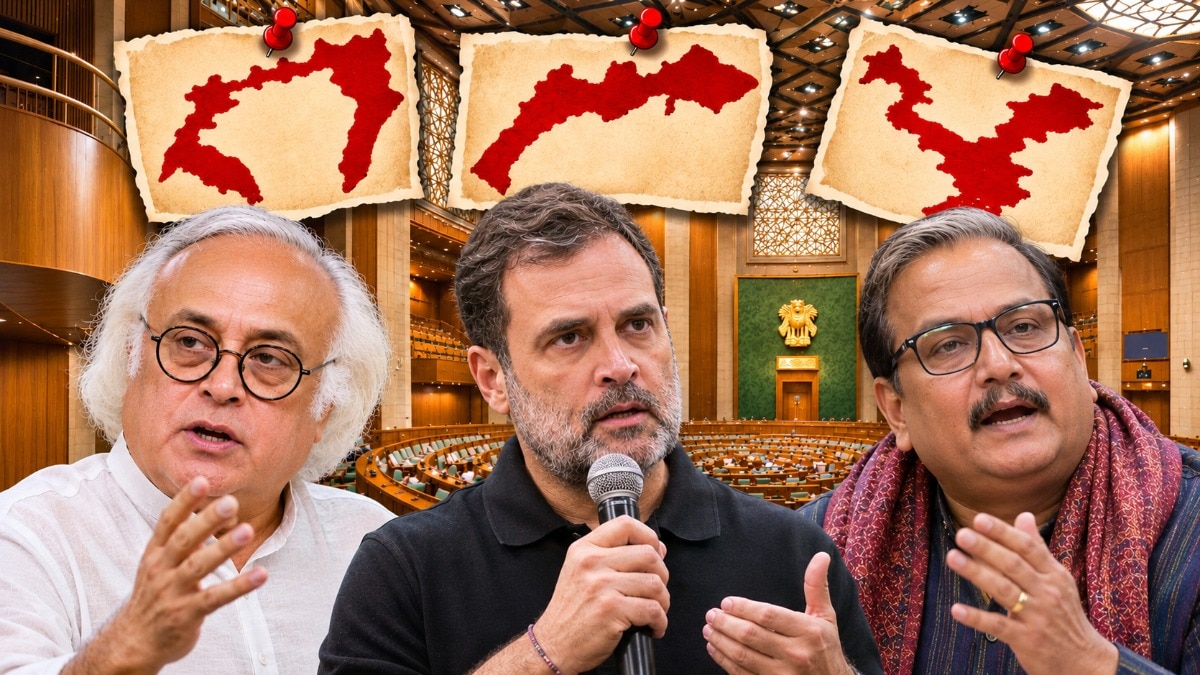
The Centre's revised delimitation proposal might have addressed concerns over the distribution of Lok Sabha seats among southern states, but it has triggered a controversy over who will "redraw India's electoral map". The Congress, RJD and other Opposition parties fear that the proposed Delimitation Commission could redraw constituency boundaries to favour the ruling BJP, an allegation the party has rejected.Congress leader Rahul Gandhi on Saturday (November 28) vowed to fight the revised delimitation proposal. Party general secretary Jairam Ramesh warned that the delimitation exercise could allow the BJP to manipulate constituency boundaries and gain an electoral advantage."We want a bipartisan Delimitation Commission that has members of the Opposition," Rahul Gandhi said at a media briefing on Saturday. "PM Modi wants a blank cheque to redraw constituencies," he added.In simpler terms, it is gerrymandering or the redrawing of the constituency boundaries in a manner to benefit a political party, that the Opposition parties fear could benefit the BJP. So, more than the Delimitation Bill, they are fearing the Delimitation Commission. Opposition leaders, including Rahul Gandhi, Jairam Ramesh, P Chidambaram and RJD's Manoj Kumar Jha, say the redrawing of constituency boundaries could give the BJP an electoral advantage. On Saturday, Union Home Minister Amit Shah defended the revised delimitation proposal, saying it would increase legislative representation and give women a greater political voice. BJP MP Tejasvi Surya dismissed gerrymandering fears in a post on X, arguing that constituency boundaries are drawn by an independent commission headed by a former Supreme Court judge, rather than by the government. He questioned the Congress on the previous delimitation exercises, asking, "Do you admit to gerrymandering then?"The Narendra Modi government's revised proposal, cleared by the Union Cabinet on November 27, seeks to increase Lok Sabha and state Assembly seats by 50% while preserving states' relative representation until 2051. It also seeks to facilitate the implementation of 33% reservation for women through delimitation, with the legislation scheduled to be introduced in Parliament on November 30. However, the Opposition's isn't just the addition of the number of seats."Gerrymandering is the greater evil and the greater danger," Former Union minister and Congress leader P Chidambaram said in a post on X.The BJP has dismissed the apprehensions, citing the commission's statutory composition and judicial safeguards.Let us examine what Opposition leaders and other critics said, the specific concerns they have raised, and where they believe the dangers of the proposed delimitation exercise lie.WHAT IS GERRYMANDERING? HOW DOES IT IMPACT ELECTION RESULTS?The revised proposal seeks to address one of the biggest objections raised when the government's earlier delimitation package failed to secure the required majority in the Lok Sabha on April 17. Under the new formula, states would receive approximately 50% more seats without substantially changing their existing share of parliamentary representation.But the additional constituencies would have to be carved out by redrawing existing electoral boundaries. That is where the Opposition sees a potential danger.Returning to the buzzword, gerrymandering, which refers to the deliberate manipulation of electoral constituency boundaries to benefit a political party or disadvantage certain groups of voters. The term originated in the US in 1812, when a Massachusetts electoral district approved by Governor Elbridge Gerry was depicted as resembling a salamander (an amphibian). A political cartoon combined Gerry's name with salamander to coin the term "gerrymander".Congress leaders Rahul Gandhi and Gaurav Gogoi have cited Assam's 2023 delimitation as alleged gerrymandering.In the 2023 delimitation exercise, Assam shifted three Muslim-dominated Assembly segments, Dhing, Rupohihat and Samaguri, from Kaliabor to Nagaon, which had a significant Muslim population already. Three BJP-leaning segments, Barhampur, Hojai and Lumding, were moved into the newly drawn Kaziranga seat. In the 2024 Lok Sabha polls, the BJP won Kaziranga and the Congress retained Nagaon.So, even if a state's overall share of Lok Sabha seats remains unchanged, the way constituency boundaries are redrawn can influence electoral outcomes.Under the delimitation legislation introduced in April, the proposed delimitation commission would comprise a serving or former Supreme Court judge appointed by the Centre, the Chief Election Commissioner or a nominated Election Commissioner, and the State Election Commissioner concerned.Associate MPs and MLAs would assist the commission but would have no voting rights, according to Section 5(4) of the revised and proposed Delimitation Bill.The Opposition has questioned whether this structure provides sufficient independence, particularly because the Centre appoints the chairperson.ON DELIMITATION, OPPOSITION WARNS OF POLITICAL GERRYMANDERINGOn November 27, former Chief Election Commissioner SY Quraishi questioned the proposed commission's impartiality through a sarcastic post on X. "My feeling is that the chairperson of the Delimitation Commission will be a lady. Preferably a gerrymandering expert!" he wrote.Congress leader Rahul Gandhi reportedly told party MPs on November 27, "We will fight it tooth and nail to defeat it, just as we did last time," and pledged to bring Opposition parties together against the Bill. On gerrymandering, Gandhi had said on April 17, "You did it in Assam and Jammu and Kashmir, and now you believe you can do it across India."Congress media coordinator Harmeet Kaur said that a uniform increase in seats would not necessarily translate into fair representation. "More seats do not mean fairer representation. Without clear safeguards, delimitation will become a tool for gerrymandering, redrawing electoral boundaries to manipulate political representation," she wrote on X. Kaur cited Assam's 2023 delimitation exercise as a warning of what she described as politically engineered constituency boundaries.Senior Advocate of the Supreme Court, Karuna Nundy, expressed similar concerns, describing women's reservation as a "Trojan horse for delimitation".RJD MP Manoj Kumar Jha also cited Assam while alleging that delimitation could be undertaken to serve the electoral interests of Prime Minister Modi and Home Minister Amit Shah.Congress general secretary Jairam Ramesh, meanwhile, questioned the government's decision to link women's reservations with delimitation. "The Special Session is thus NOT for women's reservations. That is already a law which the PM-HM jodi have put into cold storage for over three years," Ramesh said on X on November 27.Congress MP Gaurav Gogoi also alleged that the government wanted to increase its parliamentary numbers for political advantage."The BJP's intention is to change the Constitution. Since they could not achieve their objectives earlier, they now want to change the Constitution by increasing their numbers through delimitation. That is their ultimate goal," Gogoi said.Karnataka minister Priyank Kharge alleged that the government wanted control over the delimitation process. "They want to redraw boundaries; they want to ensure demographics are divided so that they stay in power for the rest of their lives," he said.BJP REJECTS GERRYMANDERING CHARGEBJP MP Tejasvi Surya rejected the allegations, pointing to the commission's independent statutory character."Gerrymandering? Boundaries are drawn by an independent Commission headed by a retired Supreme Court judge. The last one was notified under your own government. Do you admit to gerrymandering then?" he posted on X.Advocate Navroop Singh also challenged the allegations, arguing that the commission's composition and the availability of judicial review provided safeguards against arbitrary decisions. "Gerrymandering is mere allegation and apprehension with a retired Supreme Court judge heading the Delimitation Commission along with Election Commission of India and the Offices for state electoral commissioners, is also subject to judicial review by the Supreme Court," he wrote on X.The government's broader argument is that the expansion would improve parliamentary representation while creating the additional constituencies needed to implement women's reservation. The revised formula also seeks to address concerns from southern states that a population-based redistribution could reduce their relative influence in Parliament. At least three non-NDA parties, the DMK, NCP (Sharad Pawar) and YSR Congress Party, have backed or indicated support for the Centre's revised delimitation proposal.DELIMITATION UNDER JUDICIAL OVERSIGHT. CAN CONSTITUENCY STILL BE MANIPULATED?How constituency boundaries can be allegedly manipulated was illustrated by data analyst Karthik Shashidhar, who studied the geographical shapes of India's Lok Sabha seats after the 2002–2008 delimitation, India's last nationwide exercise. The changes came into effect in 2008. It was constituted under the BJP-led Atal Bihari Vajpayee government. Retired Supreme Court judge Justice Kuldip Singh was the chairman. Election Commissioner BB Tandon were the members. It was during the Congress-led UPA government's tenure when the recommendations of the 2002 Commission were finalised and implemented.In 2023, Assam underwent a separate delimitation exercise because the 2008 exercise had been deferred in the state over security concerns. Using a mathematical measure called the convex hull, data analyst Shashidhar said that he found that Assam's former Kaliabor constituency occupied just 39% of the smallest convex area enclosing it, against a national average of around 72%. Bengaluru North, at approximately 51%, was another example of an unusually shaped constituency, he said in the 2019 research.An India Today Data Intelligence Unit analysis found that the 2023 delimitation retained all 126 Assembly seats but reduced Assam's estimated Muslim-majority constituencies from around 35 to 22-24.However, Shashidhar's findings demonstrated irregular boundaries, not necessarily deliberate political gerrymandering.Article 329(a) of the Constitution generally bars courts from questioning delimitation laws, although the Supreme Court has held that delimitation orders may be subject to limited judicial review in cases of constitutional violations or actions beyond the commission's legal powers.In 2024, in Kishorchandra Chhanganlal Rathod vs Union of India, a bench of Justices Surya Kant and Ujjal Bhuyan held that courts could examine delimitation orders found to be "manifestly arbitrary and irreconcilable to the constitutional values". The court also observed that a complete bar on judicial intervention would leave citizens "solely at the mercy of the Delimitation Commission". Under the 2002 Act, the commission must consider population, geographical compactness, physical features, administrative boundaries and public convenience while redrawing constituencies.One must remember how the scope of such a review can be limited. The opposition parties are concerned if the current safeguards will be sufficient to prevent manipulation by the ruling BJP. The BJP says the allegations are speculative because the commission has not yet redrawn any constituencies. That's the dark spot in the proposed delimitation exercise, over which Chidambaram warned, "Gerrymandering is the greater evil and the greater danger."- Ends
Why gerrymandering, not the Delimitation Bill, is the bigger fear for Opposition
Full Article
Original Source
Read the full article at Indiatoday →KhanList aggregates and links to publicly available news content. We do not host full articles from third-party sources. Always verify important information with original sources.