
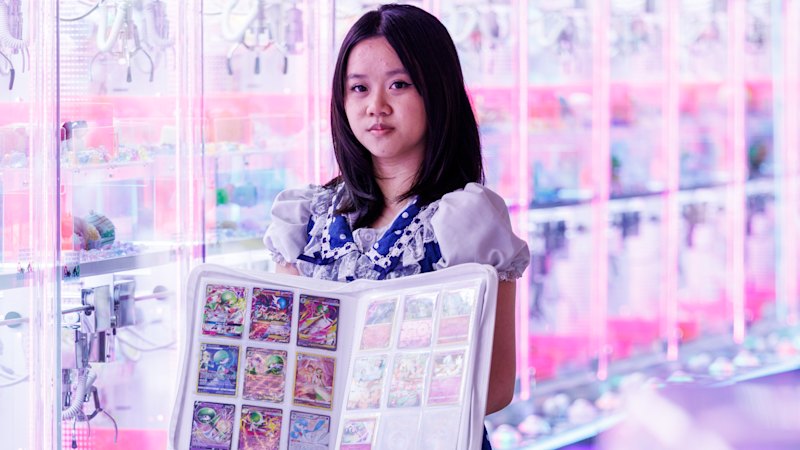
For 19-year-old Kathy Nguyen, Pokemon – and its motley crew of monsters – has been a fixture of her life since she first spotted them on the franchise’s 1990s television series.“I just fell in love with it. And I think it really heightened when I started making friends because of that shared interest,” says the commerce/law university student from Sydney, who used to beg her parents for Pokemon cards to trade with classmates when she was younger.“The idea of having these creatures with all these different designs – they kind of just follow you. It’s the same idea as having a pet.”University student Kathy Nguyen, 19, with her binder of Pokemon cards. Oscar ColmanShe connects her generation’s discovery of Pokemon cards with their growing affinity for “analog” culture and ’90s trends.Like other collectors, Nguyen displays her favourite cards in a binder as a way of honouring the art (Pokemon employs illustrators, whose names are signed on each card).“That’s so important now because AI is becoming more normalised in creative mediums. So having this strong appreciation for real artists and their work is really nice to see,” she says.Nguyen wasn’t alive when Pokemon was first dreamt up by Japanese video game designer Satoshi Tajiri in 1996 but she’s part of a new generation finding fun, friendship and, for some, fortune in the Millennial hobby.30 years of PokemonPokemon mania has reached fever pitch. Celebrations of its 30th anniversary in September this year were marked with fans queueing up for hours in the hope of snagging the brand’s anniversary pack, which promptly sold out and reappeared on resale platforms like eBay at mark-ups as high as 230 per cent.The company can hardly keep up, printing 10 billion cards worldwide between March 2025 and March 2026.The Pokemon card market is currently valued at nearly $US20 billion ($30 billion), with its value climbing more than 3800 per cent (about 23 times more than the Australian sharemarket) since 2004.‘Multigenerational fandom’Like many Millennials, 35-year-old Kirushi Arunthavasothy was a child during the first wave of Pokemon fever.The Kiwi-born, Brisbane-based entrepreneur believes COVID – when people were stuck at home and left to rediscover their card collections – and the rise of cryptocurrency helped create the “perfect storm” for the craze.“Many people got crypto-wealthy in our demographic and started to invest in what they liked,” says Arunthavasothy.Compared with investing in the sharemarket, collectables like Pokemon cards carry potent cultural currency: “It’s like owning a piece of your memory … Millennials are suffering from nostalgia,” he says.Pokemon cards are a lucrative business, with one card alone selling for $7.9 million three years ago.Max Mason-HubersArunthavasothy has turned this passion into a business, launching online trading-card marketplace Fetch in 2023. Today, the platform – where IP like Japanese manga series One Piece is also popular – sells one card every 28 seconds.The founder of trading-card event CardCon, Jose Caballero, 22, thinks social media – replete with “unboxing videos” of users displaying their card collections – and celebrities are helping amplify the hype and inflate value.In February YouTuber Logan Paul turned a tidy profit when he sold a rare Pokemon card for $US16.492 million.Justin Bieber, Spanish footballer Lamine Yamal, and Kim Kardashian are also collectors.“It tells the world, ‘hey, wait a minute – Pokemon is a hobby but there’s serious money to be made’,” says Caballero.“I know people who’ve been able to find a house deposit in their parents’ attic because they found their binder from when they were a kid and sold it at CardCon.’”Rachel Schmid, senior manager of collectables at eBay Australia, where overall Pokemon searches surged 34 per cent this year, says Pokemon is a multigenerational fandom.“Millennials grew up with Pokemon in the ’90s and a lot of them regret giving away their collections. But they have kids now and are bringing their family into it, too.”Caballero says his little brother Lucas, 6, is getting in on the hobby.As with any lucrative market, there is a dark side. Hobby shops have been targeted by crime syndicates in recent years, while new releases are frequently snapped up by AI bots to be resold for huge profits.Arunthavasothy is worried Pokemon may go the way of the sneaker resale bubble, which burst with rising inflation, tariffs and the prevalence of scalpers creating artificial scarcity. So he’s introduced measures like mobile number verification on Fetch to try ward off bots.Meanwhile, Nguyen took time away from the hobby in 2023 because of surging costs. “People I was talking to were very centred on profit … It really takes away from the enjoyment,” she says.‘It gets pretty competitive’Jacob Sulte, pictured at General Games Highpoint, has been playing Pokemon trading card games competitively for the past few years.Simon SchluterPokemon was a childhood obsession for Jacob Sulte, 16. But as peers grew out of the hobby, Sulte’s passion only grew.The Melbourne high schooler has been playing Pokemon competitively for the past few years. It has taken him to tournaments across the country (and included a narrow miss at a shot at the World Championships).The game, Sulte explains, is about strategy and luck. Each card is printed with manoeuvres like attack and special abilities (“Pikachu that can generate powerful electricity have cheek sacs that are extra soft and super squishy”) to guide players.Like Nguyen’s, his love of Pokemon is not about investment but about the skill and higher-level thinking involved in the game (players don’t require rare or expensive cards).“I think overall [competitions] are a bit healthier than collecting. People have built up these strong communities and it’s all family-friendly as well.”The competition helped Sulte forge close friendships, though he admits it gets pretty competitive.“There is a heap of pressure, there’s so many people who tune in to these Pokemon livestreams now – hundreds of thousands, sometimes even millions around the world.”The year 10 student, whose favourite subjects are biology, PE and English, hopes to be a pilot one day.“I love to travel, so I was thinking I could get my own plane and be able to play a bit of Pokemon on the side.”Make the most of your health, relationships, fitness and nutrition with our Live Well newsletter. Get it in your inbox every Monday.More:CollectingFor subscribersGamblingVideo gamesMillennialsGen ZFrom our partners
Why Gen Z wants a slice of this multimillion-dollar ’90s hobby
Full Article
Original Source
Read the full article at Smh →KhanList aggregates and links to publicly available news content. We do not host full articles from third-party sources. Always verify important information with original sources.