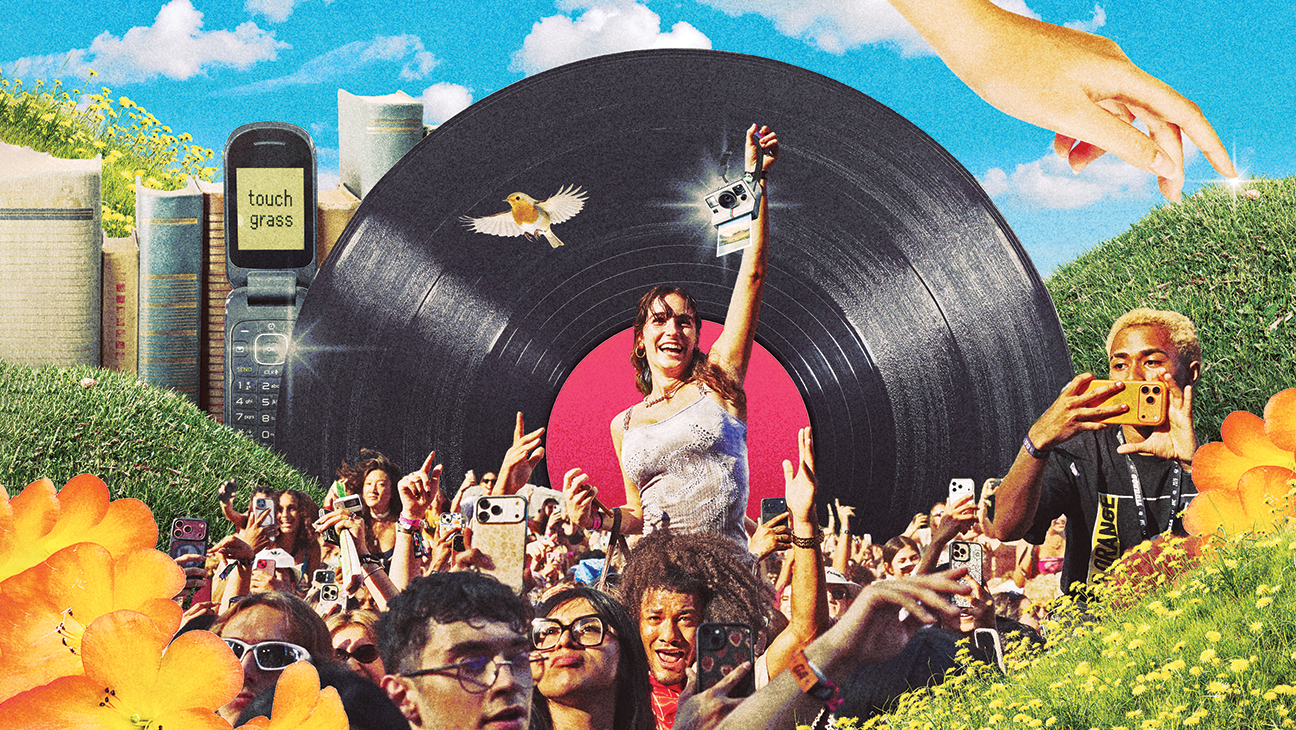
Have you heard of Angine de Poitrine? They are a Quebecois experimental rock duo from a remote region in the north best known for beluga whales and fjords who perform as aliens in a getup of polka-dot masks with giant noses. Their music is a high-tempo mix of the White Stripes’ raw energy, Frank Zappa’s complex time signatures and Cirque du Soleil’s playful absurdism … made from loops on a custom, double-necked bass/guitar and a driving drumbeat. They look and sound unlike anything anyone has ever seen or heard and have become one of the fastest-growing acts on the planet this year. Angine de Poitrine has been hailed as an antidote to AI slop by everyone from critics to random commenters. Their act is so weird, unexpected, mathematically and artistically unpredictable, and original that it defies common logic. They don’t chase clicks. Their costumes are handmade, each dot painstakingly painted on their limbs before the show. Their performances are a riot of energy, switching from jam band dancing to violent mosh pits in seconds, part rave, part post-punk art project. They’ve become the poster band for the analog movement that’s sweeping Gen Alpha and Gen Z in defiance of an AI revolution young people are increasingly skeptical of. I first began researching and writing about the resurgence of nondigital goods, spaces and experiences 20 years ago, back when the word “analog” was mostly used by engineers. This was the dawn of the smartphone and social media, a heady time of technological promise and digital evangelism. Silicon Valley was a beacon on a hill, and Mark Zuckerberg and Elon Musk remained beloved figures. I followed the analog revival through subsequent waves of digital innovation, from new streaming platforms and social networks to the emergence of VR, crypto and now AI. Analog has continued its steady resurgence all that time despite consistent predictions of its impending demise. Sales of vinyl records and turntables, paper notebooks, pens, analog watches, board games, books and film cameras continued to grow, year after year. The pandemic increased our hunger for physical goods and in-person experiences. Broadway has not gone dark (attendance is positively booming), while concert tickets are precious commodities. The trend is broad, global and most importantly driven by youth … the very same kids who were supposed to cast off the physical world because they were “digital natives,” completely enamored with screens. Gen Alpha and Gen Z may be digital natives, but they crave in-person experiences, such as concerts by the absurdist math-rock duo Angine de Poitrine (left), for example, or blockbusters like The Odyssey, starring Zendaya Matthew Baker/Getty Images/Victor Boyko/Getty Images for Universal Pictures Go into any bookstore or record store and you’ll see customers in their 20s and 30s, thumbing through novels and Blu-rays. Walk around a city like New York, Budapest, Seoul or Mexico City and look who has film cameras hanging off their necks. Who packed movie theaters this year for films like Obsession and Backrooms? On TikTok, Instagram and YouTube, it’s Gen Z posting “Hey Guys” videos about the knitting, magazines and puzzles in their screen-free #analogbags and their plans for an unplugged #analogsummer. The drivers of analog’s resurgence are individuals born long after the internet arrived and who could navigate a smartphone before they could speak. Despite the false assumption that all “the kids” wanted were social media, video games and endless swipes, it is these kids, not wistful Boomers and Gen Xers, who have made analog a core cultural trend. “Young people are self- selecting to engage with real, physical communities,” says Rev. Moose, who runs the independent music agency Marauder, and is the founder of the National Independent Venue Association. Moose was buoyed by a recent conversation with a radio station manager at Colorado State University who’d seen a big uptick in listeners tuning in during the past year. “College radio offers alternatives to the algorithm,” he notes. “The station is presenting the content as We Speak Human. They’re feeling it, not just speaking it. That’s an amazing thing.” The industry’s biggest challenge isn’t getting young fans interested in live music, he says, it’s getting them to afford it, at a time when tickets for popular concerts by artists like Zach Bryan or SZA start at hundreds of dollars (thank you, Ticketmaster/Live Nation). The biggest misconception about the analog revival is that it’s driven by nostalgia or some rejection of digital. But neither is true. Someone in their 20s and 30s who goes to see a chamber quartet (Gen Z and millennials led global attendance at classical concerts in 2025) aren’t reminiscing about their days waltzing around Vienna, just as my children aren’t taking their Instax cameras to summer camp to capture memories on film like they did decades before they were born. To them, analog is new, novel and an entirely unique experience compared to digital, which is the experiential equivalent of vanilla ice cream. Our use of different technologies to create and consume culture is not binary. Barnes & Noble can sell more books and open more physical stores at the same time that audiobook sales increase. Streaming services like Amazon can upload more content online and release more movies into theaters. Everyone writing in a Moleskine notebook also uses a computer. That’s not a contradiction, it’s a choice. “People have underestimated the importance of a social experience,” says Tim Richards, founder and CEO of Vue, Europe’s largest cinema operator. “People forget how fun it is to enjoy something with others.” This year, Vue’s audiences have returned from pandemic lows at an astounding rate. Vue’s first quarter was bigger than all of last year, with 2026 forecast to see up to three times more ticket sales than 2025. The resurgence of vinyl records — sales in the U.S. surpassed $1 billion in 2025 — has only grown as young people increasingly embrace all forms of analog media. Rich Fury/Getty Images All of it is driven by young audiences. “We saw a 30 percent rise in Gen Z audiences last year,” says Richards. “Gen Alpha is also in that camp. Those generations have a growing awareness about the negative effects of being online. Coming to the movies forces them to turn off their phones for a couple of hours. It’s kind of obvious, but most people don’t connect the dots.” Richards cites the blockbuster release of Christopher Nolan’s The Odyssey — a resolutely analog interpretation of a 3,000-year-old story, shot entirely on film, on a real boat, on the actual ocean, by a revered director who has claimed that he doesn’t “do” email — as the symbol of a growing global desire to be entertained by something tangible and thoroughly human. “We are coming into the next golden age of cinema,” he predicts. Independent bookstores in the U.S. have grown 70 percent since 2020. Vintage markets are everywhere. Japanese zines are on the rise. This is how younger generations are choosing to live. Because analog lasts. You can hold it in your hand. It looks and feels real and is distinct and unique from the ubiquity of digital, which AI models make even more ubiquitous and vacuous. And that makes it increasingly valuable. It’s the real deal. That’s why fans of all ages are flocking to Angine de Poitrine’s shows, streaming their songs and buying their LPs in record numbers. It’s why they’ve become my 9-year-old’s favorite band, with “Yor Zarad” chosen as his team’s preferred Little League walk-up song, straight from the wilds of Saguenay, Quebec, into his beating human heart. This story appeared in the Aug. 5 issue of The Hollywood Reporter magazine. Click here to subscribe.
Why Gen-Z Is Embracing Old Tech: Fighting the Algorithm with Analog
Full Article
Original Source
Read the full article at Hollywoodreporter →KhanList aggregates and links to publicly available news content. We do not host full articles from third-party sources. Always verify important information with original sources.