
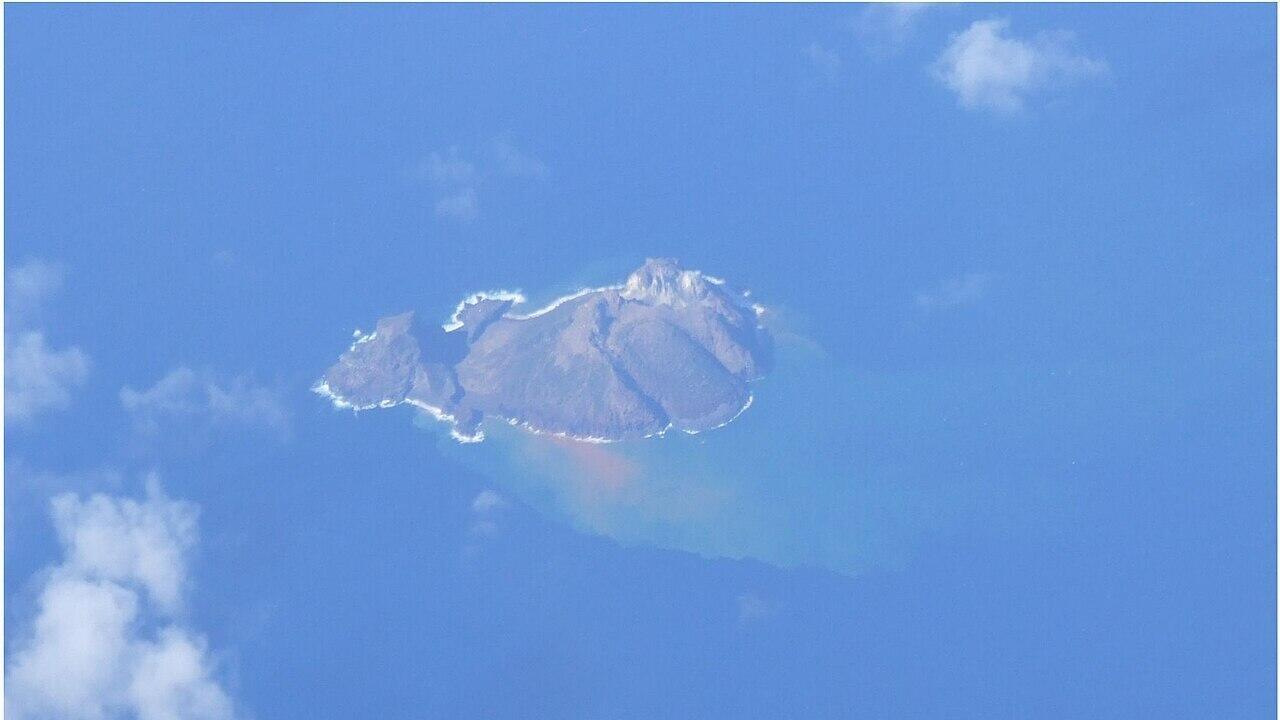
Vanuatu is challenging France on two legal fronts over Matthew and Hunter, two uninhabited volcanic islands near the French Pacific territory of New Caledonia. Both countries claim the islands, where people from what is now Vanuatu once travelled to fish and perform ceremonies. The latest challenge asks whether the islands can give France rights over roughly 350,000 square kilometres of ocean. Matthew is known in Vanuatu as Umaenupne and Hunter as Umaeneg or Leka. They lie roughly 280 kilometres south-east of Vanuatu and 445 kilometres east of Grande Terre, New Caledonia’s main island. Each island covers less than a square kilometre and is difficult to reach. “Even scientists rarely go there. You can get there by boat, but when French soldiers put up a plaque, they were flown in by helicopter,” Géraldine Giraudeau, a professor of international law at Paris-Saclay University who specialises in island territories, told RFI. In October, Vanuatu began arbitration under the United Nations Convention on the Law of the Sea, asking an international tribunal to decide whether the two islands are legally classed as rocks. That would limit the rights France could claim over the waters around them. Under the convention, rocks that cannot support people living there or sustain economic activity of their own do not constitute an exclusive economic zone – an area where a country has rights over fish and seabed resources. If the tribunal rules in Vanuatu’s favour, France could no longer base its claim to those rights on Matthew and Hunter. The arbitration also covers several reefs and atolls as well as Walpole Island, which is part of New Caledonia. Vanuatu’s announcement challenged France’s rights over the waters around Walpole and made no claim to the island itself. New Caledonia’s government has made Matthew and Hunter part of the Coral Sea Natural Park, one of the world’s largest marine protected areas. In Giraudeau’s view, there is a case for classing Matthew and Hunter as rocks under international law. “That point hasn’t come up in the negotiations because both countries have every interest in treating the islands as having an exclusive economic zone around them,” she said. France asserts sovereignty over disputed Pacific islands as Vanuatu turns to ICJ A court case on hold On 31 August, Vanuatu asked the International Court of Justice (ICJ), the United Nations’ highest court, to decide who owns Matthew and Hunter and where the maritime boundary between Vanuatu and New Caledonia should run. The court can hear the case only with France’s consent. Paris had yet to give it, Vanuatu’s deputy prime minister, Johnny Koanapo, told parliament earlier this month. However, Vanuatu was able to start the separate arbitration in October without French consent. France withdrew its general acceptance of the court’s authority in 1974 after opposition to its nuclear tests. It has since decided whether to accept the court’s authority case by case. France reaffirmed its claim to the islands in September at the Pacific Islands Forum, an annual summit of Pacific leaders, in Palau. Éléonore Caroit, France’s junior minister for the French-speaking world and international partnerships, said Paris would respond “in due course” to Vanuatu’s application, including on whether it would let the court hear the case. Caroit added that France was ready to “discuss, negotiate and try to find solutions without giving up sovereignty”. Giving it up had “never been on the table”. Hunter Island, east of New Caledonia, and south-east of Vanuatu, in the Pacific. Matthew and Hunter Islands are disputed between France and Vanuatu. © Befa34 via Wikimedia Commons Talks between France and Vanuatu had failed to resolve the dispute before Vanuatu went to court. Negotiations resumed after French President Emmanuel Macron visited Vanuatu in 2023 and continued after Vanuatu Prime Minister Jotham Napat visited Paris in July 2025. The two sides have yet to agree on a solution, such as managing the islands jointly. “France is one of the leading defenders of international law and of the rules-based international order,” Koanapo said in September. “Agreeing to take part in the proceedings before the ICJ will demonstrate its long-standing commitment to these principles.” But giving up territory, however far from mainland France, would be “an admission of weakness that could set a dangerous precedent”, Marine Le Pen and other lawmakers from the far-right National Rally have warned. China’s growing influence has also been cited as a factor in the dispute. France must change or 'risk losing' overseas territories, former PM tells RFI Two islands and a colonial legacy France and the United Kingdom jointly ruled the New Hebrides, now Vanuatu, until it gained independence in 1980. While neither Matthew nor Hunter has ever had permanent residents, “accounts indicate that in the past, people from the New Hebrides, especially from the south of the archipelago, often travelled there by canoe to fish”, Vanuatu legal scholar Morsen Mosses wrote in a 2019 research paper. The work also describes visits to perform ceremonies. In 1962, two pilots, Bob Paul and Henri Martinet, filed a claim to Matthew with the joint French-British court in Port Vila, now Vanuatu’s capital. France and the UK later agreed to make Matthew and Hunter part of New Caledonia. As Vanuatu approached independence, the future of other islands in the New Hebrides was also at stake. France tried “to separate a number of French-speaking islands before independence”, Mathias Chauchat, emeritus professor of public law at the University of New Caledonia, told RFI. That included efforts to create “liberation movements” on Santo in the north and Tanna in the south, two mainly French-speaking islands. In 1980, Vanuatu’s provisional government appealed for military support from Australia and Papua New Guinea, both of which recognised it. France then granted independence to the New Hebrides while keeping Matthew and Hunter. Vanuatu has claimed both islands ever since. ‘Survival’ at stake as Vanuatu uses ocean summit to press ICJ climate case 'Unfinished decolonisation' Local communities were never consulted about the future of Matthew and Hunter in the 1960s. A similar question arose in the Chagos Archipelago, in the Indian Ocean. The UK separated Chagos from Mauritius before Mauritius gained independence in 1968. In 2019, the ICJ concluded that Mauritius’s decolonisation had not been lawfully completed and that the UK should end its administration of Chagos as soon as possible. Joint management has also been proposed for Matthew and Hunter. New Caledonia’s government floated the idea of a “peace park”, modelled on a plan for Tromelin, an Indian Ocean island that France administers and Mauritius also claims. The plan would have put the island and its surrounding waters under joint management, but it was “never implemented because of regrettable parliamentary obstacles”, Giraudeau said. The Kanak and Socialist National Liberation Front, a pro-independence alliance in New Caledonia, has backed Vanuatu’s claim since 2009. In a declaration that year, the alliance pledged that an independent New Caledonia would respect Vanuatu’s position on the islands, including its claim based on local custom. Some in New Caledonia portray that as handing over part of the territory in return for Vanuatu’s support for decolonisation. The alliance’s position also has a basis in international law, Chauchat said. If France declines to let the ICJ hear the case, Vanuatu could ask the UN General Assembly to request an advisory opinion from the court – a route it has used before. In July last year, an opinion sought by Vanuatu set out countries’ legal duties to tackle climate change and said they could owe compensation if a breach of those duties caused harm. For Matthew and Hunter, the question goes back to what happened when Vanuatu gained independence in 1980, Chauchat said. “These two islets are of no great importance, but behind them lies our unfinished decolonisation.” This story was adapted from the original version in French by Igor Gauquelin.
Why France and Vanuatu are fighting over two uninhabited volcanic islands
Full Article
Original Source
Read the full article at Rfi →KhanList aggregates and links to publicly available news content. We do not host full articles from third-party sources. Always verify important information with original sources.