
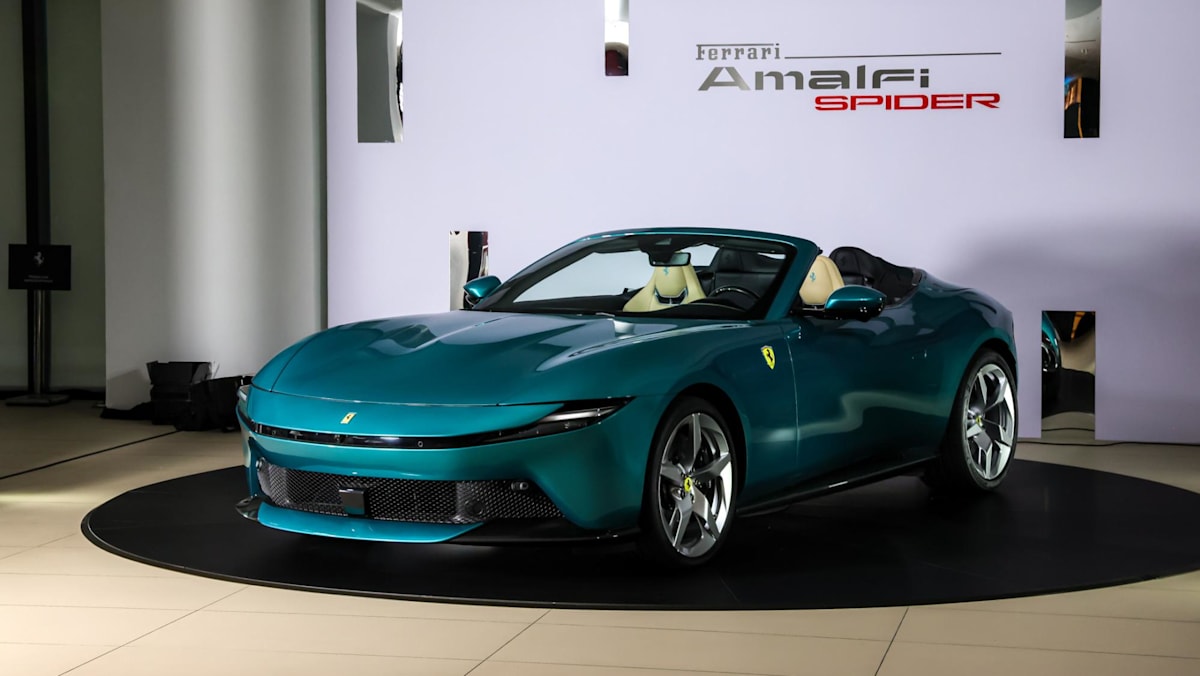
Obsessions Traffic, tropical weather and high ownership costs make this a demanding region for convertibles. Ferrari’s latest Spider has been engineered with those everyday realities in mind. The Ferrari Amalfi Spider pairs open-top performance with a greater emphasis on comfort and everyday usability. (Photo: Ferrari) New: You can now listen to articles. This audio is generated by an AI tool. Ferrari ownership in Southeast Asia has long been read through speed: Track pedigree, engine note, the theatre of arrival. But that vocabulary is shifting as a younger, more style-conscious clientele looks for cars that deliver the drama of Maranello alongside the refinement needed for daily life.Ferrari has placed Southeast Asia and India under a newly structured regional territory, giving some of the world's most dynamic luxury markets closer strategic focus. The logic is straightforward: High-net-worth buyers here may be fluent in global luxury, but they are also pragmatic about traffic, heat, taxes and daily usability.Singapore and Malaysia remain complex markets because of ownership costs, said Charles-Antoine Geneste, Ferrari’s head of Southeast Asia, while Thailand continues to show an appetite for innovation through its local representation. Demand for luxury performance cars remains resilient across the region, he added. The challenge now is to make Ferrari feel relevant beyond the weekend drive.That ambition sits within what Geneste calls the marque’s “two souls” philosophy: Performance on one side, the pleasure of living with the car on the other. In Southeast Asia, where weather, density and lifestyle patterns complicate open-top motoring, that balance matters as much as outright theatre. Charles-Antoine Geneste, Ferrari’s head of Southeast Asia. (Photo: Ferrari) At its regional launch in Kuala Lumpur, the Amalfi Spider was presented as Ferrari's answer to that brief. Designed by the Ferrari Design Studio, it takes the 2+ spider architecture and pairs it with a fabric soft top engineered to preserve the proportions and formal purity of the coupe it is based on. The silhouette is elegant, fluid, and instantly recognisable, roof up or down.Convertibles have traditionally had to work harder in tropical markets, where drivers often favour the insulation of a fixed roof. The Spider counters this with a five-layer fabric roof designed to reduce wind and road noise. It lowers in 13.5 seconds at speeds of up to 60 km/h, while structural reinforcements help maintain the car’s rigidity.The Spider offers 255 litres of luggage space with the roof closed and 172 litres with it open – useful for everyday driving as well as a weekend away.A driver-activated wind deflector adds to the Spider’s everyday usability. Integrated into the rear backrest, it deploys at a 101-degree angle to reduce turbulence in the cabin when the roof is down, allowing the driver and passenger to converse at normal driving speeds. Ferrari is positioning the Spider for expressways, city streets, humidity and sudden rain rather than reserving it for rare fair-weather drives. Inside, the Amalfi Spider uses a “pure two-cockpit” layout to give driver and passenger distinct spaces while keeping them visually connected. (Photo: Ferrari) The cabin takes a clean, contemporary approach, with a restrained design that draws attention to its materials, surfaces and geometry. Ferrari brings the instrument cluster and air vents together in a monolithic cockpit shared visually between driver and passenger. The central tunnel becomes a suspended aluminium bridge housing the main controls, with secondary functions positioned farther back for better ergonomics. A sculptural sail motif on the door panels integrates the handles and armrests.The engineering remains unmistakably Ferrari. Beneath the sculpted bodywork sits a 640-horsepower twin-turbo 3.9-litre V8, paired with an eight-speed F1 dual-clutch gearbox. The car reaches 100 km/h from rest in 3.3 seconds. Comfort and Wet modes are calibrated for everyday driving, while Sport and Race modes retain the sharper responses expected of a Ferrari.Ferrari's familiar precision carries through the chassis. Vehicle dynamics are governed by a 6D sensor and Side Slip Control 6.1, while brake-by-wire technology and ABS Evo manage braking force across different surfaces. The car stops from 100 km/h in about 30 metres, riding on custom-developed 20-inch tyres supplied by Pirelli, Goodyear, or Bridgestone.That breadth gives the Amalfi Spider a more nuanced role in the garage, Geneste said. For collectors who already own harder-edged Ferraris, it offers a gentler way to enjoy the brand. For newer buyers, it provides a point of entry that does not force a choice between performance and refinement. The engineering remains unmistakably Ferrari – a 640-horsepower twin-turbo 3.9-litre V8 sits at the heart of the Amalfi Spider. (Photo: Ferrari) Inside, the "pure two-cockpit" layout separates driver and passenger into distinct zones while keeping them visually connected through a horizontal central screen. Physical controls return to the steering wheel, along with the signature red engine-start button, giving the cabin a tactile link to Ferrari's lineage.Personalisation remains central to the proposition. Through Ferrari's Tailored Experience programme, buyers can specify roof fabrics, weaves and interior material combinations. Maranello is also introducing "Rosso Tramonto," a deep red with warm orange undertones inspired by dusk on the Amalfi Coast, alongside technical roof fabrics such as "Tecnico Ottanio." Physical controls return to the steering wheel in the Ferrari Amalfi Spider, giving the cabin a tactile link to the marque’s lineage. (Photo: Ferrari) For the first time, the technical fabric can extend over the tonneau cover and interior panels, creating material continuity when the roof is stowed. In a market where discretion and distinction often sit side by side, that level of choice is part of the appeal.The wider strategy is deliberately flexible. Ferrari continues to develop internal combustion, hybrid, and fully electric platforms in parallel, giving it room to respond to regulation, infrastructure and buyer sentiment across different markets. In Singapore, where final pricing will depend heavily on local tax structures, the Amalfi Spider is likely to be judged less on accessibility than on whether it makes Ferrari feel more usable, considered, and attuned to the region's evolving idea of luxury. The Spider is expected to arrive by the end of the year. Recent Searches Trending Topics
Why Ferrari thinks the Amalfi Spider can work in Southeast Asia
Full Article
Original Source
Read the full article at Cnaluxury →KhanList aggregates and links to publicly available news content. We do not host full articles from third-party sources. Always verify important information with original sources.