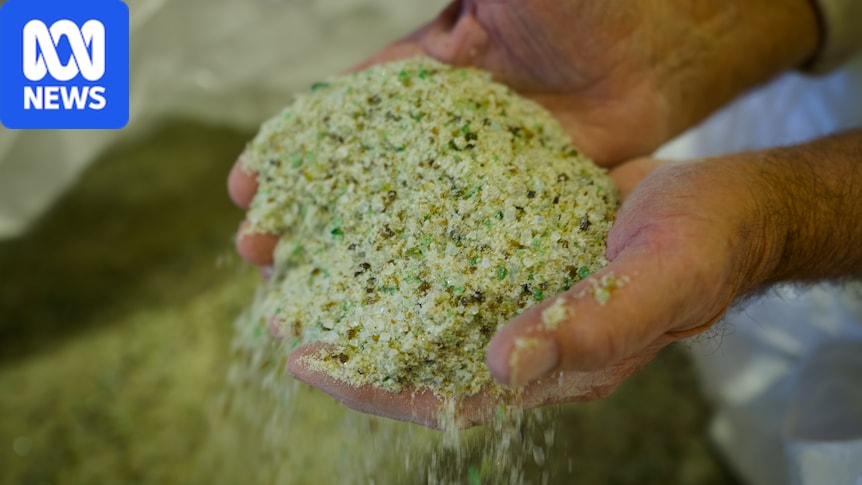
A growing number of Australian farmers are spraying or spreading pulverised glass on their paddocks to boost the productivity of their soils, plants and livestock.Victorian agronomist Peter Norwood has been recommending the Queensland-made organic product to clients for several years."There could be as much as 25 or 30 per cent improvements in plant growth and plant productivity," Mr Norwood said."We've got the potential for greater milk production, and in beef and sheep, we've got potential for greater daily body weight gain."This is a bit of a game changer."Ceramic balls are used to grind recycled glass into fine agricultural-grade particles. (ABC Landline: Cameron Lang)It is a win for the environment as the source material is glass bottles from Queensland recycler Containers for Change which pays people 10 cents for their glass empties.Turning waste glass into farming goldThe pulverised glass is turned into an agricultural product at a new $4 million factory in Brisbane co-owned by agronomist David Archer and a group of investors.A 60 tonne ceramic lined cylindrical tumbler filled with 35 tonnes of fist sized ceramic balls breaks the glass down into a variety of sizes which are applied to crops and pastures.Agronomist David Archer said he discovered the benefits of silicon by accident during plant trials. (ABC Landline: Cameron Lang)Some farmers mix the talc-like powder with water and spray it on their plants, while others prefer spreading dry granules.Mr Archer discovered the benefits accidentally, after doing some plant trials."Like most great ideas it was by accident, we were fiddling around with some glass material many moons ago, threw some in, and it was like Jack and the Beanstalk," he said.Mr Archer explained improvements in plant yields, soil health and animal weight gains are due to silicon, a chemical component of glass.Discarded glass bottles are the raw material used to produce the final silicon product. (ABC News: Che Chorley)"Silicon protects a plant against pests and disease and drought by stimulating its natural defences, its immune system if you like," he said.It is a bonus for the bottom line too, as the farmers using it do not need to apply as much fertiliser.That is because silicon unlocks elements in the soil that are 'locked up', and unavailable to plants."In the soil a good quality silicon will attract iron, so what happens is the iron will move away from the phosphate, releasing it so the roots can get at it," Mr Archer explained.How silicon helps unlock nutrients in the soilMr Norwood said seeing farmers getting access to fertiliser they have paid for which is sitting unused in their soils is exciting."Silicon is king, it releases the phosphates back to the plants and encourages all the nitrogen fixing bacteria in the soil," Mr Norwood said.Agronomist Peter Norwood (left) with client Tony Donovan, who has trialled silicon on the dairy and beef operations he manages. (ABC Landline: Kyle Harley)"We've got an opportunity to create some free nitrogen for the plants too, so there's a few wins all in one package there."The Brisbane factory trucks out 20 tonnes of ground glass, powder and granules a week to farmers growing apples, wine grapes, grain, cane, dairy and beef around the country.One of Peter Norwood's clients, Warrnambool farm manager Tony Donovan sprayed silicon on a third of the 14,000 hectares he manages for Midfield Meats' dairy and beef operations.Partially processed recycled glass on its way to be broken down to a talc-like powder or fine granules. (ABC Landline: Cameron Lang)"Ten years ago if you'd talked to me about silicon I would have said, 'what's that?'" he laughed."It's quite amazing to think the research has been done on it now for some 70, 80, 90 years and the benefits have been shown, yet it hasn't been incorporated into our standard agronomy."Weight gains surprise beef producersHe said the performance of his beef cattle over winter surprised everyone."We've taken winter weight gains from 0.7, 0.8 a day to 1.4, and up to 2 kilos a day, they're big percentages and grass growth, I've got to say we're measuring in the same way."Dairy cows on a Midfield Meats property where silicon has been trialled to improve pasture productivity and livestock performance. (Supplied)When the Iran war slowed international shipping earlier this year imported fertiliser supplies in Australia slowed and prices soared.That vulnerability has made the search for home-grown alternatives a financial imperative.Mr Donovan said adding silicon is one of several management changes he has made to reduce reliance on imported urea (nitrogen fertiliser).He said silicon will play a bigger role in coming years.The Brisbane facility processes glass collected through Queensland's Containers for Change scheme. (Getty Images)"We're getting bold enough now to step out and say, 'hey we're going to have a real proper go with all of this because we're getting the difference that we are looking for.'"Mr Donovan said he does not need to feel too guilty about drinking wine."That empty bottle of wine you can look at it and say 'you good thing go on and contribute to the health of the land and the future of the planet.'"Watch ABC TV's Landline at 12:30pm AEST on Sunday or stream anytime on ABC iview.
Why farmers are spreading crushed glass on their crops
Full Article
Original Source
Read the full article at Abc →KhanList aggregates and links to publicly available news content. We do not host full articles from third-party sources. Always verify important information with original sources.