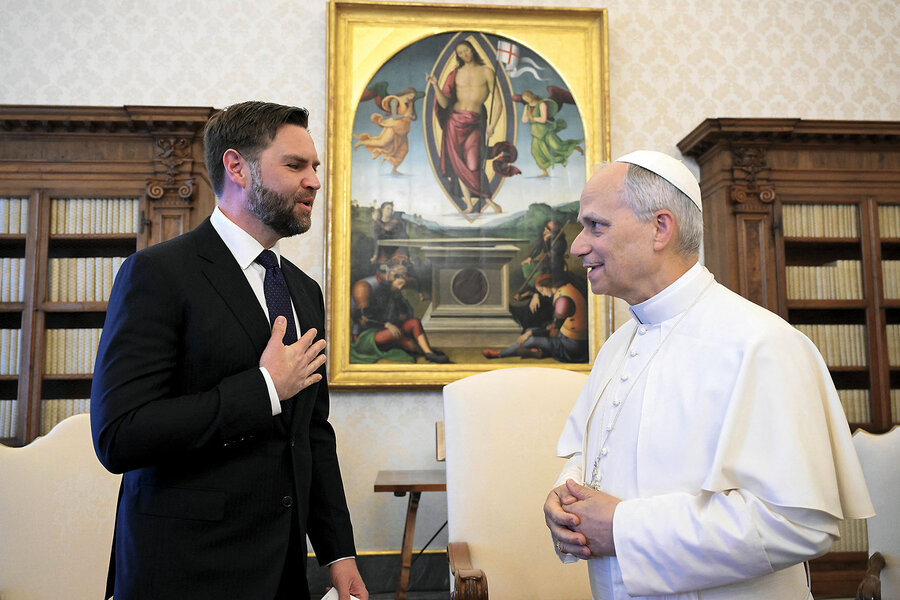
Writing a book has long been a rite of passage for those planning a run for the White House. Barack Obama, Hillary Clinton, and George W. Bush all expanded on their stump speeches to talk about their lives, introducing themselves and their ideas before they took to the campaign trail.Ahead of the midterm elections, a theme has emerged in this genre. Many in the current crop of books by politicians emphasize faith.Candidates today “are operating in a political environment that in some sense has come to demand this,” says Ellen Fitzpatrick, professor emerita of history at the University of New Hampshire. “The books are responding to the dynamics in current American politics and the way that religion has entered into the public sphere in a way that, in 1960, many voters were adamant to have it demonstrated that it would not be.” Why We Wrote This Americans increasingly want to know the details of political candidates’ faith. Politicians seem eager to share. Recent political memoirs by JD Vance, Andy Beshear, Sarah Huckabee Sanders, and Raphael Warnock focus on God, morality, and religion. That reflects a shift in public expectations. In the past, she says, voters wanted assurance that candidates would not allow their religion to influence their politics. For example, John F. Kennedy, the first Roman Catholic president, declared his commitment to the separation of church and state to allay concerns about Vatican interference.But now “religion in the arena of politics ... has attached itself to certain issues like reproductive rights, the whole question of gender roles, gay marriage,” Professor Fitzpatrick says, adding that “these foundational issues that once belonged in the realm of private life and now have become public issues.” Josh Shapiro’s hand rests atop Hebrew Bibles during his swearing-in as governor of Pennsylvania in 2023. Authors now write about faith not just as inspiration, but also as a framework for their moral beliefs and policy decisions.Democratic Kentucky Gov. Andy Beshear is publishing a book in September about how his Christianity informs his approach to government and policy in “Go and Do Likewise: How We Heal a Broken Country.” Also in the fall, Republican Arkansas Gov. Sarah Huckabee Sanders weaves her Evangelical beliefs throughout her views of leadership in “Unapologetic: Clarity and Conviction in a World Gone Crazy.”Georgia Sen. Raphael Warnock, a Democrat and a Baptist pastor, uses the book of Isaiah in the Bible to present his approach to issues such as voting rights, gun violence, and mass incarceration in “The Crooked Places Made Straight: Reflections on the Moral Meaning of America.” (See accompanying article on page 39.) And Pennsylvania Gov. Josh Shapiro, a Jewish Democrat whose home was firebombed during Passover in 2025, wrote a memoir centered around his faith: “Where We Keep the Light: Stories From a Life of Service.”In June, Vice President JD Vance published his second book, chronicling his Evangelical upbringing, drift from faith, and eventual conversion to Catholicism in 2019. “Communion: Finding My Way Back to Faith” begins with a brief picture of Mr. Vance’s childhood in Ohio (featured in his first memoir, “Hillbilly Elegy”), where he was raised mainly by his grandparents. In the current book, he reflects on conversations about God and Jesus he had with his grandmother, who didn’t regularly attend church, and with his father, with whom he attended church weekly. Mr. Vance describes religion as a tether for him, something that he rediscovered later in adulthood. "Communion: Finding My Way Back to Faith," by JD Vance, Harper, 304 pp. “If I could go back and give advice to that younger version of myself, it would be to resist that supposedly unavoidable drift into unbelief,” he writes in a chapter titled “Semper Why,” in which he recounts his early days serving in the U.S. Marines – a time when he first questioned his faith.Americans say they want virtuous leadersAs both parties face reckonings over religion, some political leaders are stepping into the foreground of public conversations about faith. A number of faith leaders are running for Congress as Democrats: most prominently James Talarico, a Texas state representative and Presbyterian seminarian who won the Democratic primary for the U.S. Senate in March. In Iowa, two pastors, Sarah Trone Garriott and Lindsay James, secured Democratic nominations for the U.S. House.While Americans’ religiosity has been dropping for decades, the majority – over 75% – of the country still claims a religious identity. About 62% are Christian. And although Americans are attending church less frequently, there’s still a high degree of concern over morality and decency in the country – two qualities many people associate with organized religion.According to the Pew Research Center, 53% of U.S. adults say the population has bad morals and ethics. And 80% say that moral values are declining, according to Gallup. While 69% of adults say they believe government policies affect people’s moral values, a smaller share – 45% – says the government should be involved in promoting moral values.This moment may have a parallel in 2000, when George W. Bush ran as the candidate who would restore morality to the White House following the scandal of Bill Clinton’s affair, says David Campbell, professor of American democracy at the University of Notre Dame. Arkansas Gov. Sarah Huckabee Sanders attends the World Economic Forum in Davos, Switzerland, in 2025. “Things that were once thought to be disqualifying are no longer, but that still doesn’t dismiss the idea that at least when you’re running for president ... there is still a need to demonstrate that you are somewhat virtuous,” he says.While past books by presidential hopefuls may have avoided or elided controversial religious topics, recent memoirs deal with issues more directly.“In our political theater, it’s kind of a necessary calling card,” says Daniel Paisner, an author of more than 80 books, including one in collaboration with former Ohio Gov. John Kasich. “In publishing now – in memoir – brutal honesty is the order of the day,” he says.No bad publicity“[Candidates] are looking at these books as an extended campaign performance,” says Mr. Paisner, adding that, in today’s media environment, candidates are scrambling to present themselves in different formats, from books to speeches to social media.“Candidates can’t be everywhere all at once, but their books can be,” he says.Campaign books used to carry more weight than they do today, says Professor Fitzpatrick, from the University of New Hampshire. Some books stand out as more memorable, she says, including Mr. Obama’s “The Audacity of Hope” and Mrs. Clinton’s “Hard Choices.” Both books “had a particular place in anticipating the campaigns that would follow them.”In a party led by President Donald Trump, Mr. Vance is the heir apparent. In “Communion,” Mr. Vance speaks mostly about his life pre-vice presidency, stating his values and vision for the future. And by framing his book around his own faith, he differentiates himself from Mr. Trump, and emphasizes one of the strengths that Republicans say Mr. Vance brought to the ticket in 2024.Throughout his book, Mr. Vance underscores his belief that America, and particularly the Republican Party, was built on Christianity. And he maps the Christian theology and thinkers that he credits with shaping his own sense of morality.Mr. Vance’s wife, Usha, doesn’t share his Catholic faith but is a practicing Hindu. The Vances’ three children often attend Catholic services. (The Vances welcomed their fourth child in July.)Mr. Vance ends “Communion” with a thanks to Ms. Vance, partly crediting her for his return to Christianity: “There is at least a little irony in the fact that my non-Christian wife helped lead me back to my own Christian faith,” he writes.A way of relating to a candidateThe particular faith of a candidate may be less important to voters than it once was. Americans are growing less religious, but most grew up in a religious environment, and a majority of Americans still claim faith, says Professor Campbell, so religious language feels natural to them and creates a way to relate to the candidate.Professor Fitzgerald agrees. “The moral language of politics resonates with a lot of people,” she says. “[Voters] are looking to return to what they see as traditional values.”
Why faith matters in today’s political memoirs
Full Article
Original Source
Read the full article at Csmonitor →KhanList aggregates and links to publicly available news content. We do not host full articles from third-party sources. Always verify important information with original sources.