
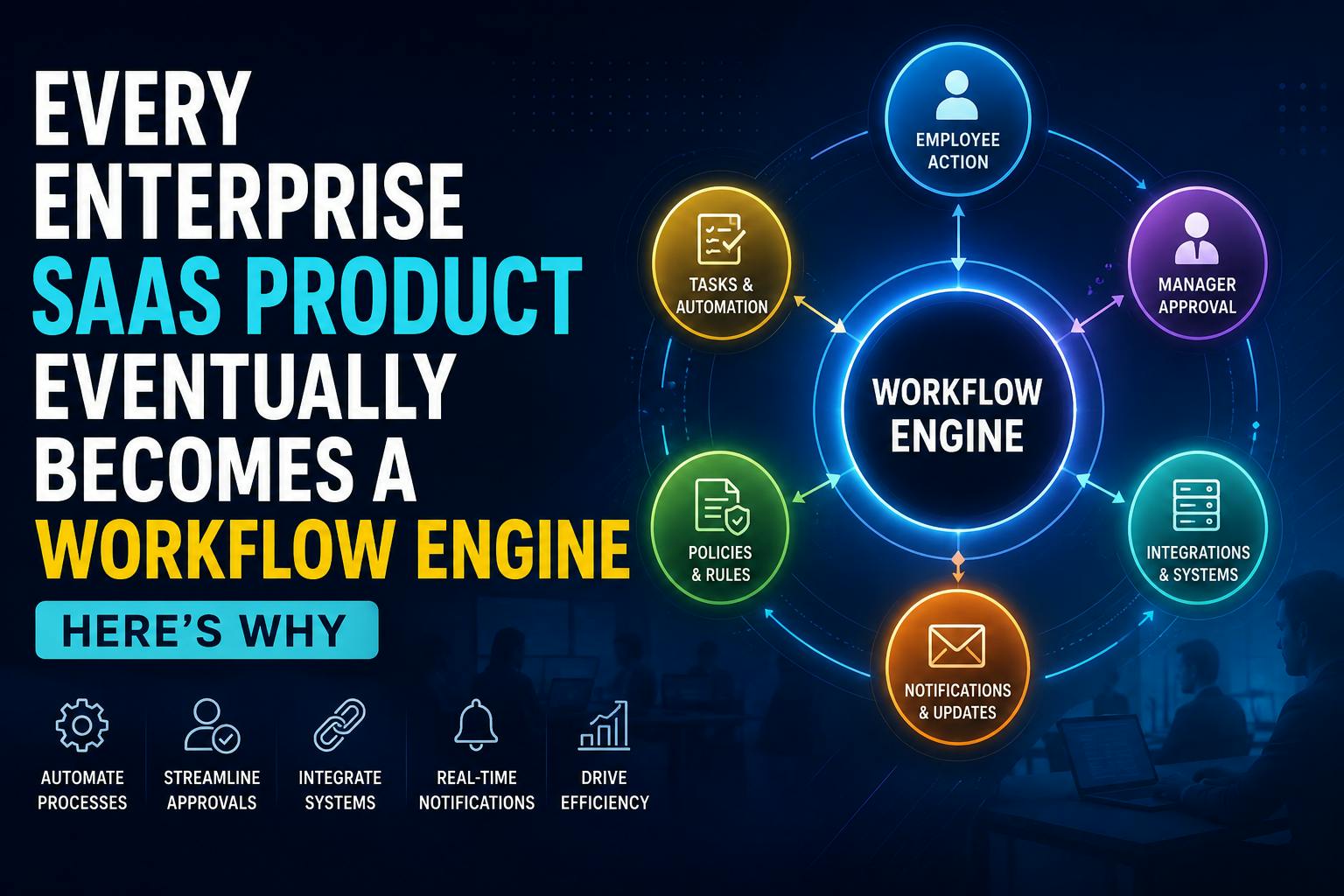
When I started researching enterprise HR platforms for my company, I expected to spend most of my time comparing feature lists. Which platform had better reporting? Which one offered more integrations? Which one had AI capabilities? The deeper I went, the less those questions seemed to matter. What stood out wasn't the number of features a platform offered. It was something much more fundamental. The best enterprise platforms weren't simply adding capabilities. They were becoming exceptionally good at orchestrating how work moved through an organisation. That observation led me to a simple idea I now think applies far beyond HR software. Every successful enterprise SaaS product eventually becomes a workflow engine. The Workflow Gravity Principle While researching enterprise SaaS, I kept noticing the same pattern across different products and industries. It eventually led me to a simple idea that I now think of as the Workflow Gravity Principle. The principle is straightforward: every SaaS product begins by solving a single business problem. However, as customers grow, their needs become more interconnected. What starts as an isolated task gradually becomes part of a larger business process involving multiple departments, approvals, systems and policies. Over time, the software is naturally pulled towards managing workflows instead of individual tasks. You can see this evolution across almost every category of enterprise software. A CRM no longer just manages customer information; it coordinates approvals, sales pipelines and customer success activities. An HR platform extends beyond employee records to orchestrate onboarding, leave management and performance reviews. Finance applications connect procurement, compliance and payment processes, while customer service platforms bring together support teams, knowledge bases and automated responses to deliver a consistent customer experience. Although these products may appear similar on the surface, what powers them behind the scenes has changed significantly. They're no longer just collections of features. They're becoming intelligent workflow engines that connect people, processes and systems, ensuring work moves forward with less manual effort and greater consistency. To me, that's one of the defining characteristics of modern enterprise SaaS. The real innovation isn't adding another feature. It's designing software that helps organisations work together more effectively. Features Solve Tasks. Workflows Solve Business Problems. There's an important distinction between building features and building workflows. A feature completes one activity. A workflow connects multiple people, systems and decisions into one continuous process. That difference becomes obvious in enterprise environments. No two organisations operate in exactly the same way. One company may require a single approval for annual leave. Another might require approvals from the reporting manager, HR and Finance depending on location, business unit or employee grade. What initially appears to be a simple leave request quickly becomes a coordinated business process involving permissions, compliance rules, notifications and integrations. The challenge is no longer building another feature. The challenge is designing software that adapts to how different organisations actually work. Behind Every "Simple" Click One of the biggest misconceptions about enterprise software is that its complexity comes from the user interface. The truth is that most of the complexity exists behind the scenes, where users never see it. Imagine a company with 5,000 employees operating across multiple countries. A new marketing employee joins the Singapore office, and from their perspective, the onboarding process feels refreshingly simple. They complete a few forms, upload the required documents and wait for their first day. What they don't see is everything happening in the background. The HR platform creates their employee profile, IT provisions email and application access, payroll receives salary information, security initiates building access, the reporting manager receives onboarding tasks, compliance teams begin document verification and equipment requests are automatically routed to the right department. To the employee, it feels like a single process. In reality, it's dozens of interconnected workflows executing simultaneously across multiple teams and systems. This is where enterprise software becomes truly powerful. The value isn't in displaying another screen or adding another feature. It's in quietly coordinating complex business operations without requiring employees to think about what's happening behind the scenes. That's no longer just an HR feature. It's enterprise workflow orchestration in action. Why Workflow Automation Matters Automation is often described as a way to save time, but I think that's only part of the story. Its real value lies in removing friction from everyday work. Think about how many business processes still rely on employees sending reminder emails, following up on approvals or manually updating multiple systems. These small tasks may seem insignificant on their own, but together they consume hours of productive time every week. When workflows are designed intelligently, those repetitive interactions begin to disappear. Employees no longer need to chase approvals, managers gain real-time visibility into pending requests, HR teams spend less time on repetitive administration and leadership can trust that business processes are being followed consistently across the organisation. The biggest benefit isn't simply that work gets done faster. It's that people spend less time managing the process and more time focusing on work that actually creates value. That's why I see workflow automation as more than an efficiency tool. It's a competitive advantage that improves productivity, strengthens governance and creates a better experience for everyone involved. The Workflow Maturity Journey While researching enterprise SaaS, I found it useful to think about workflow maturity in five stages. Level 1: Manual Work Business processes depend on emails, spreadsheets and paper approvals. Level 2: Digital Processes Organisations replace paper with software, but departments still operate independently. Level 3: Automated Tasks Routine notifications, reminders and approvals begin happening automatically. Level 4: Connected Workflows Business systems work together. HR, Finance, IT and Operations become part of one connected process rather than isolated applications. Level 5: Intelligent Operations AI, analytics and automation continuously improve workflows, helping organisations identify bottlenecks before they become business problems. Many organisations believe they've completed digital transformation once they digitise forms. Personally, I think transformation really begins when technology connects work instead of simply recording it. Customers Aren't Asking for More Features One thing I've noticed repeatedly is that enterprise customers rarely ask for another standalone feature. Instead, they ask for flexibility. Can approvals change automatically? Can the platform integrate with existing systems? Can different business units have different workflows? Can repetitive tasks happen without manual intervention? These aren't requests for more software. They're requests for software that adapts to the organisation instead of forcing the organisation to adapt to the software. Research from organisations such as Gartner, Deloitte and Microsoft's Work Trend Index consistently points in a similar direction. Digital transformation delivers the greatest value when technology removes friction, improves collaboration and simplifies how work flows across teams. A Broader Shift Across Enterprise Software This shift isn't limited to HR technology. It's happening across almost every category of enterprise software. Finance platforms are evolving beyond accounting. Customer service platforms are moving beyond ticket management. Procurement solutions are doing much more than managing purchase requests. Across industries, enterprise applications are gradually transforming into systems that connect people, processes and decisions through intelligent workflows. While researching enterprise HR technology, I noticed the same pattern in many platforms. Beyond managing employee information, the platform places significant emphasis on connecting approvals, notifications and day-to-day HR processes through configurable workflows. Rather than seeing this as a feature unique to one solution, I see it as part of a much broader evolution taking place across enterprise SaaS. To me, that's the bigger story. The future of enterprise software isn't about building more features or larger platforms. It's about creating systems that simplify work by intelligently coordinating everything happening behind the scenes. Final Thoughts For years, enterprise software companies competed by adding more features. Every new release promised another dashboard, another integration or another capability that would supposedly give organisations an edge. While innovation will always matter, I believe the next generation of enterprise SaaS will be judged by a different standard. The platforms that stand out won't necessarily be the ones with the longest feature lists. They'll be the ones that remove the most friction from everyday work. When approvals happen automatically, information reaches the right people at the right time and teams no longer have to chase emails or manually coordinate routine tasks, technology fades into the background. Employees stop thinking about the software because it simply works. That's what makes workflow orchestration so powerful. It shifts the conversation away from adding more functionality and towards creating better experiences for the people who rely on these systems every day. If there's one lesson I've taken away from researching enterprise SaaS, it's this: the future doesn't belong to software that simply stores information. It belongs to software that connects people, processes and decisions in ways that make work feel almost effortless. Perhaps the greatest achievement of enterprise software isn't becoming bigger or more sophisticated. It's becoming almost invisible, quietly enabling organisations to focus less on managing processes and more on creating value.
Why Every Enterprise SaaS Platform Is Becoming a Workflow Engine
Full Article
Original Source
Read the full article at Hackernoon →KhanList aggregates and links to publicly available news content. We do not host full articles from third-party sources. Always verify important information with original sources.