
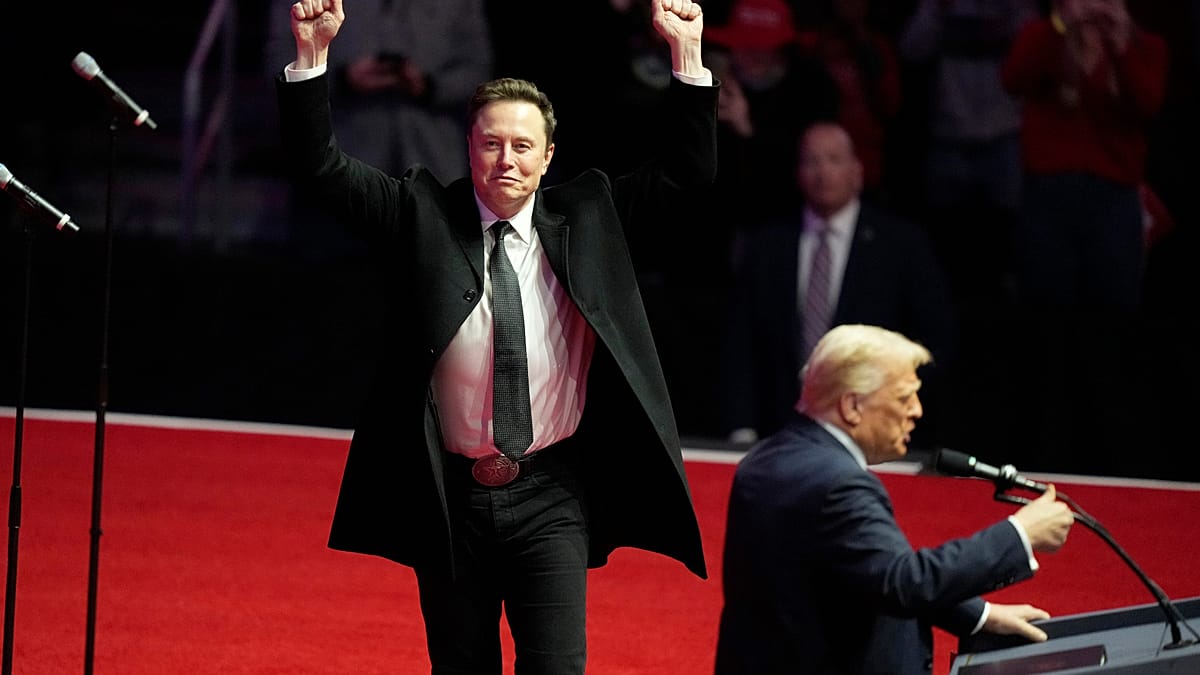
The world's richest man confirmed this week that Tesla and SpaceX are exploring a merger. Together, the companies are worth about $3.5 trillion (€3.1tn), making it potentially the biggest merger ever. ADVERTISEMENT ADVERTISEMENT It would cap a string of deals tying Elon Musk's businesses together, and the goal is to complete it while Donald Trump is still the US president, according to Bloomberg, citing people familiar with the matter. A merger between Tesla and SpaceX would be the latest chapter in a story that began a decade ago, when Musk started stitching his companies together. In 2016, Tesla bought SolarCity, a solar panel installer run by his cousins, a deal that was only upheld by a Delaware court after years of litigation. In March 2025, his AI start-up xAI swallowed X, the social network formerly known as Twitter, which Musk acquired for $44 billion (€39.1bn) in 2022. In February this year, SpaceX absorbed xAI, in a deal that valued the rocket maker at $1 trillion (€890bn) and the AI firm at $250 billion (€222bn), ahead of SpaceX's initial public offering (IPO). Four months later, SpaceX listed on the Nasdaq, raising $85.7 billion (€76.3bn) in the biggest stock market debut in history. Seen together, the deals look like part of a long-running plan to fold Musk's businesses into one publicly traded group. Musk himself spoke of "more and more overlap" between Tesla and SpaceX on an earnings call in July. On Tuesday, Musk told analysts on SpaceX's earnings call that both companies had set up committees of independent board members to study a merger. He called it "a good idea", while admitting he felt he was "tap dancing through a minefield". Why one company Musk argues that AI will decide where both companies go next. They are already jointly developing Terafab, an AI chip factory in Texas, while Tesla's driverless cars and Optimus humanoid robots could benefit from the computing power SpaceX is racing to build, including planned data centres in orbit. The numbers also fit. SpaceX posted its first quarterly profit since listing, earning $4.4 billion (€3.9bn) as revenue jumped 161%, but its capital spending reached $19.6 billion (€17.4bn) in the quarter, mostly on AI. By contrast, a day later, Tesla reported that its net profit fell 43% to $787 million (€700mn) on flat revenue of $28 billion (€24.9bn), as deliveries slipped 2%. In a combined company, SpaceX's surging revenue could help offset Tesla's figures. Merging the businesses would also allow Musk to run all their operations under one roof, moving engineers and resources between the companies without disclosures or lawsuits over related-party deals. Control is another potential benefit. Musk owns about 48% of SpaceX and holds more than 80% of its votes through special shares, but only about 20% of Tesla. Since 2024, Musk has said he is uncomfortable turning Tesla into an AI and robotics leader without at least 25% of the votes. A merger could also make him richer, as his Tesla pay package treats many of its performance goals as achieved if certain types of mergers go through. Racing the political clock Reportedly, the aim is to announce a merger deal in the first half of 2027 and complete it before US President Donald Trump's term ends in January 2029, according to Bloomberg, citing people familiar with the matter. Completing the deal while Trump is in office could give it a friendlier political reception, although it would still face regulatory and shareholder scrutiny. Musk, who led Trump's cost-cutting drive in 2025 before a public falling-out, has since made up with the US president and returned to the administration. He has also become the biggest known donor supporting Republican candidates in next month's US midterm elections, giving more than $276 million (€245mn) since July, according to a spokesperson for America PAC, Musk's conservative super PAC. A Democratic win could bring tougher scrutiny of SpaceX's federal contracts and Tesla's self-driving software. SpaceX itself warned in its listing documents that a shift in power in Congress could have a "material and adverse impact on our growth and competitive position". The committees have yet to agree on terms, and any deal would need the backing of more than half of all Tesla shares, which Musk called "quite a high hurdle". He cautioned that a merger was not certain. Tesla shareholders meet on 3 December.
Why Elon Musk wants to merge Tesla and SpaceX before Trump leaves office
Full Article
Original Source
Read the full article at Euronews →KhanList aggregates and links to publicly available news content. We do not host full articles from third-party sources. Always verify important information with original sources.