
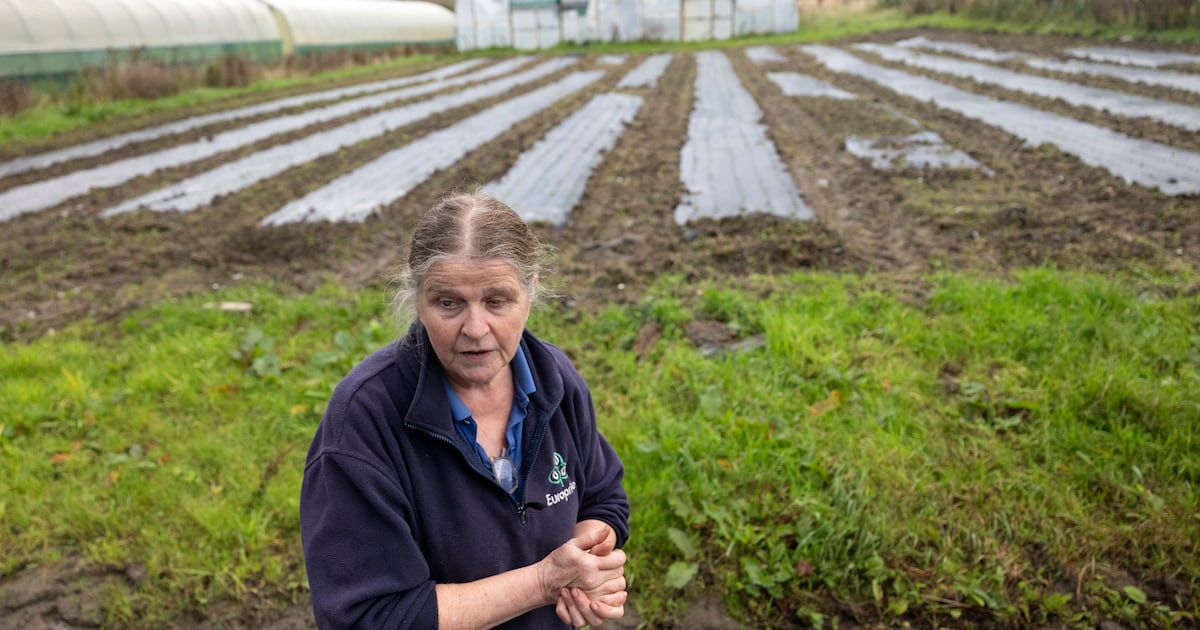
“Nobody wants to work,” Jenny McNally laughs when asked what might turn someone away from a career in vegetable growing. “It’s hard labour; your bones ache. There’s nothing easy about horticultural farming.”Since 1997, she and her husband Patrick have operated an organic, family farm in north Co Dublin, selling their produce directly at markets and from a shop on-site. On the couple’s 99 acres, they cultivate a wide variety of vegetables, salad and some fruit. At one point during the 1990s, there were more than 600 commercial vegetable growers in Ireland. Today, there are fewer than 70. READ MOREA recent report by the Climate Change Advisory Council noted that an estimated 83 per cent of fruit and vegetables consumed in the Republic are imported from overseas. “When you hear about another veg producer going out of business, sometimes it’s because there’s nobody there following behind,” McNally says. “There are no children, or the farmer’s children are not interested. They’ve seen mum and dad work so hard all their life and why should they do it?”Fortunately, three of the five McNally children are part of the family business. If it weren’t for their involvement, “Pat and myself would be growing a tunnel of salads or something and that would be it,” McNally says.Before 1997, they had been conventional farmers, raising livestock and growing barley and oats as well as vegetables.People like us, we had moved into growing courgettes and beans and mangetout— Jenny McNallyFrom a commercial point of view, McNally says that there was no security around veg in the open market. You were “always on a wing and a prayer”, and never guaranteed a sale.That culture made life difficult for smaller farms, and it was compounded by a growing need for expensive equipment and machinery. McNally says that over time, a lot of sellers were pushed out. It suited supermarkets to work with larger, specialised operations focusing on large-scale production of individual vegetables.“People like us, we had moved into growing courgettes and beans and mangetout,” McNally says. “We were told if you don’t have a refrigerated van and a cold store, you’re not up to our expectations and our levels, so that was that. At the time, we had five small children and there was no way we could afford to even think of anything like that.”The solution was a stall at Temple Bar Food Market where they could sell “wonky courgettes”, beans that weren’t topped and tailed, and “cabbages that weren’t all exactly the same size”. It turned out a market for this sort of food existed. Niamh McNally and Jenny McNally at McNally Family Farm shop, growers of seasonal organic vegetables and salads, in Balrickard, Co Dublin. Photograph: Chris Maddaloni/The Irish Times McNally Family Farm veg can be bought at three markets today. Queues often form before they have had a chance to lay out their produce. They have built up relationships with their customers over three decades, many of whom have grown to appreciate the journey from farm to fork, are understanding of seasonal setbacks that impact the size or volume of what’s being sold. This summer of 2026 – Ireland’s hottest on record – was difficult for vegetable producers. A recent report carried out by Teagasc, the national agriculture and food development authority, found that in 2026, there were yield and quality losses of 25 to 40 per cent on unirrigated vegetable crops.Irrigated fields were protected, albeit at a price. For some crops, growers spent more than €2,700 per hectare on water alone, before equipment and infrastructure costs. Only 30 to 35 per cent of the Irish vegetable production area carries sufficient irrigation capacity. “Ultimately, it’s an increased cost of production,” says Dermot Callaghan, head of horticulture at Teagasc. Labour accounts for 43.4 per cent of input costs on horticulture farms, a Teagasc report finds. Photograph: Chris Maddaloni/The Irish Times “Irrigation costs money to do, between ‘cap-ex’ and ‘op-ex’ – so, capital expenditure on the equipment and infrastructure, including reservoirs which may be needed in the future, and operational costs, the ‘op-ex’, which is the cost of actually moving irrigation systems, pumping stations, running diesel pumps to extract water and so on.”The positive, he explains, is that Ireland has something of an advantage on its European neighbours when it comes to accessing water. Though investment will be needed for farmers to adapt to the effects of the climate crisis over the coming years, it should be cheaper to irrigate here than in hotter countries. Over the last few years, Teagasc has carried out a series of cost studies on horticulture farms, documenting a trend of rising costs that has not been matched by the farm gate price – in other words, the value of the farmer’s produce as it leaves the farm.According to the agriculture and food authority’s most recent report, labour accounts for 43.4 per cent of costs on horticulture farms. It is a figure that echoes Jenny McNally’s concerns around the availability of labour in horticulture. Callaghan says the answer, where possible, is to adopt technology, automation and even robotics.Ireland could be growing huge quantities of fruit and vegetables— James O’Donovan, Vegan Society of Ireland“Still, there are crops which have to be touched by the human hand,”says Callaghan, “and those are the crops which will obviously have a higher labour cost associated [with them], and will probably be the last to get automated. Having labour to do that job will be paramount.”Six supermarkets signed up to a “horticulture grower-retail charter” this year, establishing five ‘key principles’ intended to support a stronger and more sustainable sector. The charter commits to improved communication and promotion around Irish produce, as well as a sustainable approach to cost inputs and reduced food waste. “They’re prepared now to work on a longer, three- to five-year arrangement with growers, which is a big change because that will allow growers to invest in their businesses,” Callaghan says. “They have a line of sight on having a market for their product.”Efforts are being made to encourage more domestic growers. Over the last couple of years, the Department of Agriculture’s Organic Farming Scheme (OFS) was opened up to horticultural producers. Recently, the scheme helped fund the digging of a new well on the McNally family farm. More than 250 commercial growers across fruit, vegetable and potato sectors are operating under Bord Bia’s Sustainable Horticulture Assurance Scheme (SHAS), generating a farm gate value of about €652 million in 2025. Emer Gallahar Hall, the senior manager for horticulture at Bord Bia, says the drop in the number of individual vegetable growers in Ireland since the 1990s “should not be interpreted as a proportional decline in output”, but rather a reflection of the reality that vegetable production is “increasingly concentrated among fewer, larger, highly specialised businesses”. There are fewer than 70 commercial vegetable growers in Ireland today. Photograph: Chris Maddaloni/The Irish Times Ireland is a “net importer of fresh produce,” Gallahar Hall says, though a substantial portion of imported fruit and vegetables, such as citrus fruits, bananas and Mediterranean crops, cannot be commercially produced in Ireland due to the Irish climate. Bord Bia recently launched HortLink, a community network for growers and professionals in horticulture to come together and share their experiences. It ties into another concern Jenny McNally raises: that sometimes the most important thing “is to be able to chat to other farmers”.Despite the various ongoing initiatives, Gallahar Hall notes that economic viability remains a key challenge in horticulture, with growers facing an increase of 51 per cent in production costs since 2021.The Vegan Society of Ireland suggests looking abroad. In October 2023, Denmark launched a world-first, plant-based action plan designed to increase the number of vegetarian foods in the national diet and reduce the climate footprint of its agricultural industry. Backed by a €170 million government fund, it targets a full suite of improvements to the Danish domestic food chain, from farms and food processors to retail and restaurants. In advance of Budget 2027, the vegan society called on the Irish Government to introduce a similar programme.“[Ireland and Denmark are] super similar,” says the society’s chairperson James O’Donovan on the potential for the agricultural sector. “Ireland could be growing huge quantities of fruit and vegetables.”O’Donovan suggests that less food could be imported across the board. Sugar and bread, he says, have potential to become stronger domestic products. The vegan society advocates for a move towards organic foods – a transition that is also prioritised by Denmark’s action plan.In May, the society commissioned a survey to gauge the Irish public’s attitude to plant-based foods. Four in five respondents said they wanted to eat more fruit, vegetables and legumes, while 62 per cent said Ireland should make healthy, sustainable diets a national political priority. O’Donovan sees this as a “clear mandate” for politicians to act.“The quantity of fruits and vegetables that we’re importing is huge,” he says. “The quantity of legumes and grains and tillage crops that we’re importing is also huge. That’s why we’re calling for a holistic approach – just increasing Ireland’s food security.”
Why doesn’t Ireland grow more veg?
Full Article
Original Source
Read the full article at Irishtimes →KhanList aggregates and links to publicly available news content. We do not host full articles from third-party sources. Always verify important information with original sources.