
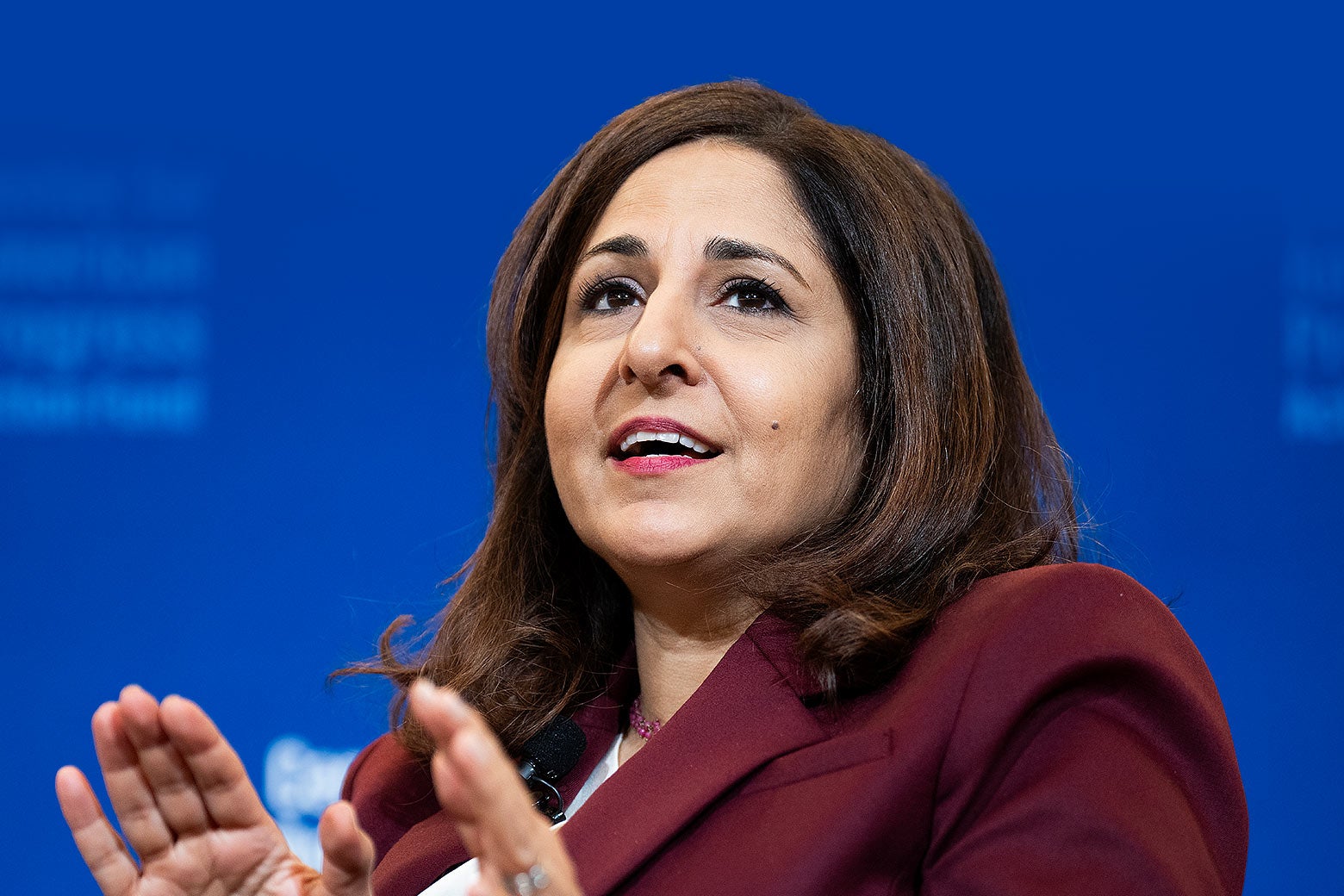
Photo illustration by Slate. Photo by Tom Williams/CQ-Roll Call Inc. via Getty Images. Seated across from me, in her pearls and charcoal pantsuit, is Neera Tanden—one of the most accomplished political agents in America, and someone to whom I have just posed a deeply offensive question. We are in her spacious corner office at the Center for American Progress, colloquially known as CAP, the influential liberal think tank where Tanden serves as both president and CEO. She’s in the midst of a busy day, with places to go and people to see. Just a few minutes from now, Tanden will be on stage with Vermont Sen. Peter Welch, discussing how Trump’s tariffs are impacting the supply chains of the state’s cheesemakers. Earlier this morning, she was huddled in a room full of men—each brandishing neatly bullet-pointed memos—drumming up talking points about A.I. safety that will soon be disseminated across Capitol Hill. But I don’t want to talk about any of that. Instead, I asked her something I’ve wondered about for years. When I see Tanden on Twitter/X late at night, embroiled in a flame war with the socialist Twitch streamer Hasan Piker, or the leftist podcaster Sam Seder, or, on more than one occasion, a random shitposter with a username like @Bot420Crazy, is she drunk? She knows what I’m talking about. She’s seen the memes. Some of her most inventive haters have dubbed her “Beera Tanden.” Another shitposter, with a hammer-and-sickle studded in their bio, is currently operating under the username “Neera Tanden’s Wine Addiction.” But no, she is not drunk. In fact, she doesn’t really drink much at all. “I mean maybe I’ll have a glass of wine,” she said. “But the bad tweets are 100 percent sober tweets.” Screenshots via Neera Tanden/X This is just what life is like for a woman who has become, without question, one of the great villains of the online left. Who has an army of trolls who fill up her mentions every day with invective. And—there’s no doubt—Tanden takes some pleasure in dispatching them. About the theory that she would only be engaging with these people if she were plastered? “I find it to be completely sexist. I don’t understand it. What, did I misspell something?” she said. At her core, Neera Tanden is a policy wonk. Policy wonks are not typically famous: If they are, that fame is restricted to a league of Beltway professionals—famous in the way that really good brain surgeons are famous to other, presumably lesser brain surgeons. I saw her aptitude firsthand as I tailed her around CAP. She relishes the tedious sausage-making of statecraft, the kind of stuff that makes you and me bleed from our ears. Tanden can reflexively rattle off the particularities of housing protocols I couldn’t begin to decode; she titters with satisfaction upon recounting the intricacies of a long-discarded Australian cap-and-trade proposal. This is a skillset of someone who is happiest in the darkest corners of government—the swampiest of swamps—a realm of acronyms, white papers, and multihyphenate bureaucracies. And that is exactly what makes Tanden’s transformation into one of the country’s most widely derided Twitter pundits so bizarre. It all began, like so many things did, in 2016. Tanden—who has close ties with the Clintons, and has spent her entire professional life within the ironworks of the Democratic Party—backed Hillary for president. (She served as an unofficial adviser to the former first lady and secretary of state throughout her run.) Meanwhile, an amassing contingency of voters regarded Clinton tepidly at best, and were more inspired by Bernie Sanders. As the primary grew testier, Tanden took to Twitter to defend the sanctity of normie liberal values, and to implore (some might say scold) Sanders supporters into lining up behind the establishment candidate. (“I’m old enough to remember when the left was the strongest fighters against fascist governments,” she posted, just months before the election.) Some portions of Tanden’s audience were amenable to her frustrations, but others were happy to make her a vessel for their exasperations with the overarching Democratic brand. They called her an empty suit, or a soulless enabler of corporate politics, or, at other times, a drunk and an idiot. Tanden only dug in further, her annoyance with the party’s leftward flank recursively expanding, in a stalemate that persists to this day. Tanden has since cemented her status as the unlikely face of a feud that continues to bifurcate the Democratic polity; a wound that dramatically fissured in 2016, and, to this point, has yet to heal. She isn’t exactly a firebrand, but she is very much available; willing to take on all comers, vociferously, at seemingly any hour of the day. If you scroll through Twitter, you might encounter Tanden engaging in a testy back-and-forth with progressive journalist Mehdi Hasan. Other times, you’ll see her riposting a man named @JrGoob. The pattern repeats ad nauseum, in slightly different permutations. I’ve seen Tanden get into a headline-making spat with progressive blogger Matt Bruenig; I’ve even watched her carry on a one-sided vendetta against Susan Sarandon. (Tanden was furious about the actress’s support of perennial Green Party nominee Jill Stein.) Unsurprisingly, her current focus is the aforementioned Hasan Piker, a man who is no stranger to controversy and has courted plenty of internet feuds of his own. Throughout the summer of 2026, when Piker was popping up on various midterm campaign trails, Tanden condemned him as a hatemonger who dabbles in antisemitic tropes—someone who has no place in the big tent—with her usual aplomb. “Proud to be one of the people fighting off the predator,” said Tanden, just days ago, while quote-tweeting a profile of Piker by veteran center-left columnist Jonathan Chait, which does, indeed, characterize the streamer as a marauding force within Democratic politics. It is the prolificness of her social media output that made Tanden one of the very few people in politics to suffer professional ramifications from her conduct online. In 2021, when the Biden administration nominated Tanden to run the characteristically opaque Office of Management and Budget, senators on either side of the aisle roadblocked the confirmation. One of them was Bernie Sanders; he wasn’t happy with Tanden’s tweets. Screenshots via Neera Tanden/X You might be wondering what use any of this is. Especially considering how, online, Tanden appears to be profoundly alone. Sure, she has her allies in and around the Democratic Party, but her fellow policy nerds are not spending their evenings on X. She often seems to be a solitary voice crying out against the onslaught. Every tweet is met with an infinite scroll of rejoinders; no observation she posits goes unpunished. And yet, despite all the tirades thrown Tanden’s way, the isolation doesn’t bother her. Perhaps because she understands that the internet is not real life, and that her message is resonating with a silent majority. More than anything else, that’s what keeps her around. “There was a woman on the Hill who told me she was in a group chat where people share my tweets and they appreciate me standing up, even though people scream at me,” said Tanden. “Even when everyone is yelling at me, people will hear what I’m saying.” Really, If you ask her about any of her online kerfuffles, Tanden sticks to that refrain: “People viciously attack normie Dems, and nobody defends them,” she said. “The problem with the online world is that people can say insane things, and it becomes conventional wisdom unless you have an alternative.” Through that lens, clapping back at Bot420Crazy rings a bit more existential—a battle for the soul of liberalism that Tanden genuinely feels is at risk of being hijacked, and can perhaps be course-corrected by browbeating one shitposter after another. Frankly, that might be what is required of our think tank executives in 2026, in an era of mass disinformation and flatlining public trust. It is not enough to do the work of pragmatic policymaking. You must be prepared to stridently defend it to the trolls. And it’s important to remember that Tanden has been involved in basically every big-ticket Democratic Party project of her lifetime. She had stints on Bill Clinton’s presidential bids, and Hillary Clinton’s senatorial operation. She burrowed deep in the recesses of the early Obama administration, welding together the voluminous Affordable Care Act. She volunteered for the Dukakis campaign, for God’s sake. In fact, she is so enmeshed with the Democratic establishment that Joe Biden did eventually find a job for her. (She chaired the gloriously ambiguous “Domestic Policy Council.”) All of this has made Tanden something of an idealist. She believes in principled liberalism with the exact same vigor with which the revolutionary vanguard in her mentions wants to dismantle our sclerotic institutions. No wonder they’ve never seen eye to eye. “I’m a big government-policy wonk. That’s my whole life. I’m a big government liberal. And most people in government are trying to solve problems,” Tanden told me. “This might sound absurd, given the level of cynicism, but I actually do believe the Democratic Party is a force for good in this world.” The problem, of course, is that a waning number of Americans agree with Tanden. The Democratic Party is unpopular, and has been for years. Liberal consensus is smarting after two humiliating defeats by Donald Trump. Nobody should be surprised that voters are seeking alternatives further out on the left, as a handful of key Senate races this midterms cycle demonstrate. But ironically, there really isn’t that much daylight between CAP’s portfolio and the kinds of topics bandied about at your local Democratic Socialists of America chapter. For instance: Tanden is on record endorsing Alexandria Ocasio-Cortez’s Green New Deal resolution. One ambitious report published by the think tank floated the radical idea of curbing the credit-card swipe fees enforced at grocery stores. And how about the fact that Patrick Gaspard, who ran CAP while Tanden was away in the Biden world, has since emerged as one of Zohran Mamdani’s advisers? Set her digital footprint aside, and “you would almost think, ‘Well, this is the moderate wing of the Bernie Sanders movement,’ ” said the political blogger Matt Yglesias, in another recent profile of Tanden. Sure, she’s done plenty to rankle hardcore leftists beyond her posts. Chief among them is an incident in 2015, when CAP hosted Israel’s Prime Minister Benjamin Netanyahu for a softball Q&A. (Tanden brought this up unprompted during our interview. She blamed a Pollyanna-ish Obama administration. “Ben Rhodes was like, ‘This is a good thing to do.’ I would have never done it, but they were trying to get him on a path to be less insane,” she said. For what it’s worth, CAP has struck a more adversarial tone toward Israel in the intervening years.) But at least from my vantage point, the differences between the two factions are more rhetorical than they are material. They’ve just been fighting for too long to know how to stop. Naturally, the past decade of abuse has taken a toll on Tanden. She speaks about herself like she’s a martyr for the Democratic mainstream—a human shield sponging up all the slings and arrows at the left on behalf of those in her coalition who have much more at stake. Tanden willingly participates in the roasting, and as a woman of color, she’s destined to be on the brunt end of the internet, but as far as she’s concerned, it’s all been worth it. “I’m not a politician, I’m never going to run for office. I’m not going to lose any voters,” she said. “The only consequence is that people might yell at me online.” Screenshots via Neera Tanden/X Here is where I must admit that, like so many other Americans, I too have lost some faith in the liberal orthodoxies she holds dear. I am one of those Obama-voting millennials beaten down by the MAGA imperium, to the point that I’m now no longer convinced that a return to normalcy is even possible. And ultimately, that is what Tanden is up against. She remains confident that with the right people and policies in place, the ossified gridlock gumming up the mechanisms of American democracy can be purged, without drawing too far outside the lines. In the past, she has portrayed those casting doubts that such a resolution could be achieved as irksome malcontents. For a time she used the term “alt-left” to refer to disaffected socialism-curious youths, drawing direct parallels between them, and, you know, the Charlottesville Nazis. One of Tanden’s most consistent mantras is that she, and people like her, are more serious about gaining power and saving democracy than those further on the fringes. (“Please name a competitive election where your preferred politics has actually won,” she memorably barbed leftie commentator Jeet Heer in 2018.) Alas, Tanden is committed to that dream during a moment in our national story when it has become disturbingly common to believe such an idea to be laughably fantastical, or worse, totally contemptible. With that said, the more time I spent around CAP, the more I found myself narcotized by the contact high of establishment liberalism. The hope and the change, the transcendent conviction that the systemic levers of government are not corroded beyond repair, the optimist I used to be—it all came rushing back. I traipsed down corridors full of smart young people tapping away at their computers, seemingly doing things. I passed by auditoriums with heavily fractionalized pie-charts projected onto massive screens. The hallway to the bathrooms was lined with the movie posters that CAP has screened as part of their free film series, Reel Progress. (They included the much-ridiculed 2004 Best Picture winner Crash, and a Pete Buttigieg documentary produced by Amazon.) Eventually, I am deposited into a conference room with two CAP agents who tell me about their plan to defang Citizens United, the 2010 Supreme Court decision that allowed unfettered corporate money into our elections. They intend to accomplish this with a complicated retrofitting of the corporate chartering code that would allow individual states to rescind the ability for companies to make political donations. They’ve been plugging away on this policy for years, and they’re finally seeing results. The measure has already passed in Hawaiʻi, and it will be on the ballot in Montana come November. I found the encounter winsomely demystifying. This is really what these people do all day. If only more Americans understood that behind the checkered partition of Washington, you’ll mostly find a legion of wonks tinkering with their pet projects. Despite so much evidence to the contrary, some folks, Tanden included, are trying to rescue this country through the raw vehicles of competence. I took my leave of CAP and jumped on the Amtrak back home to New York City. Tanden has finished up her marathon day with an appearance on CNN; she sparred with Scott Jennings about Donald Trump’s flagging poll numbers. A few hours later, with the sun hidden underneath the ocean, I whipped out my phone and discovered Tanden, up late and on Twitter, in the midst of yet another public spat—this time with the journalist and onetime CAP contributor Wajahat Ali. Ali asserted that Tanden had tanked the Democratic Party’s public image; that she had sold out to the PACs, the corporations, and the Israel lobby. “Hopefully the party you constantly shit on will win despite you in 41 days,” Tanden retorted. The residual optimism that briefly consumed me slowly deflated. We were right back where we started. It is still the summer of 2016. At this point, it probably will be forever. Democrats Politics Social Media Twitter 2026 Midterms
Why Does Neera Tanden Do It?
Full Article
Original Source
Read the full article at Slate →KhanList aggregates and links to publicly available news content. We do not host full articles from third-party sources. Always verify important information with original sources.