
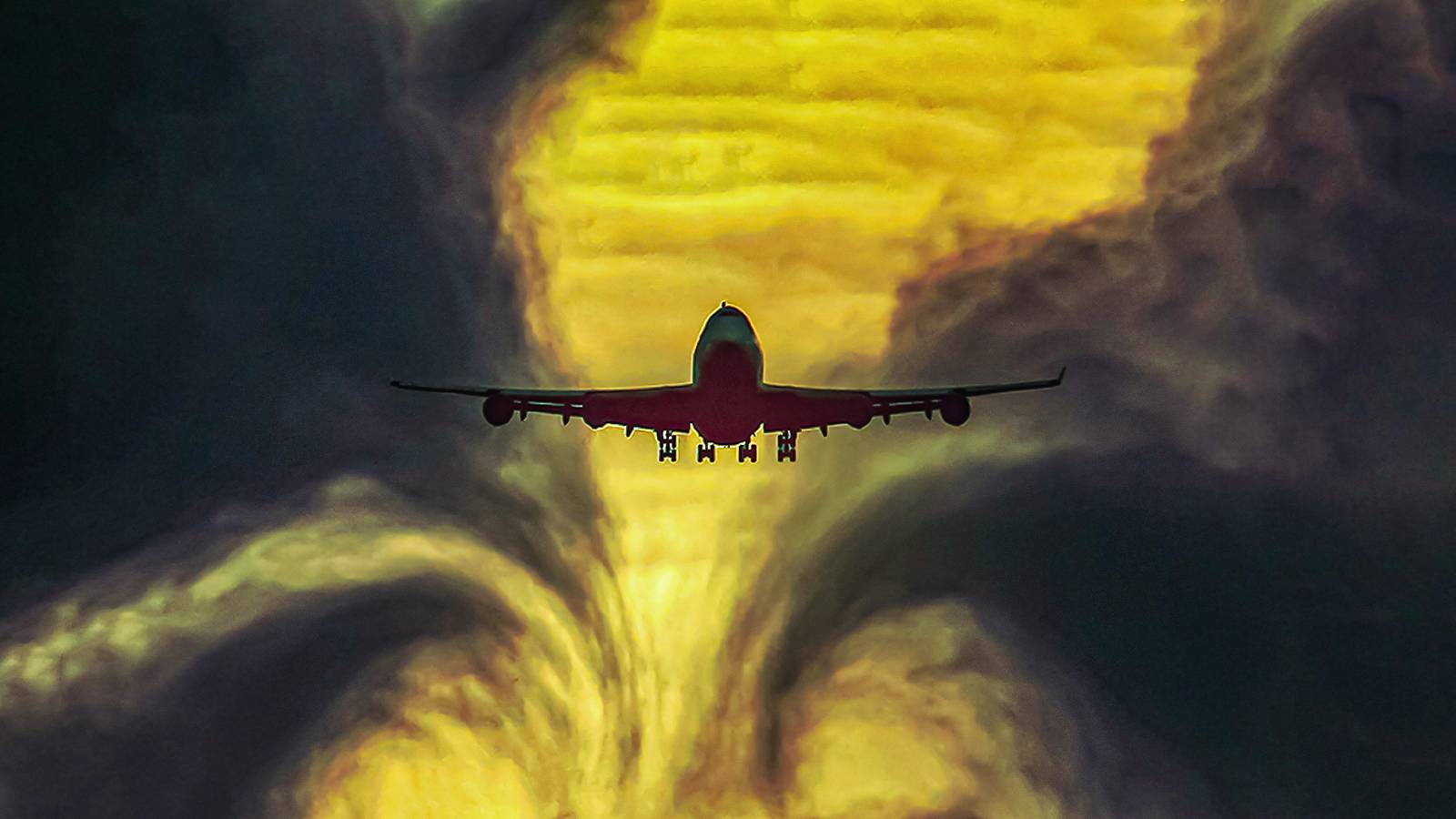
Credit: hlopex | Shutterstock | Simple Flying Published Nov 18, 2026, 12:00 PM EST Louis is a military historian and the staff writer for History of War magazine, a leading military history monthly. He also has an interest in private and commercial aviation. Avgeeks are often frustrated when a layperson refers to an air pocket when they are talking about turbulence. They'll say that the airliner they were in entered a seeming vacuum in the sky, and losing lift, it dropped violently and worryingly. Enthusiasts, meteorologists, and pilots know that these air pockets don't really exist. Air pockets are a myth, but turbulence certainly isn't. Instead of a gap in the air, we can think of turbulence as like a boat traveling through choppy seas. There are a number of factors that can cause it, such as warm air rising, wind that has been disrupted by an obstacle (like a mountain), or clean-air turbulence high in the atmosphere. The Air Pocket Myth The idea that there are gaps in the air that a plane can fall through originates in the early days of flying. Airmen in early and exceedingly slow biplanes would experience a sudden downdraft, and it would feel like the plane was falling through a hole in the sky. These pilots had no instruments and a rudimentary understanding of aerodynamics. The lack of knowledge led them to conclude that the sky has small pockets of vacuum or low-density air within it that could bring danger to an unsuspecting pilot. There would suddenly be no air to give the plane lift, meaning it could drop out of the sky or lose any semblance of control. Despite originating over a hundred years ago, the air pocket myth is still pervasive amongst those with little interest in aviation. As part of the Ask the Expert series on its YouTube channel, Swiss International Air Lines asked various members of the public what they think an air pocket is. They seemed to parrot the myth, with statements like "an air pocket is differences in air pressure," and "it's when the plane suddenly drops." An Air Pocket Is Actually Windshear The specific type of turbulence where an aircraft suddenly drops or rises in altitude is caused by windshear. This is a sudden change in wind speed or direction within a small amount of atmosphere. Speaking with Live Science, Guy Gratton, an aeronautical engineer, test pilot, and professor of aviation and the environment at Cranfield University, said: "If a plane is flying along at a constant speed and height, then suddenly the headwind reduces, or it enters a descending column of air, this can cause the aircraft to suddenly descend. Conversely, if the headwind rapidly increases, or the plane enters a rising column of air, this can cause it to suddenly climb." A common type of windshear is a microburst, which is a small column of rapidly descending air underneath a storm cloud. Airbus notes three dangerous phases that an aircraft goes through when encountering a microburst, which are particularly troublesome given that this phenomenon inherently occurs at a relatively low altitude. The table below explains these phases and how pilots respond to them. Phase number Phase Effect Appropriate pilot response 1 Headwind On entering the microburst, the aircraft hits a severe headwind gust that greatly increases airspeed and lift. The pilot reduces throttle and pushes the stick forward, forcing the aircraft's unintended ascent to stop. 2 Downdraft Flying through the microburst, a downdraft strikes the aircraft, forcing it to descend. The pilot adds more power and initiates a climb. 3 Tailwind On exiting the microburst, the wind speed suddenly changes, causing a tailwind. Airspeed and lift instantly drop. As above, the pilot must avoid the forced descent getting out of control. There are several common locations where an airliner might encounter windshear. This includes in the vicinity of a large cumulonimbus thundercloud or at the edges of a jet stream. In both cases, an aircraft will be traveling through air that has a number of air currents going in different directions. Many Types Of Turbulence Can Create The Air Pocket Effect The air pocket myth oversimplifies turbulence, as it can actually have a range of different causes. Mechanical turbulence occurs when an obstacle disrupts the usual airflow. At high altitudes, a mountain many thousands of feet below can cause air to rise to meet the aircraft. The effect can also occur at lower altitudes because of large buildings. Another human-made type of turbulence is wake turbulence. It happens as a result of the spiraling air currents at large planes' wingtips. As a result, turbulence occurs most often at busy airports and is most dangerous to small aircraft. Rising air also causes a bumpy ride in the case of convective or thermal turbulence. The Earth does not heat up evenly. Hot spots on the ground cause the air directly above it to rise. This turbulence is most common on sunny afternoons, meaning fine weather does not indicate smooth flying. Cumulus clouds, which form because of ground warming, can indicate approaching turbulence. Weather also causes frontal turbulence, happening at the boundary between a warm and a cold front. The air in the cold front can rapidly displace the warm front air, which is forced upwards. This turbulence is visible because thunderstorms often develop at these boundaries. Clean Air Turbulence Is As Worrying As Air Pockets Air pockets may not be real, but modern aviation has seen the rise of a phenomenon that is just as terrifying. Clean air turbulence occurs without any visual warning. It can't be detected by standard weather radar systems. This means pilots often don't have the ability to warn passengers and crew members to return to their seats and put their belts on. The table below uses Skybrary data to explain five notable incidents in the last decade that have been caused by clear-air turbulence. It shows that, while the phenomenon may not be dangerous for the entire aircraft, it can cause serious issues for those who are not expecting it. Year Aircraft Location Incident description 2024 Airbus A330-300 Loxton, South Africa In clean air turbulence, the first officer disengaged the autopilot without communicating with the captain. The aircraft exceeded its maximum permitted airspeed and four unsecured cabin crew were injured. 2015 Boeing 737-800 Toulouse, France The aircraft encountered severe turbulence while crossing the Pyrenees. Two cabin crew were seriously injured, causing the aircraft to divert. 2021 Airbus A350-900 Cayenne, French Guiana In unexpected turbulence, the senior member of the cabin crew fell and was injured. An investigation revealed the pilots had wrongfully released cabin crew from their secure positions. 2022 Airbus A320 Okayama, Japan During a relatively light period of clean air, a passenger was seriously injured despite wearing their seatbelt. The passenger struck their armrest, resulting in a broken rib. 2019 ATR 42-500 Tanegashima, Japan During captain upgrade line training, the aircraft encountered clean air turbulence. The pilot's response was excessive, leading to a pitch change from -2.3 degrees to +6.3 degrees in one second. The unsecured cabin crew were injured. Clear-air turbulence typically occurs at altitudes above 15,000 feet (4,570 m), often near jet streams, which cause rapid changes in wind speed. Their location is the only aspect that is predictable, so pilots can lessen the risk by changing altitude or flying around the area. They can also instruct passengers and crew members to stay seated when the aircraft is entering a high-risk area. Widely Publicized Turbulence Incidents Mean The Air Pocket Myth Isn't Going Anywhere Data from the University of Reading's meteorology department shows that global warming has caused an increase in turbulence by 55% in some regions. Human-caused climate change intensifies jet stream currents and alters atmospheric temperatures, leading to stronger windshear. It has also increased the prevalence of clear-air turbulence. An increase in turbulence will lead to an increase in widely known turbulence-related incidents. That could lead to a rise in wrongful assumptions that air pockets are involved, particularly with clean air turbulence being a phenomenon that can seem unexplainable. An example of one such recent notable turbulence incident happened in late October onboard a United Airlines flight from Daniel K. Inouye International Airport (HNL) to Los Angeles International Airport (LAX). The Los Angeles Times reported that UA1157, operated by a Boeing 777-200, descended more than 3,000 feet (914 meters) in about one minute. Four flight attendants were injured, one of whom was hospitalized. All the 190 passengers escaped unscathed. However, the incident was concerning. A passenger called Marly Wadlington told ABC 7: “I was watching a movie, and all of a sudden we just dropped. And it felt like we dropped pretty far. It started shaking, everyone was yelling. We were all super scared.” Flights involving Hawaii have been particularly impacted by turbulence in recent years. The most worrying example was an Airbus A330-200 flight in December 2022. The turbulence incident injured 24 people, four of whom were seriously injured. SFGATE has reported a 30% increase in moderate-or-greater turbulence affecting the Hawaii and West Coast region.
Why Does A Plane Seem To Drop If There Are No 'Air Pockets' In The Sky?
Full Article
Original Source
Read the full article at Simpleflying →KhanList aggregates and links to publicly available news content. We do not host full articles from third-party sources. Always verify important information with original sources.