
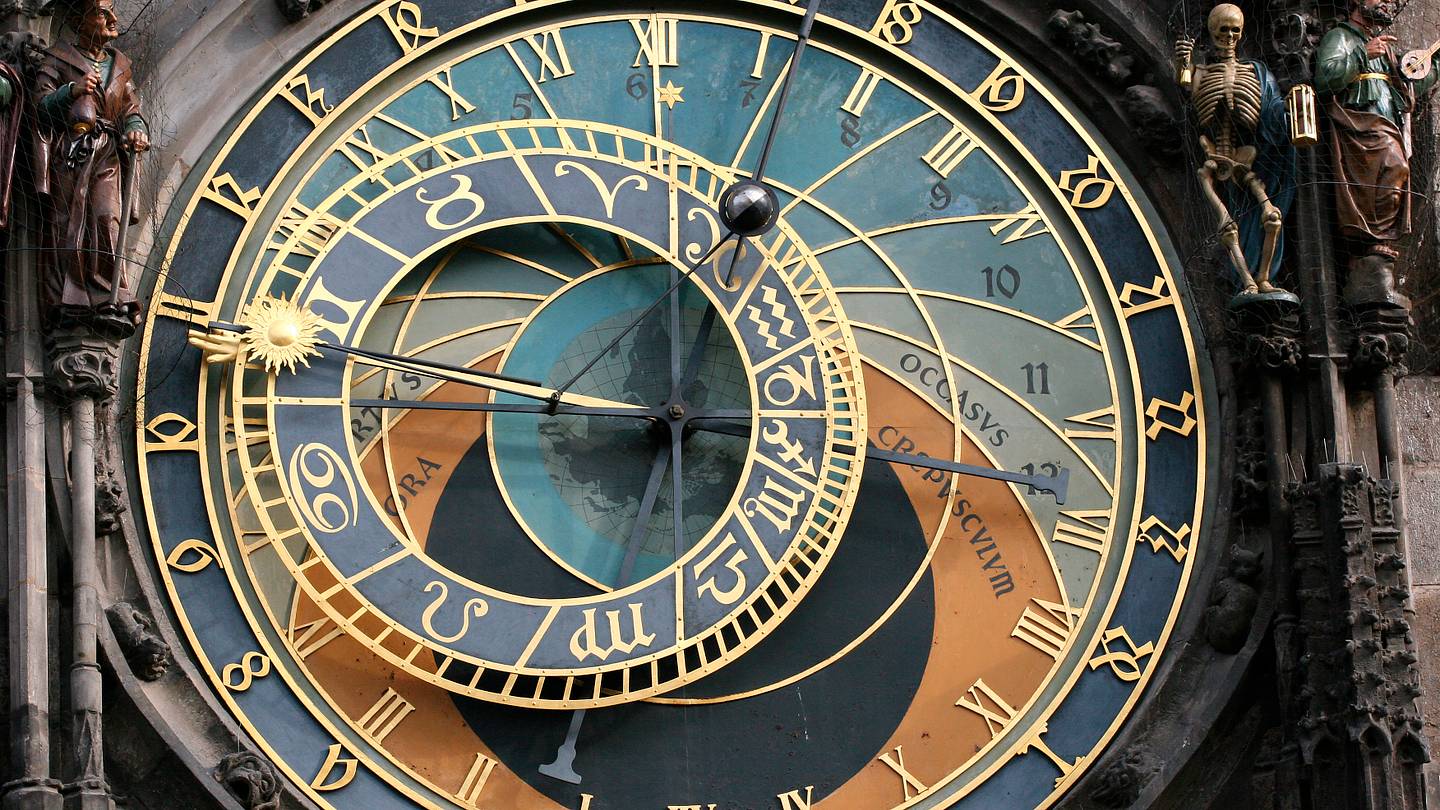
Much like a dog perking up after hearing the word "walk," there's no sound better to the average white-collar worker than "five o'clock." Those three syllables bring to mind many things: a discounted cocktail, slamming your laptop shut, and pretty much anything other than a literal clock.That detachment makes sense given how we tell time today. In an era dominated by smartphones and digital clocks, we rarely interact with traditional ticking mechanical ones anymore. And yet, we still use a word specifically created to describe them. But why "o'clock"? Why has the letter "o" stayed linked to an apostrophe for centuries? As it turns out, this everyday phrase is evidence of the evolution of timekeeping from the late Middle Ages. Saved by the BellFamous Gros-Horloge medieval clock in Rouen, France. | Michael Derrer Fuchs/GettyImagesWhile humans have been tracking time for millennia, the word "clock" itself is a relatively modern invention. Both the mechanical clock and the word used to refer to it didn’t exist in the English language until the 14th century.Early timekeeping relied on light-based instruments like sundials. That all changed when the first mechanical clocks were invented in Europe during the Middle Ages. When the word clok entered Middle English around the 1300s, it didn't refer to a face with ticking hands. Borrowed from Middle Dutch, Old French, and Medieval Latin—tracing back to the Middle Irish clocc—the word simply meant "bell." If you've ever had the chance to marvel at an intricate European clock tower like the Prague Astronomical Clock or Munich's Glockenspiel, you might have a guess as to why. These early towering timepieces were built to ring out on the hour, alerting townsfolk to work or prayer.But as they say, old habits die hard, including the centuries-old reliance on sundials. The arrival of these newfangled clock towers created a localized timekeeping crisis. While sundial hours expanded and contracted with the seasons, mechanical clocks chopped the day into the 24 equal segments we still use today.Because solar time and mechanical time rarely ever aligned, people needed to be crystal clear regarding their reference points. If you set a meeting at "four," you had to indicate whether you meant four by the sun, or four according to the hands moving on the mechanical clock. To specify the latter, they began saying in Middle English that it was four "of the clokke."The Shortcut That StuckThe next part of the "o'clock" timeline contextualizes how we went from "of the clokke" to what sounds like it could be an Irish surname. With 24 hours in each day, saying the trisyllabic phrase over and over again got tedious. Thus, much like the middle child of a family, the middle syllable within "of the" was slowly forgotten—or at least lost in the fast-talking slur of modern spoken English.By the 16th century, written records began reflecting this natural shift. Variations like "a clock" and "o'clock" quickly replaced the longer phrase, leading to the earliest recorded use of "o'clock" in 1560. Before long, the contraction made its way into print, with playwrights like William Shakespeare writing lines like "What is't o'clock?" in Richard III.This slurred speech habit caught on beyond timekeeping. As the 17th century rolled around, the abbreviation of "of" to "o'" before words beginning with consonants paved the way for apostrophe-laden terms like "jack-o'-lantern" and "will-o'-the-wisp."Why didn't the contraction stick to every time of day? As digital time displays made exact minute-reading easier, the phrase became reserved for top-of-the-hour markers. We readily say "six o’clock," but "six-fifteen o’clock" was apparently a syllable too many.Borrowed Timepocketlight/GettyImagesWhile sundials have retired to gardens and mechanical clocks are replaced by smartwatches, "o'clock" remains a staple of everyday speech. It’s a stubborn piece of 14th-century slang that stuck around long after the bell towers fell silent.More Like This:
Why Do We Say "O'Clock"?
Full Article
Original Source
Read the full article at Mentalfloss →KhanList aggregates and links to publicly available news content. We do not host full articles from third-party sources. Always verify important information with original sources.