
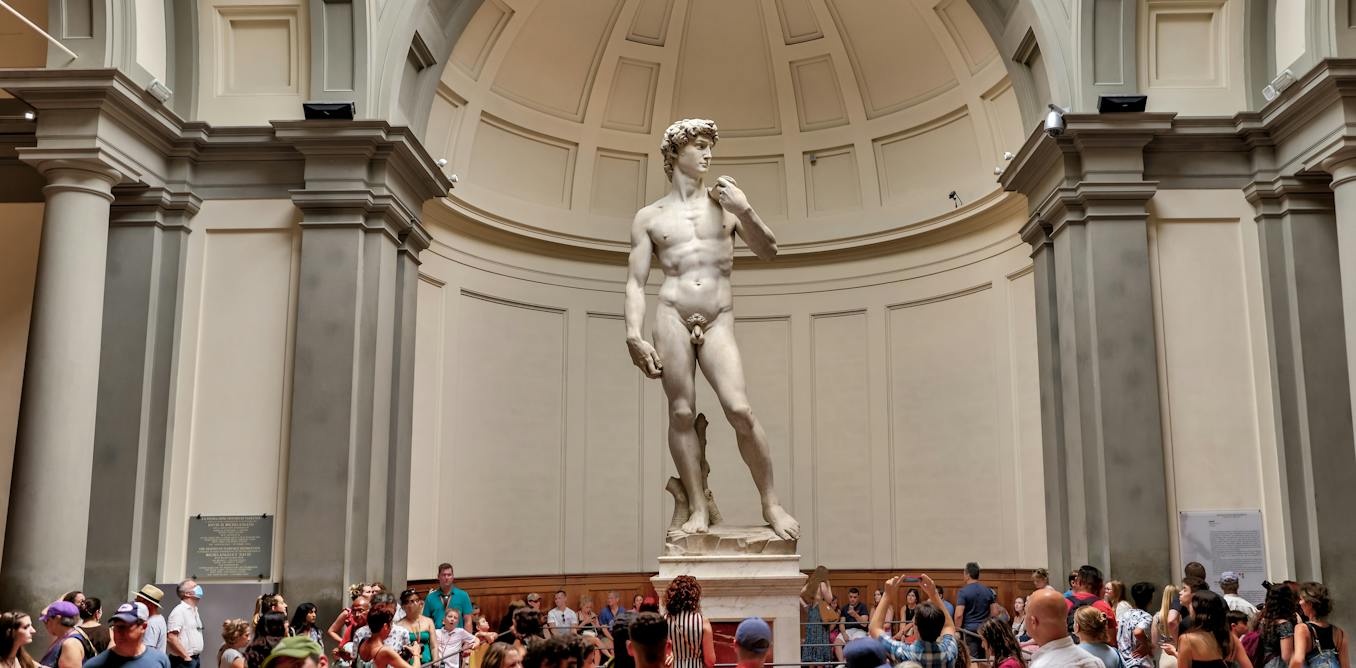
Michelangelo’s David is one of the most celebrated representations of masculine beauty in art history. Its muscular body, imposing presence and heroic subject (the biblical giant-slayer) have made it a symbol of male strength for more than five centuries. Yet one of its most recognisable features – the way David stands – may complicate that interpretation. David stands with most of his weight on one leg, causing his hips to tilt and his shoulders to shift in the opposite direction. This posture, known as contrapposto, was established in classical sculpture to create a more natural and dynamic representation of the human body. One famous example is Polykleitos’ Doryphoros, created around 440BC. My colleagues and I have investigated how this particular posture influences perceptions of men. Our findings suggest that, for modern viewers, it can make male figures appear less masculine, less dominant and more likely to be perceived as non-heterosexual. Digitally manipulated versions of Michelangelo’s David showing upright, original and exaggerated contrapposto stances. Author provided (no reuse) We created digitally manipulated versions of classical statues, including David, varying the degree of contrapposto while keeping other characteristics constant. We conducted three experiments using two-dimensional images and three-dimensional statues viewed in virtual reality. Unlike the two-dimensional studies, which showed no significant differences in viewer perception, our VR experiment with 47 participants found that upright male statues were rated as more attractive and masculine than those posed in a pronounced contrapposto. Subsequent research extended our experiment to male body models rather than classical statues. These experiments similarly found that contrapposto reduced perceptions of masculinity and dominance. Using eye-tracking, we also examined where observers directed their attention, although we found no significant differences in gaze between the postures. Michelangelo by Daniele da Volterra (1545). Metropolitan Museum of Art Interestingly, our earlier research involving female figures found that contrapposto could enhance perceived attractiveness among both male and female viewers. Further studies showed that the posture attracted greater visual attention and influenced neural processing. The same posture therefore appears to influence perceptions of male and female bodies differently. We later extended our research to examine whether contrapposto also influences assumptions about male sexual orientation. In our study involving 85 gay and bisexual men from North America, participants were more likely to perceive male figures adopting contrapposto as homosexual. These figures were also judged as less masculine. Another of our studies involving 120 Japanese observers found a similar association between contrapposto and perceived non-heterosexuality. The findings from both these studies are being reported for the first time in my book, The Psychology of Attractiveness and Aesthetics. In the book, I also explore a separate, more speculative possibility – that Michelangelo may have deliberately used this pose to communicate a subtle meaning about male sexuality, drawing on additional artistic and historical evidence. How modern brains read an ancient pose In everyday life, we routinely make quick assessments of others from their body language. Upright and expansive postures are often associated with confidence, strength and social standing, whereas shifting weight onto one leg and tilting the hips can create a more relaxed impression. Our perceptions of sexual orientation may also involve another process. People develop expectations about how men and women typically stand, move and present themselves, and departures from these expectations can shape assumptions about sexuality. The contrapposto stance means most of the weight is on one foot with the other leg relaxed and bent at the knee. Todamo/Shutterstock, Author provided (no reuse) Previous research on body movement has shown that movements perceived as less typical of a person’s gender can influence our judgments about their sexual orientation. Contrapposto may activate similar associations through the positioning of the hips and shoulders, even in a stationary figure. Importantly, these impressions reflect socially learned stereotypes about masculinity and sexuality rather than characteristics inherent to heterosexual or non-heterosexual men. Our experiments demonstrate how modern observers interpret these postures, not whether posture accurately reveals sexual orientation or whether people in Renaissance Florence shared the same associations. David has become such a familiar symbol of masculine perfection that we rarely question what its posture might communicate. Of course, these experimental conditions cannot fully reproduce the experience of standing beneath a towering, five-metre marble statue. Yet our research demonstrates that relatively subtle changes in how a male body is positioned can influence perceptions of masculinity, dominance and sexuality.
Why do some people think Michelangelo’s David is gay? My research zones in on his iconic stance
Full Article
Original Source
Read the full article at Theconversation →KhanList aggregates and links to publicly available news content. We do not host full articles from third-party sources. Always verify important information with original sources.