
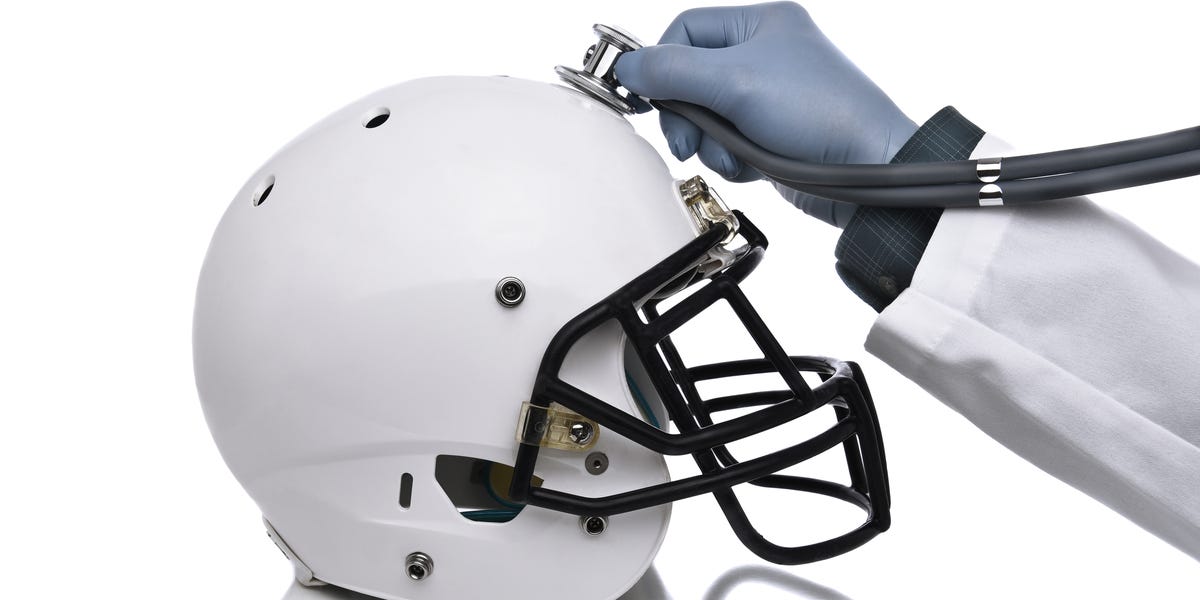
3 min readAn estimated 3.8 million sports-related concussions occur in the U.S. each year. They’re so common that you might assume they’re not as serious as other injuries—but in fact, these mild traumatic brain injuries (TBIs) can often be more dangerous. While tendons, muscle, and bone heal good as new, repeated and sustained concussions—a typical occurrence in many athletic endeavors—can lead to dementia and chronic traumatic encephalopathy (CTE), an aggressive degenerative brain disease.Although helmets have grown safer over the years in certain sports, concussions are still commonplace. That’s especially true in football, even after the high-profile introduction of the Guardian Cap for NFL preseason practices in 2022 and then in regular-season games in 2024. This suggests that there’s something about concussions, specifically the relationship of linear and rotational acceleration and the brain, that scientists still don’t understand.During World War II, Scottish physicist A.H.S. Holbourn argued that rotational acceleration (think of an uppercut to the jaw) was more dangerous than linear acceleration (a straight-on, direct hit whose force goes through the center of the head). His theory was that rotation was worse because it stretches and strains brain tissue by moving different parts at different speeds. Scientists have focused on protecting against rotation ever since.However, a new Stanford Medicine-led study suggests that linear acceleration, not rotation, may be the better predictor of concussion. The research comes from the lab of bioengineer David Camarillo, who’s spent more than a decade studying concussions and helmet safety. By analyzing unprecedentedly accurate impact data from motion-sensing mouthguards worn by 203 athletes across seven different sports, Camarillo and his team discovered that Holbourn’s initial assumptions weren’t correct. The results of their study were published in the journal Annals of Biomedical Engineering. “Holbourn’s reasoning was based just on mechanics; it wasn’t biology,” David Camarillo, senior author of the study, said in a press statement. “The question we started out with many years ago was, ‘What are the forces required to cause concussion?’ If we understand the nature of those forces and the limits of the human brain, then it might be possible to prevent concussions.”Previous studies relied on helmet-mounted sensors, but the authors note that those sensors are often inaccurate because helmets tend to move around a lot. Across the mouthguard-enabled data set, the researchers analyzed 3,851 impacts, of which 47 were verified as concussions. In their mathematical models comparing the data, peak linear acceleration was the single most predictive factor in whether a hit eventually produced a concussion. Camarillo and his team haven’t pinned down a mechanism for this result, but they suspect one of two culprits: the brain striking the inside of the skull, or cavitation, in which sudden pressure changes form tiny bubbles that then collapse.If these results hold up in future studies, they could have profound implications for helmet safety and design. The mouthguard data showed that a hit producing 100 g of linear acceleration (100 times the acceleration of gravity) carries a 50 percent risk of concussion. That’s far lower than the often-cited 192 g threshold from earlier helmet-sensor studies. At 150 g, a hit that older data would have considered below the danger line, concussion risk tops 99 percent.“Why are there so many concussions even when people are wearing helmets?” Camarillo asked. “Part of the answer could be in this paper, which is that the linear accelerations that we previously thought were safe, we now see are much more dangerous.”In a way, the new results offer a bit of hope that helmets do have room for improvement, and with a greater focus on addressing linear acceleration, concussions could significantly drop in the coming years and decades. One Stanford-developed technology is a helmet with liquid-filled pads that reduces peak linear acceleration and knocks nearly 20 percentage points off the chances of concussion on high-impact hits versus standard football helmets.“If linear acceleration is its own distinct mechanism of concussion and it’s very common, then we’ve been missing a lot,” Camarillo said. “We haven’t tried as hard to optimize for this variable. It gives me some hope that there’s a new opportunity for preventing concussions.”Darren lives in Portland, has a cat, and writes/edits about sci-fi and how our world works. You can find his previous stuff at Gizmodo and Paste if you look hard enough.
Why Do Helmets Still Fail to Stop Concussions? Scientists May Have Been Fighting the Wrong Force All Along.
Full Article
Original Source
Read the full article at Popularmechanics →KhanList aggregates and links to publicly available news content. We do not host full articles from third-party sources. Always verify important information with original sources.