
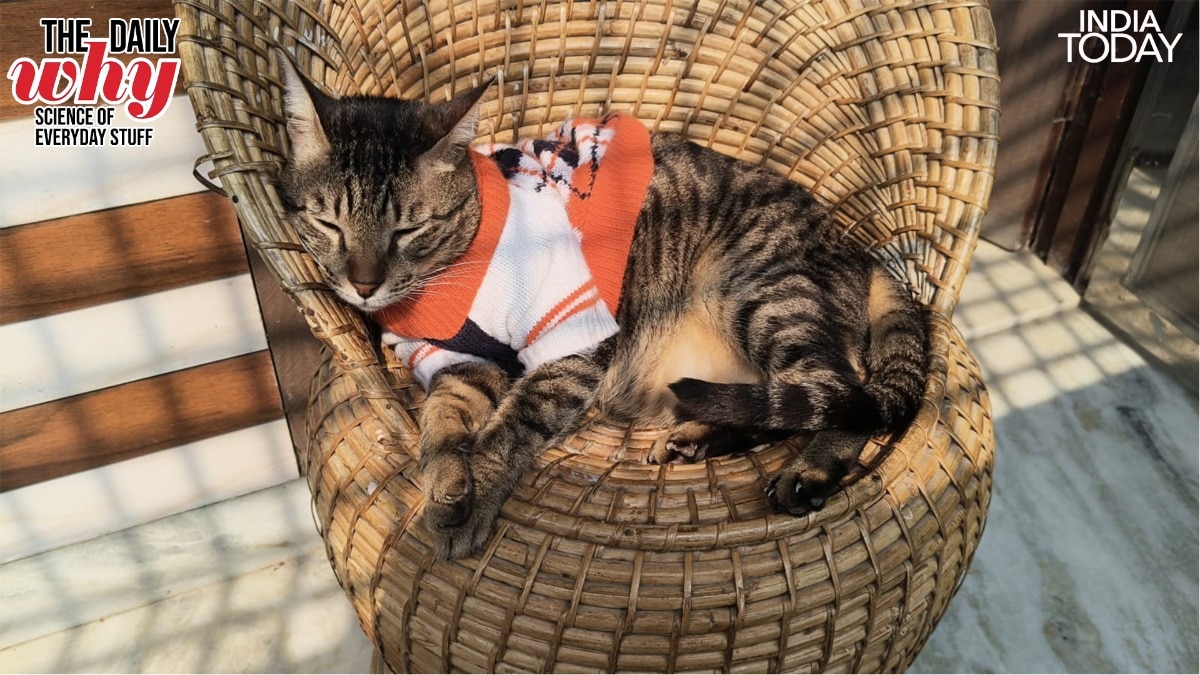
Evening settles over the house. A cat climbs into the warmest lap in the room, turns twice, and folds its paws away with the grace of a duke or a duchess putting away their gloves. Then it begins. A soft engine starts somewhere inside its chest, low and steady, so deep that you feel it through your fingertips before you hear it.It is perhaps the most comforting sound in any home. It is also one of the quiet puzzles of animal science. Cats have purred beside humans for thousands of years, and scientists are still working out exactly how they do it, and why.WHY DO CATS PURR?Most of us read a purr as happiness, and often it is. Cats purr when they are stroked, when they curl up beside someone they trust, and when they knead a blanket with slow, rhythmic paws, making biscuits.But a purr is not simply a smile. Cats also purr when they are frightened, unwell, giving birth, and sometimes when they are close to death. The author’s tabby cat rests on a balcony ledge, wrapped in an orange sweater. (Photo: Radifah Kabir/India Today) That is why many scientists now see purring less as a sign of joy and more as a signal of comfort, sometimes offered to others and sometimes to themselves.The habit begins early. Kittens purr within their first days of life, usually while feeding, and the mother purrs too. Kittens are born unable to see or hear, so a purr, felt through the body, works like a quiet message that all is well.HOW DO CATS PURR? For about 50 years, the textbook answer was that the brain drove it. A purr, the theory went, came from the muscles of the larynx, the voice box in the throat, twitching with clockwork rhythm on signals from the brain. A cat purrs while breathing in and while breathing out, which is why the sound seems never to pause.In 2023, a team led by voice scientist Christian Herbst of the University of Vienna added a surprising twist. Working with cat voice boxes in the laboratory, the researchers found that they could produce purring sounds without any signal from the brain at all. Their study, published in Current Biology, recorded these sounds at about 20 to 30 vibrations a second. The author’s tabby cat in an orange sweater dozes in a cane chair in the winter Sun. Cats often purr when they feel safe and relaxed. (Photo: Radifah Kabir/India Today) The secret may lie in unusual pads of tissue inside a cat’s vocal folds, the two flaps in the voice box that vibrate to make sound. The pads may work like extra weight on a guitar string: the heavier the string, the deeper its note.That would explain how a small animal can make a sound deeper than the lowest note of a human bass singer. The researchers compared it with vocal fry, the creaky, crackling voice humans use at the very bottom of their range. The author’s tabby cat stretches out on a sunny balcony grille. (Photo: Radifah Kabir/India Today) The team was careful to say that this does not fully overturn the old theory. The brain and muscles may still play a part, and the full story is still being written.Hearing in humans begins at about 20 vibrations a second, so a purr sits right at the edge of what our ears can catch. That is why you feel a purr as much as you hear it.DO CATS PURR TO GET FOOD?Some purrs carry a hidden request. In 2009, animal behaviour researcher Karen McComb and her colleagues at the University of Sussex recorded cats purring in two moods: while relaxing, and while asking their owners for food.They reported in Current Biology that the food-seeking purrs had a high-pitched cry woven into them, with a pitch similar to that of a crying human baby.When 50 people listened to the recordings, they rated these solicitation purrs, a scientist’s name for asking purrs, as more urgent and less pleasant.Even people who had never owned a cat could tell the difference. The cat, it seems, has learnt to borrow the one sound humans find hardest to ignore.DO CATS PURR WHEN THEY ARE IN PAIN?Yes, and every cat owner should know it. “There is no fixed answer,” Dr Mahesh, a veterinarian at Kia Pet Clinic in Delhi, tells India Today Digital. “Generally, cats do this when they are stressed, in pain, or want attention.” The purr may help a cat calm itself, much as a frightened child hums softly in the dark.When a cat seems to be purring out of stress, Dr Mahesh suggests gently breaking its focus. “To distract the mind, give it food or a treat, or give a gentle massage,” he says. The author’s tabby cat curls up in a cane chair with alert green eyes. Why cats choose to purr beside us remains part of their mystery. (Photo: Radifah Kabir/India Today) The veterinarian also advises handling the cat less, which means not keeping it in your lap for long or touching it again and again.So a purring cat is not always a contented one. A cat that purrs but also hides, refuses food or moves stiffly may be asking for help, not showing gratitude.CAN A CAT’S PURR HEAL BONES?This is the most romantic idea about purring, and the least proven. In 2001, bioacoustics researcher Elizabeth von Muggenthaler presented work to the Acoustical Society of America asking whether the purr might be a healing mechanism. Her idea was that the low vibrations of a purr fall in a range that some studies have linked to the repair of bone and tissue.Her recordings covered 44 members of the cat family, from house cats to cheetahs, and every one of them purred strongly at frequencies between 25 and 150 vibrations a second.The same year, a team led by biomedical engineer Clinton Rubin reported in Nature that sheep standing on a plate vibrating 30 times a second, for 20 minutes a day over a year, grew about 34 per cent denser spongy bone in the thigh than sheep that did not. The sheep, however, stood on a machine, not beside a purring cat. The author’s tabby cat naps peacefully in the sun. A cat’s purr is felt as much as it is heard. (Photo: Radifah Kabir/India Today) It is a lovely thought, but it remains a hypothesis, an idea still waiting to be proven. No study has yet shown that a cat heals faster because it purrs.So the next time a cat settles into your lap and the low engine starts, listen closely. You may be hearing contentment, a polite request for breakfast, or a small animal steadying itself.Science can now explain part of how a cat does it. Why it chooses to do it beside you remains, like most things about cats, entirely its own business.- Ends
Why do cats purr? Science behind the most soothing sound in your home
Full Article
Original Source
Read the full article at Indiatoday →KhanList aggregates and links to publicly available news content. We do not host full articles from third-party sources. Always verify important information with original sources.