
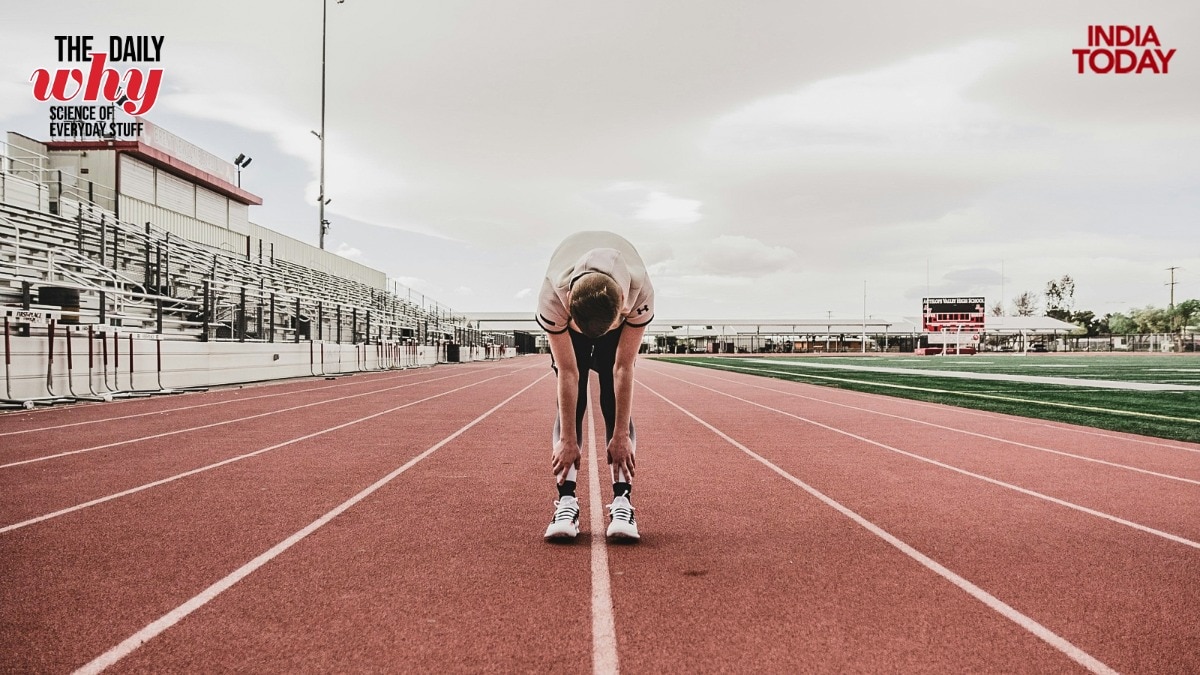
Bending over with your hands on your knees after a hard run is not a sign of weakness, it is a clever move the body makes on its own. Experts and new research reveal how the hunched position helps you breathe deeper and recover faster, and why the coaches were wrong to fight it.You have seen it a thousand times, and you have almost certainly done it yourself. The final whistle goes. The sprint runs out. The lungs catch fire. And the body, without waiting for permission, folds gently at the waist, the hands finding the knees, the head bowing, the chest rising and falling like a bellows worked by some unseen hand.A footballer does it on a floodlit pitch. A schoolchild does it at the end of a race. You do it at the top of a staircase you swore would be easier than it was.It is one of the most universal gestures the human body possesses, and for the better part of a century, coaches read it as a small surrender. Stand up straight, they would shout. Hands off your knees. Open up those lungs.It turns out they had it exactly backwards. The exhausted, hunched over body, gasping and undignified, may have been the wiser of the two all along. WHY DO WE BEND OVER AND PUT OUR HANDS ON OUR KNEES?Because it helps us breathe, and it does so with a quiet cleverness the body never bothered to explain."When an athlete bends forward with their hands on their knees, it seems to put the diaphragm and rib cage into a position that allows for more efficient breathing," Paddy Upton, among the most respected performance coaches in world sport, tells India Today Digital. For a century, coaches told tired athletes to stand up straight and get their hands off their knees. New research suggests the opposite. Bending over with hands on the knees may help you breathe more efficiently and slow your heart rate faster. Sometimes the body knows best. (Photo: Unsplash/Pexels) The diaphragm is the large, dome-shaped muscle slung beneath the lungs, and it is the engine of every breath you take. When you breathe in, it pulls downward to make room for air rushing into the lungs.Pulmonologists explain that when you bend forward and let your hands rest on your knees, the belly softens instead of staying braced, and that small release gives the diaphragm a little more room to move. A muscle with more room to travel moves more air. And so, without panting any faster, you simply breathe deeper.A chest specialist puts it more precisely. "The contents of the abdomen are raised upward to assist the diaphragm in achieving a more favourable starting position," Dr Arun Chowdary Kotaru, Unit Head and Senior Consultant of Respiratory Disease and Sleep Medicine at Artemis Hospitals, tells India Today Digital. From that better starting position, he explains, the diaphragm can generate pressure more effectively as you draw a breath in, which is why, after a hard effort, you find yourself breathing deeper and more comfortably.WHAT DO YOUR ARMS HAVE TO DO WITH BREATHING?More than you would ever guess. Tucked into the neck, chest and shoulders are muscles that lead a double life. Their everyday job is to move your arms about. But pin those arms in place and the very same muscles turn to a second task, pulling on the ribs and prising the chest open. When the body bends forward, the dome-shaped diaphragm beneath the lungs gains room to move, drawing in more air with every breath. (Photo: Pexels) "When you press your hands into your knees, you are essentially turning your arm into an anchor point," Dr Akhil Kulshreshtha, Director of Orthopaedics, Joint Replacement and Sports Medicine at Yashoda Medicity, tells India Today Digital. "Instead of using their strength to move your arm, these chest and shoulder muscles can now use that same strength to pull your ribcage toward the fixed arm. Since the arm isn't going anywhere, it's the ribs that end up moving, lifting and widening the chest."Dr Kotaru describes the same trick from the lungs' side. When breathing is hard, he says, the muscles of the neck, shoulders and upper chest pitch in to help lift and expand the ribcage, and resting your hands on your knees or thighs gives them a stable base to pull from. Anchored this way, rather than busy holding the body upright, they can work far more effectively, increasing their leverage so that each breath comes a little easier.It is a beautiful little piece of improvisation. You borrow the steadiness of a propped arm, and muscles that were built for lifting and reaching quietly volunteer, for a moment, to help you breathe.DOES BENDING OVER ACTUALLY HELP YOU RECOVER FASTER?This is where the science turns genuinely interesting, and where Paddy Upton is careful not to say more than he knows. "I wouldn't say the science is definitive yet, but there is enough evidence to suggest bent over with hands on knees is an effective recovery position," he says.The evidence he leans on is a small, elegant 2019 study of 20 female footballers. They ran themselves ragged at 90 to 95 per cent of their maximum heart rate, then recovered in one of two ways, hands on their heads or hands on their knees.The difference was striking. With hands on the knees, the heart slowed further in that crucial first minute, the players drew in more air with every breath, and they cleared more carbon dioxide, the waste gas the body races to expel after hard effort."Rather than the old coaching instruction of standing up straight and getting your hands off your knees, the body may actually know what it's doing," Paddy Upton says. "That slightly bent, supported position seems to help us breathe more efficiently and shift more quickly from a high-stress exercise state towards recovery." Resting the arms on the knees turns them into anchors, letting chest and shoulder muscles pull the ribcage wide open. (Photo: Pexels) You will often hear a second explanation, about blood. Stop moving suddenly and blood tends to pool in the legs, and folding forward is said to send it flowing back to the heart. Doctors call this venous return.A sports physician lays out the full chain of events. "It improves venous return," Dr Meenu Virdi, Consultant at Max Multi-Speciality Centre, Panchsheel Park, tells India Today Digital. As more blood flows back to the heart, she explains, the heart fills more completely and pushes out more with every beat, so it no longer needs to race to keep up with the body, and the heart rate falls away faster.But Paddy Upton will not lean his whole weight on it. "Venous return may be part of the overall physiology, but I wouldn't identify it as the primary mechanism," he says. "The stronger evidence seems to point towards improved breathing mechanics and a faster shift in the autonomic nervous system from work towards recovery."The autonomic nervous system is the body's automatic control room, the one that runs your heartbeat and breathing without asking you, and after exercise, it slowly turns the dial from racing back to calm.And some of the relief, Dr Kotaru adds, lives in the mind as much as in the lungs. A supported posture simply makes breathing feel easier, softening the very sensation of breathlessness, so the comfort you feel is both physiological and perceptual, real air and a calmer read of it at once.IF BENDING HELPS, WHY DO GYM TRAINERS ASK US TO KEEP WALKING AFTER INTENSE WORKOUT?There is a puzzle hiding here. In one breath, a trainer lets you fold over your knees, and in the next, they are waving you up to walk a lap of the gym. It sounds like a contradiction, but it is not. The two instructions answer two different questions, on two different timescales. Bending over is about the lungs in the first few seconds, when the only thing that matters is dragging air in and pushing carbon dioxide out. Walking around is about the blood over the next few minutes, and that is a separate problem entirely.Here is what is actually going on. While you exercise, the muscles of your legs squeeze rhythmically around your veins and shunt blood back up towards the heart, a mechanism sports scientists rather lovingly call the muscle pump. The moment you stop dead and stand still, that pump switches off, and gravity does what gravity does. A 2019 study of female footballers found the heart slowed faster with hands on knees than with hands on the head. (Photo: Pexels) Blood begins to pool in the legs, less of it reaches the brain, blood pressure dips, and you suddenly feel light-headed, even faint. Doctors call this postural or orthostatic hypotension, and it is precisely why runners sometimes crumple at the finish line.Gentle movement keeps the pump working and the blood circulating, and a slow walk also helps flush out lactate, the waste product that builds up in hard-working muscle, a little faster than standing about would.The same caution applies after heavy strength training, which is why a trainer would rather you keep moving than sit abruptly on a bench. So the two are not rivals at all. Bend for a moment to find your breath, then walk to keep your blood moving. Once again, the body, left to its own devices, tends to do both without being told.IS THE HUNCHED POSITION BAD FOR YOUR BACK?For a minute or two, not in the least. Bending at the hips and spine shortens the distance your upper body has to be held up over, which spares your back and core muscles a good deal of effort.Rest your arms on your legs and you unburden the shoulders too. The joints take this brief, weightless fold in their stride. Orthopaedic doctors say the posture is safe for a minute or two, but should not be held too long under load. (Photo: Unsplash/Pexels) The only caution is against overstaying. "Maintaining this posture for prolonged periods can place additional stress on the spine, shoulders, wrists and knees," Dr Dhrumin Sangoi, Consultant at the Nanavati Max Institute of Advanced Orthopaedics in Mumbai, tells India Today Digital. As a passing place to gather yourself, though, it is mechanically sound and gentle on the body.Dr Hemant Sharma, Chairman of the Marengo Asia Robotic Centre for Orthopaedics and Joint Care in Gurugram, sees it the same way, as a smart short-term strategy rather than a lasting posture. Supporting the upper body through the arms eases the demand on the muscles that stabilise the spine and pelvis, he tells India Today Digital, and it steadies the shoulder girdle, so the chest can help with breathing.But sustained forward bending, he cautions, is not built to be held for long. It is an efficient recovery posture, not a resting one.SHOULD COACHES STOP SHOUTING AT TIRED ATHLETES?This is the part Paddy Upton plainly relishes. "Watch people immediately after a genuinely hard physical effort, and many naturally bend forward and put their hands on their knees," he says. "Long before they have read any sports science, their body seems to find a position that feels easier to breathe and recover in."The coaches, Paddy Upton suspects, have been fighting that instinct for no good reason at all. "What I like about the newer research is that it suggests we may have been coaching athletes away from something their bodies naturally figured out." Performance coach Paddy Upton says athletes should be free to find the position in which they breathe best. (Photo: Unsplash/Pexels) He would not press the posture on anyone. "I would give them permission to find the position in which they recover and breathe most effectively."And then the line that stays with you, the sort only a coach who has watched thousands of tired bodies can earn. "Sometimes the athlete's body is a better sports scientist than the coach."So the next time you reach the end of yourself, breath ragged, hands falling to your knees, do not straighten up out of some inherited sense of poise.Let the body do what it has always known how to do. It read this research long before anyone thought to write it down.- EndsPublished By: Radifah KabirPublished On: Aug 31, 2026 14:02 IST
Why do athletes bend to catch their breath? Turns out the coaches had it wrong
Full Article
Original Source
Read the full article at Indiatoday →KhanList aggregates and links to publicly available news content. We do not host full articles from third-party sources. Always verify important information with original sources.