
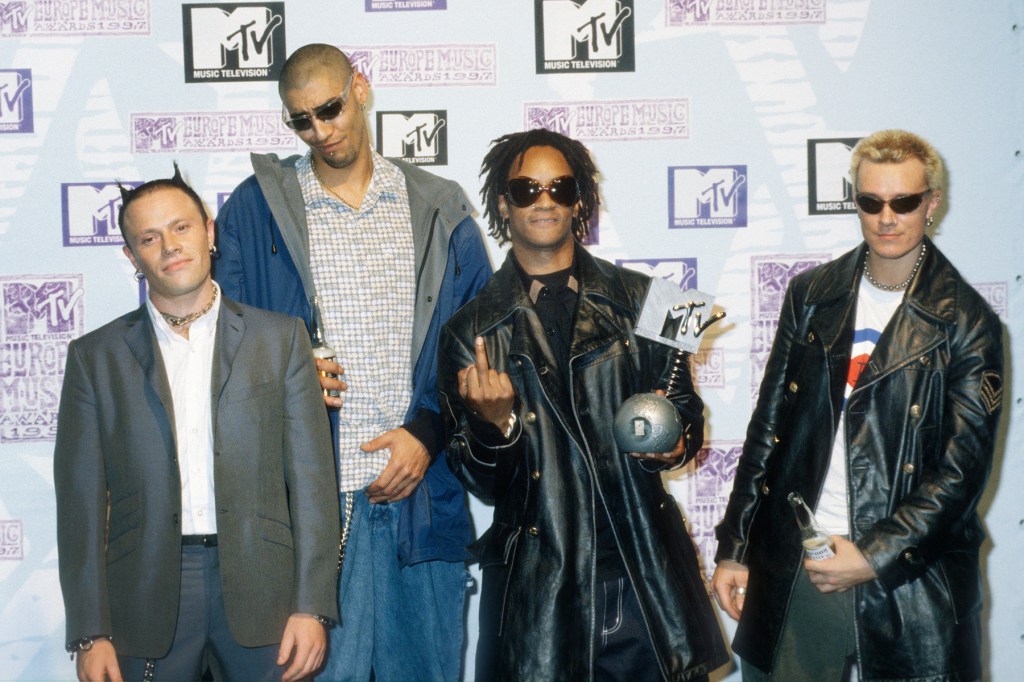
Our Vintage Almost-Pop Stardom month continues on the 'Greatest Pop Stars' podcast with a look at one of the most fun musical moments of the '90s, where a U.K. dance act took over U.S. rock. The Prodigy: Keith Flint, Leeroy Thornhill, Maxim, Liam Howlett at the MTV Europe Music Awards at Ahoy Sportpaleis, Rotterdam, Holland, on November 6th 1997. Gie Knaeps/Getty Images Trending on Billboard In 1997, alternative rock was in a strange place, having already seen the grunge era come and go, and with no clear core to the genre to keep it commercially and culturally competitive with pop and hip-hop as the turn of the century approached. One potential way forward presented itself in the form of big beat, the loosely defined, hard-hitting electronic subgenre that also took cues from hip-hop and rock and fit on radio stations and MTV playlists alongside songs by Sublime and Smashing Pumpkins. And the biggest artist of that big beat moment was unquestionably The Prodigy: the quartet of U.K. rave-era survivors who matched dazzling production with explosive beats, confrontational lyrics (and attention-grabbing videos) with a level of star power previously unseen in the scene. Explore See latest videos, charts and news This month on the Greatest Pop Stars podcast, we’re returning for another mini-series spin-off of our usual Vintage Pop Stardom series, titled Vintage Almost-Pop Stardom. All October, we’ll be welcoming on some of our favorite guests (and one or two first-timers) to look at a quintet of really interesting artists during years in which they brushed against pop stardom, but perhaps never quite got all the way there (at least in this country). This week, we’ve got the legendary Tom Breihan of Stereogum (and The Number Ones) on to talk about 1997 Prodigy, where the band briefly became stars on both sides of The Altantic, taking over MTV and getting rock writers way too excited in making future-of-rock predictions. Along the way, we answer all the most pressing questions about 1997 Prodigy? Was it weird to have a band where the most important member was also its least visible? Should The Prodigy’s first two albums have gotten more attention in the U.S.? How did “Firestarter” turn them into immediate music video stars? Was “Breathe” actually even better than “Firestarter”? What the hell was Liam Howlett doing behind those gigantic banks of synths at their live shows? Did MTV overestimate the group’s ability to provide appropriate runway model music? Are “Smack My Bitch Up” and its video defensible on any level? And perhaps most importantly: Why did both Prodigy and big beat disappear pretty much immediately after this? Check it out above — along with a YouTube playlist of some of the most important moments from The Prodigy’s 1997, all of which are discussed in the podcast. And subscribe to the Greatest Pop Stars podcast on Apple Music or Spotify (or wherever you get your podcasts) for weekly discussions every Thursday about all things related to pop stardom, including more Vintage Almost-Pop Stardom episodes all this October! Pick up Tom’s The Number Ones book here and of course subscribe to Stereogum here. And finally, as we say in every one of these GPS podcast posts — if you have the time and money to spare, please consider donating to any of these causes in the fight for trans rights: Transgender Law Center Trans Lifeline Destination Tomorrow Gender-Affirming Care Fundraising on GoFundMe Human Rights Campaign – In Your Area Get weekly rundowns straight to your inbox Sign Up
Why Did People Consider The Prodigy the Future of Rock in 1997 — And Why Didn’t It Quite Work Out Like That? (Greatest Pop Stars Podcast)
Full Article
Original Source
Read the full article at Billboard →KhanList aggregates and links to publicly available news content. We do not host full articles from third-party sources. Always verify important information with original sources.