
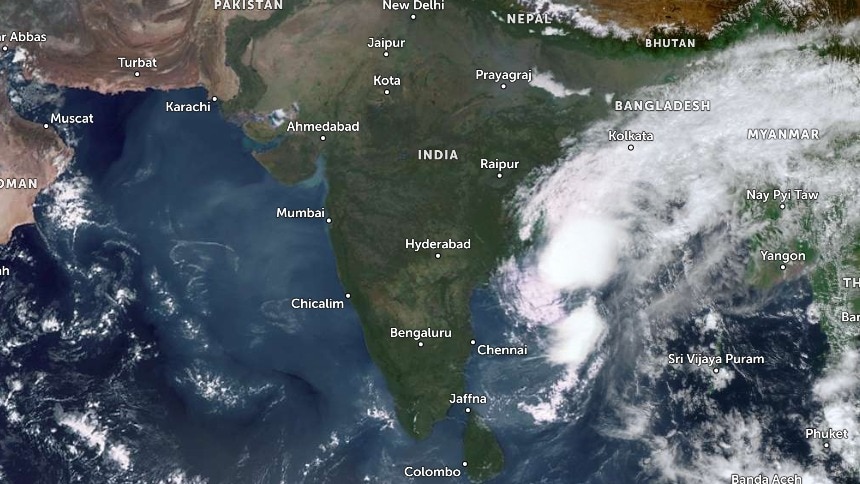
Cyclone Akvan, the third storm to threaten India's east coast in recent weeks, weakened on Friday as it began making landfall near Gopalpur in Odisha.The India Meteorological Department (IMD) said the system weakened from a severe cyclonic storm into a cyclonic storm overnight. The landfall process began early Friday along the North Andhra Pradesh-South Odisha coast. A satellite image shows Cyclone Akvan having made landfall in Odisha. (Photo: IMD) "The severe cyclonic storm Akvan has weakened into a cyclonic storm and now lies over the northwest, adjoining the West Central Bay of Bengal," IMD Bhubaneswar Director Manorama Mohanty told news agency ANI. "The current wind speed is about 80 to 90 kmph, gusting to 100 kmph."WHY DID CYCLONE AKVAN WEAKEN?Akvan formed over the warm waters of the Bay of Bengal and was initially expected to strengthen further, with wind speeds reaching 90-100 kmph or higher. However, conditions became less favourable as it approached the coast. A satellite image shows Cyclone Akvan making landfall on the Indian subcontinent. (Photo: IMD) Winds at different heights began blowing in different directions, disrupting the storm's structure. Cooler coastal waters and the mixing of drier air also limited its strength, preventing further intensification and weakening the system.WHAT HAS BEEN THE IMPACT OF CYCLONE AKVAN?The weakening is expected to reduce the risk of widespread damage to homes, trees and power lines in coastal villages across Ganjam, Gajapati and neighbouring districts.#WATCH | Gopalpur, Odisha: Rough seas, heavy rain and strong winds at the Gopalpur coast due to the impact of Cyclone Akvan. https://t.co/X6AxuCvNcq— ANI (@ANI) November 20, 2026However, heavy to very heavy rainfall remains a concern, with isolated areas potentially receiving more than 20 cm of rain.More than 3 lakh people have been moved to shelters across Odisha. Schools have been closed in several districts, dozens of trains have been cancelled, and rescue teams remain on standby.Akvan follows Cyclone Arnab, which made landfall near Narsapur in late October, and Cyclone Murasu, which approached the coast near Ongole in early November.The succession of storms has kept coastal communities on alert for nearly a month. NDRF personnel walk in a neighbourhood, spreading awareness about Cyclone Akvan. (Photo: PTI) WHAT'S NEXT FOR CYCLONE AKVAN?After crossing the coast near Gopalpur by late Friday morning, Akvan is expected to move inland and weaken further into a depression.Rainfall is likely to continue across parts of Odisha and neighbouring areas through the day as the system gradually loses strength.Authorities are continuing to monitor low-lying areas for possible flooding, even as the weaker winds offer some relief compared with earlier forecasts.- Ends
Why did Cyclone Akvan lose strength before making landfall in Odisha
Full Article
Original Source
Read the full article at Indiatoday →KhanList aggregates and links to publicly available news content. We do not host full articles from third-party sources. Always verify important information with original sources.