
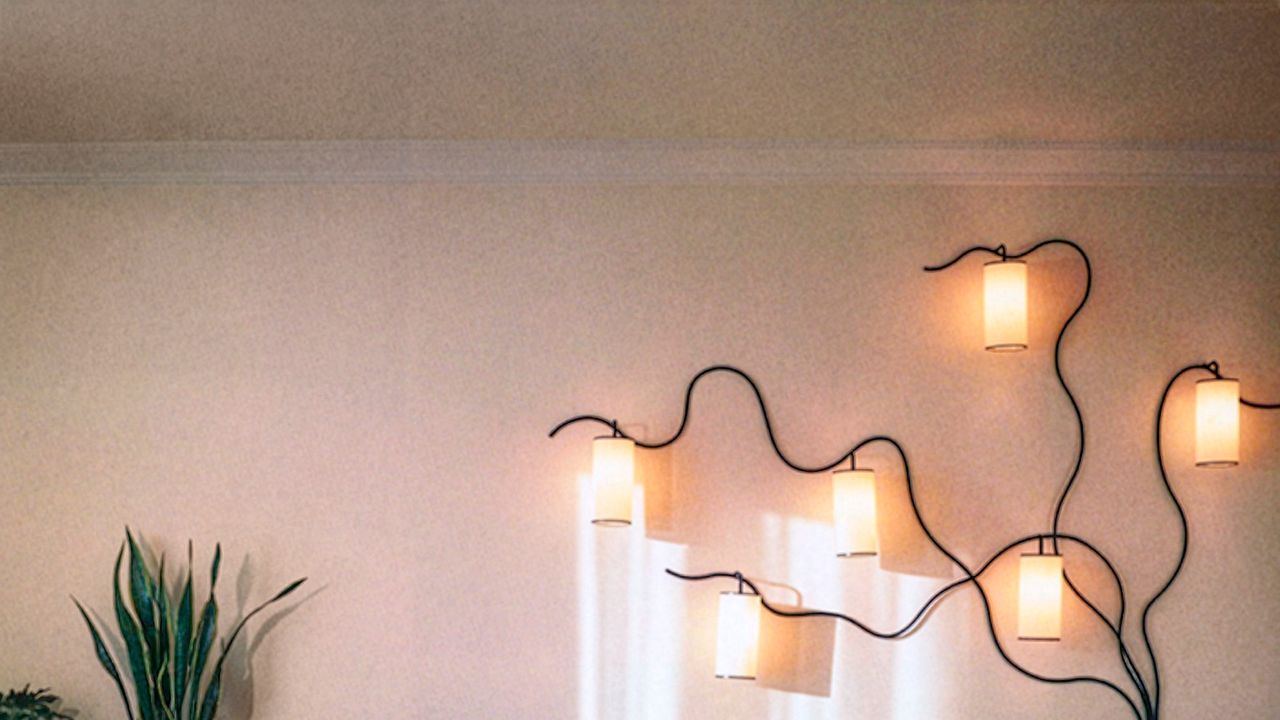
In 1949, just returned from a tour of Scandinavia, French designer Jean Royère penned a detailed report of his journey for the magazine Le Decor d’Aujourd’hui. In his entry about Stockholm, he gushed about the jungle atmosphere at Svenskt Tenn, the design emporium run by Josef Frank. “One must lift aside vines and branches to select a candy dish," he wrote. “In all these Nordic countries, there is a charming custom of incorporating climbing plants into interiors. I have seen living rooms where ivy zigzags around paintings and mirrors, circling the walls several times, and dining rooms where Virginia creeper trails down into the chandeliers.”Jean Royère’s Liane light fixture in Caroline Sarkozy and Jacques Lacoste’s Paris apartment. Photo: Jean-François JaussaudSoon after, Royère designed Liane—vine in English—a series of squiggly, hand-forged tubular steel lamps that crawled across the wall like ivy, with the stems held in a bouquet by a block at the base. Site-specific wall pieces made in the mid ’50s evolved into chandeliers, sconces, and even a tangled floor lamp, all of which got a coat of coral, blue, or black house paint (a few were gold leafed) that lent a unique, aged texture. Their cylindrical shades, with a color-matched paper trim, were made of cellulose acetate.A circa 1955 sketch of the wall light in blue Photo: Courtesy of Musée des Arts DécoratifsRoyère’s interest in tubular steel might have been picked up from the Bauhaus, but he livened up the industrial material with his playful touch—starting with a more controlled wiggle in the ’30s, which became progressively freer and more naturalistic over the decades. “It’s never purely expressive,” says Jonathan Wray, creative director at Royère. The brand was revived in 2018 by Vladimir Markovic, the great-nephew of Royère’s partner, Micha Djordjevic. “The decorative elements are always structural.”A fixture made for Royère’s client Monsieur Ranson, circa 1960s Photo: Courtesy of Musée des Arts DécoratifsToday, as shoddy Liane look-alikes proliferate in the market, real Royère-heads can order from a catalog of the 35 original Liane varietals (now made in powder-coated steel, with Japanese paper shades) but cannot specify bespoke versions. Consider it a work of art. “It’s an expression of his hand,” says Wray, inspecting one elaborate plan. “The result really feels like a wall drawing.”This story appears in the October issue. Never miss a story when you subscribe to AD.
Why Designers Can't Get Enough of Jean Royère's Liane Light Fixtures
Full Article
Original Source
Read the full article at Architecturaldigest →KhanList aggregates and links to publicly available news content. We do not host full articles from third-party sources. Always verify important information with original sources.