
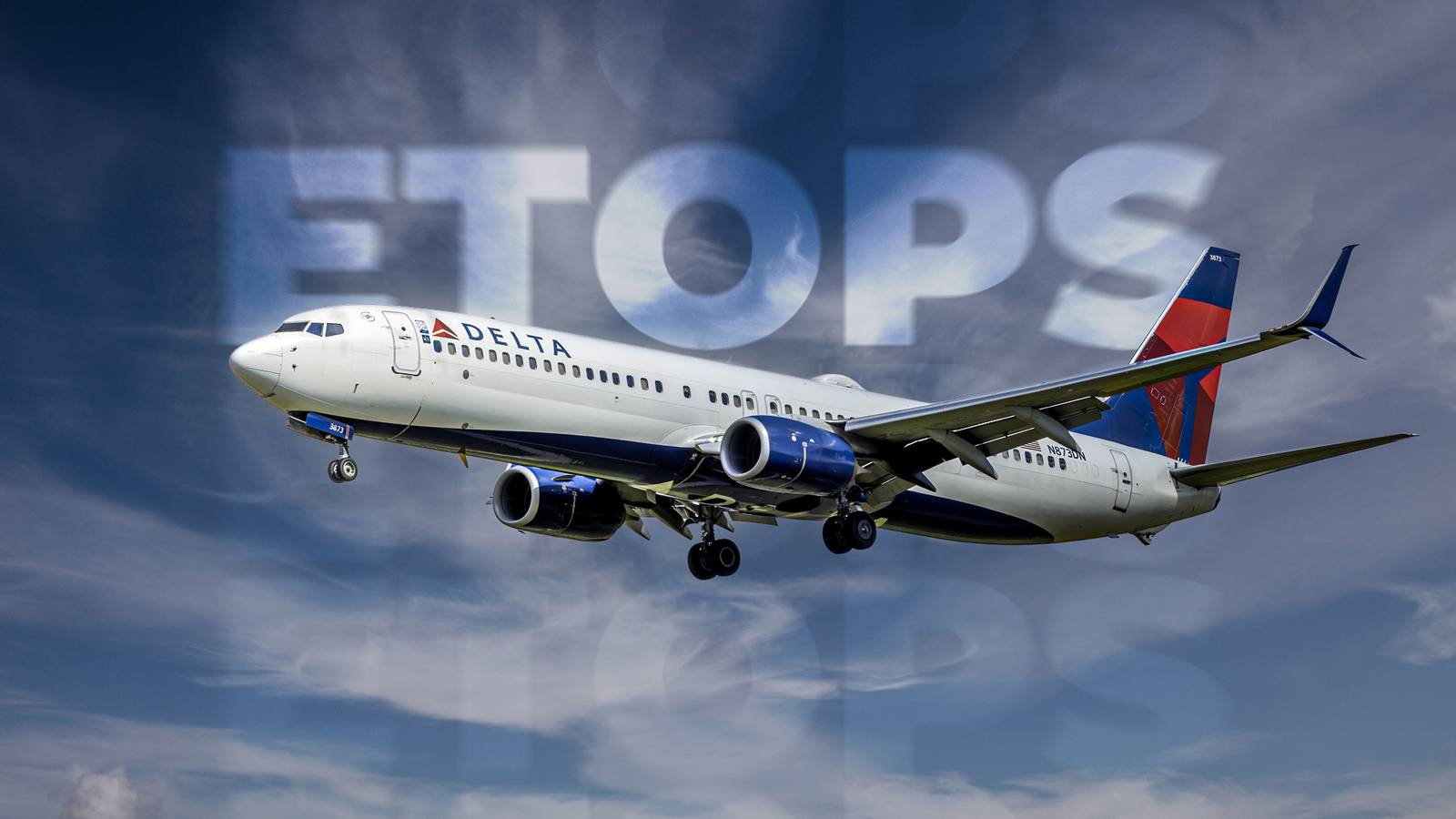
In 2011, Delta Air Lines announced an order for 100 Boeing 737-900ERs, the largest variant of the 737 family. It later ordered another 20 units in 2015 and another 10 in 2017, bringing its total to 130, and the airline acquired another 33 second-hand aircraft after COVID. They first started arriving in 2013, and the large, efficient 737-900ER has become a workhorse for Delta's domestic network. The type, however, isn't known for exceptional range and flies only within North America. Yet, these aircraft are certified for ETOPS-180 operations. ETOPS stands for Extended-range Twin-engine Operational Performance Standards (or alternatively, Engines Turn Or Passengers Swim), and ETOPS certification demonstrates that a twin-engine aircraft may safely fly more than 60 minutes from a diversion airfield. The number denotes how far the aircraft may fly from an airfield in minutes. Although the 737-900ER does not operate any transoceanic flights, Delta has chosen to maintain ETOPS certification on some of its 737-900ERs, but not all of them. The Importance Of ETOPS Certification Credit: Markus Mainka I Shutterstock Modern twinjets are certified by regulators with an ETOPS type design approval, but this doesn't mean that a specific aircraft is ETOPS-certified. Planes need to be individually approved for ETOPS operations, as the regulator needs to verify that the aircraft features special equipment mandatory for overwater operations and that the airline has procedures in place that comply with ETOPS practices. An airline could even choose to have just one aircraft certified for ETOPS, or it could certify its entire fleet if desired. The ETOPS certification process is expensive, and the extra equipment adds weight to the aircraft. Therefore, airlines generally only certify aircraft with ETOPS if the aircraft will regularly operate overwater flights to make the investment worth it. As an example, all of Delta's widebodies are ETOPS certified, but many of its short-haul aircraft are not. Notably, however, the 737-900ER lacks the range to operate transoceanic routes and is primarily used for domestic services. But although the 737-900ER is not generally known for having long range, the aircraft is still capable of operating longer services. This includes transcontinental flights or services to the Caribbean. While ETOPS is not generally necessary for Caribbean flights, it can permit more efficient routings in some cases, and the 737-900ER is still commonly deployed on the carrier's routes to this region. In addition, while the role of the 737-900ER has been changing as Delta receives a higher number of new narrowbody aircraft, the carrier formerly had a majority of its 737-900ERs ETOPS certified. Delta's Initial Role For The 737-900ER Credit: Robin Guess I Shutterstock Today, Delta only maintains a small subfleet of roughly 20 737-900ERs with ETOPS certification, while the remaining are not certified for extended overwater operations. However, many of these planes formerly featured equipment for ETOPS operations and were maintained to ETOPS-180 standards. Delta later removed the extra equipment from many of its 737s and no longer holds them to ETOPS standards. The 737-900ER was Delta's newest and most economical large narrowbody in the mid-2010s. With such a large order, the Atlanta-based carrier intended to deploy the 737-900ER throughout its network on some of its longest routes within North America. Some of these are Caribbean services that would require ETOPS certification for more efficient routings; hence, most of the 737-900ERs got ETOPS certification. In addition, Delta also originally intended to use the 737-900ER for some of its services to Hawaii from the West Coast, which necessitates ETOPS-180. ETOPS equipment and maintaining ETOPS certification for an aircraft is expensive, so Delta has removed it from most 737s as the airline uses the 737 on fewer overwater routes today. Part of this is because the carrier now has a large Airbus A321neo fleet, which has been deployed on longer Caribbean routes due to its excellent fuel efficiency. The other reason is that the previously planned Hawaii services didn't work out, and Delta pulled the 737s from these operations. Pushing The 737-900ER Too Far Credit: Robin Guess I Shutterstock Until the arrival of the 737-900ER, Delta primarily relied on the far less efficient 757 for its routes from the West Coast to Hawaii. In 2016, the airline began scheduling the 737-900ER on flights between Seattle and Honolulu, while the 737 began flying to Kona shortly afterwards. However, the airline would end up pulling the 737-900ER off of these routes, instead replacing it with the 757 again, as these routes pushed the 737-900ER too far past its payload-range limitations. The 737-900ER can and has operated longer routes than these Hawaii services, even for Delta itself. However, operating an ETOPS flight requires extra fuel reserves; in the case of the Hawaii routes, the aircraft needs to carry enough fuel to essentially turn around midway, as there are no diversion airports between the West Coast and Hawaii. The fuel reserves add significant weight, cutting into payload, and the 737-900ERs were frequently payload-restricted when flying to Hawaii, hurting revenue. United Airlines also faced this same issue when operating the 737-900ER to Hawaii, but the Chicago-based carrier had a smaller 757 fleet than Delta, and most of its examples were configured with lie-flat business class seats. Delta, with its large subfleets of domestic-configured 757s, was able to switch the routes back to the 757s, which cost more to operate but also earned more revenue. Today, Delta mainly relies on the A321neo for its Hawaii routes, while United relies on the 737 MAX, neither of which faces these issues. Different Approaches To ETOPS Credit: Robin Guess I Shutterstock Delta Air Lines uses the A321neo, 737-900ER, and 757 for routes to the Caribbean and Hawaii. Because its network of overwater routes within North America is operated by several types, the airline maintains subfleets of planes with ETOPS certification and planes without. Only about half of the A321neos are certified for ETOPS operations, as well as select 737s and 757s. As a whole, just over 100 of Delta's 828 narrowbodies are certified for ETOPS, because this is all that the airline needs. United Airlines, however, certifies all of its 640 737s and 61 757s for ETOPS operations. The 737s are the airline's primary aircraft for Caribbean and Hawaii routes, while the 757-200 is heavily used to Europe. The 757-300s are also still used on several of United's flights to Hawaii. Still, the carrier has significantly more ETOPS-certified aircraft than it likely needs; it even maintains ETOPS certification on its 12 737-900s, which mainly operate short domestic trips out of Houston. This is a costlier approach, but what it allows is operational flexibility. Delta Air Lines Narrowbody Fleet Number United Airlines Narrowbody Fleet Number Airbus A220-100 45 Airbus A319-100 64 Airbus A220-300 50 Airbus A320-200 61 Airbus A319-100 57 Airbus A321neo 77 Airbus A320-200 38 Airbus A321XLR 3 Airbus A321-200 127 Boeing 737-700 40 Airbus A321neo 111 Boeing 737-800 141 Boeing 717-200 74 Boeing 737-900 12 Boeing 737-800 77 Boeing 737-900ER 136 Boeing 737-900ER 163 Boeing 737 MAX 8 123 Boeing 757-200 70 Boeing 737 MAX 9 188 Boeing 757-300 16 Boeing 757-200 40 Boeing 757-300 21 Total 828 906 Planespotters.net If an ETOPS-certified 737 goes out of service, United can just swap it for another 737 without complicating the rest of its schedule. If one of Delta's ETOPS-certified 737s is taken out of service, the carrier has to swap it out for another ETOPS-certified 737, of which it has far fewer. Delta is maintaining separate subfleets of A321neos, 737s, and 757s, which is a less flexible arrangement regarding operational disruptions and spares. By certifying all of its 737s with ETOPS, United avoids this problem. United doesn't maintain ETOPS certification on its A319-100, A320-200, or A321neo fleets, and so it essentially designates one aircraft type (the 737) for Caribbean and Hawaii runs, while the A320 family is restricted to the US mainland. The catch is that this approach is more expensive upfront. ETOPS Certification In US Airline Operations Credit: Robin Guess I Shutterstock ETOPS certification is not generally required for flights from the US to the Caribbean. However, there are some airways southeast of Bermuda to the Eastern Caribbean that take an aircraft more than 60 minutes away from a diversion airfield, and if Bermuda is unavailable as a diversion point, then planes need to hug the Florida coastline. While ETOPS certification is not necessary for Caribbean flights, it does offer benefits through more direct flight paths, and it is necessary for Hawaii operations. To actually be certified for ETOPS operations, an aircraft needs to be maintained according to a special ETOPS program. It needs to be equipped with additional communications and navigation equipment, and an ETOPS-qualified mechanic is required to complete a service check before the flight. The engines must be inspected by two separate technicians, and the aircraft's maintenance logs also denote it specifically as being ETOPS-certified. ETOPS is meant to be a thorough process that ensures a twinjet can safely fly far away from a diversion point due to having only two engines. Because it's expensive, airlines generally only certify aircraft with ETOPS if the plane will routinely be used on overwater routes. Even if a route doesn't necessarily require it, ETOPS can offer better routings that save time and fuel. Today, 737s and A321s now routinely operate overwater routes to Hawaii or across oceans, and this would have been unimaginable 40 years ago.
Why Delta Air Lines Quietly Added ETOPS Certification To Its Boeing 737-900ERs Even Though They Don't Fly Transatlantic & Pacific Legs
Full Article
Original Source
Read the full article at Simpleflying →KhanList aggregates and links to publicly available news content. We do not host full articles from third-party sources. Always verify important information with original sources.