
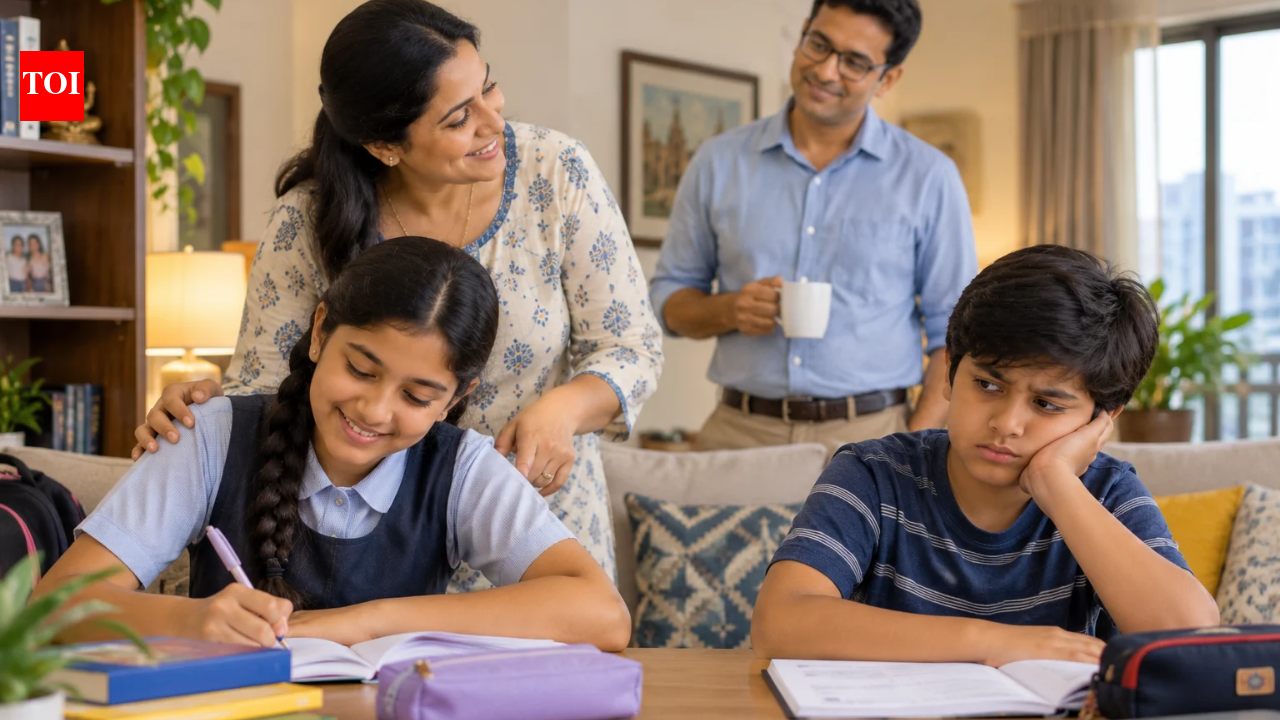
These comparisons can become particularly significant when children use their parents' reactions to understand who they are.“Look at your sister. She finishes her homework without being told. Why can’t you do the same?”For many parents, such a sentence may sound like an ordinary part of raising children. It might come out during a rushed school morning, while helping with homework or when one child refuses to follow instructions. The intention is often simple: parents want the younger child to learn from the older one, or hope that a little competition will encourage both children to do better.28 Sept 2026 | 08:18Does your teenager tell you about their friends, or do you often have to ask? How much do you know about their social life?But children may hear something quite different.One child may feel that their efforts are never enough, while the other may begin to feel responsible for always being the one who gets things right. Over time, what begins as a seemingly harmless comparison can influence how siblings view themselves, how they behave around each other and how they understand their place in the family.Psychological research suggests that the issue is not simply that parents notice differences between their children, but how those differences are communicated and whether children feel that they are being treated fairly.How sibling comparisons can change the way children see each otherChildren naturally notice differences between themselves and their siblings. They may compare marks, toys, friendships, physical abilities or the amount of attention each child receives from a parent. These comparisons can become particularly significant when children use their parents' reactions to understand who they are.Consider two siblings, one who finds reading easy and another who needs more time. If parents repeatedly praise the first child for being intelligent while asking the second why they cannot keep up, the difference may gradually become more than a difference in ability.The child who struggles may begin to see the sibling as a competitor rather than a companion. The child who receives praise may also become uncomfortable, especially if they feel that their achievements make their brother or sister look less capable.This does not mean that every comparison will create resentment or that siblings cannot motivate each other. Siblings can be important sources of encouragement and learning. However, repeated comparisons can make it harder for children to appreciate each other's strengths without feeling that they are competing for approval.A study published in the journal Child Development in 2000 examined sibling comparisons and parental treatment in 516 two-child families. The researchers found evidence that how parents treated one child could have different implications for that child's sibling in some cases. The findings highlighted how children may interpret parenting in relation to the treatment their siblings receive.The child who is always called the 'responsible one' can feel the pressure tooSibling comparisons do not affect only the child who is criticised. The child who is repeatedly described as more mature, obedient or academically successful may also feel trapped by the role.Imagine an older child who is frequently told, “You are the sensible one. Your younger brother looks up to you.” The statement may sound affectionate, but if it is used to demand constant patience, it can leave the older child feeling that they are not allowed to make mistakes or express frustration.The child may start hiding their own difficulties because they are expected to be the capable one. They may also become irritated with the younger sibling, who appears to receive more patience or fewer responsibilities.Meanwhile, the younger child may feel that the older one is always held up as the example to follow.This can create a subtle imbalance in the relationship. One child feels burdened by expectations, while the other feels that they are always being measured against a standard they cannot meet.Parents can acknowledge maturity and responsibility without turning them into permanent identities. Instead of saying, “You are the good one; learn from your brother,” they can recognise a specific action: “You remembered to put your books away today. That was helpful.”The difference is that the child is being appreciated for what they did, rather than being placed above another child.Why fairness matters more than treating both children exactly the sameAn important distinction in sibling relationships is the difference between equal treatment and fair treatment.A toddler may need more hands-on help than a school-going sibling. One child may need extra support with homework, while another may be allowed more independence. Different ages, temperaments and needs naturally call for different parenting approaches.Children do not necessarily expect every rule to be identical. However, they may become upset when they believe that differences in treatment reflect favouritism or that one sibling is consistently valued more than the other.A 2023 meta-analysis published in Developmental Psychology examined parental differences in the treatment of siblings across 23 samples, covering 13,628 participants. It found that differences in parental treatment were associated, in part, with differences between siblings themselves. For example, age gaps were linked to differences in parental control and the granting of autonomy.This is an important qualification: parents may treat children differently because their needs differ. The research does not suggest that every difference in parenting is harmful.What matters is how children experience that difference. If one child has a later bedtime because they are older, parents can explain why the rule changes with age. If one child needs more help with a school subject, they can clarify that receiving extra support does not make that child more or less loved.Such explanations help children understand that fairness does not always mean sameness.Comparing siblings can create a subtle imbalance in their relationship.When comparison begins to affect the sibling bondThe effects of comparison may not always appear as an obvious fight. Sometimes, a child may stop sharing achievements with a sibling, become reluctant to help them or dismiss their accomplishments.Other children may respond by trying harder to win parental approval. They may turn ordinary activities into competitions or become upset when a sibling receives praise.Research has also linked differences in parental treatment with sibling relationship quality. A longitudinal study published in Journal of Family Psychology in 2005 followed 133 families across three assessments. It found that changes in sibling relationship quality were associated with changes in children's adjustment. The study also found that as children became less favoured relative to their siblings, externalising problems increased.These findings describe associations, not a guarantee that sibling comparisons will lead to behavioural difficulties. Children's temperaments, family circumstances and the quality of their individual relationships with parents also matter.Still, the research offers parents a reason to pay attention to the messages children receive when siblings are repeatedly compared.A home where children feel they must outperform each other to be noticed may leave less room for cooperation. A home where each child's progress is recognised on its own terms can make it easier for siblings to celebrate one another.What parents can do instead of comparing siblingsParents do not have to stop noticing differences or praising good behaviour. The goal is to avoid making one child the standard against which another is judged.1. Compare a child with their own progress. Instead of saying, “Your sister learnt this much faster,” try, “You needed some practice, but look at what you can do now.”2. Praise specific actions, not fixed identities. Calling one child “the smart one” or “the responsible one” can create expectations that are difficult to escape. Recognise effort, patience, kindness and improvement in both children without ranking them.3. Avoid using one sibling to discipline another. If a child has not completed their homework, address the unfinished work directly. Bringing a sibling into the conversation may add shame without helping the child understand what needs to change.4. Make space for individual strengths. One child may enjoy drawing, another may be good at solving puzzles, and a third may need more time to warm up to new people. Children do not have to excel in the same areas to feel valued.5. Listen when a child says something feels unfair. Rather than immediately responding, “We treat you both equally,” ask what made the child feel that way. Their interpretation may not capture the entire situation, but understanding it can help parents address the concern.6. Encourage cooperation instead of competition. Give siblings opportunities to work towards a shared goal, such as preparing a meal together, building something or organising their toys. These activities allow children to experience each other's abilities as useful rather than threatening.The bigger lesson for parentsSibling relationships are shaped by many things, including age, temperament, shared experiences and the family environment. Comparisons alone do not determine whether children will grow up close or distant.However, children can learn to view their siblings either as people with different strengths or as rivals against whom their own worth is measured.When parents make room for individual progress, explain differences in expectations and avoid repeatedly placing one child above another, they help children understand that love and recognition are not prizes that must be won.The aim is not to make every child feel equally good at everything. It is to help each child feel that they have a place in the family that does not depend on being better than their sibling.
Why comparing siblings can hurt their bond, psychology says
Full Article
Original Source
Read the full article at Timesofindia →KhanList aggregates and links to publicly available news content. We do not host full articles from third-party sources. Always verify important information with original sources.