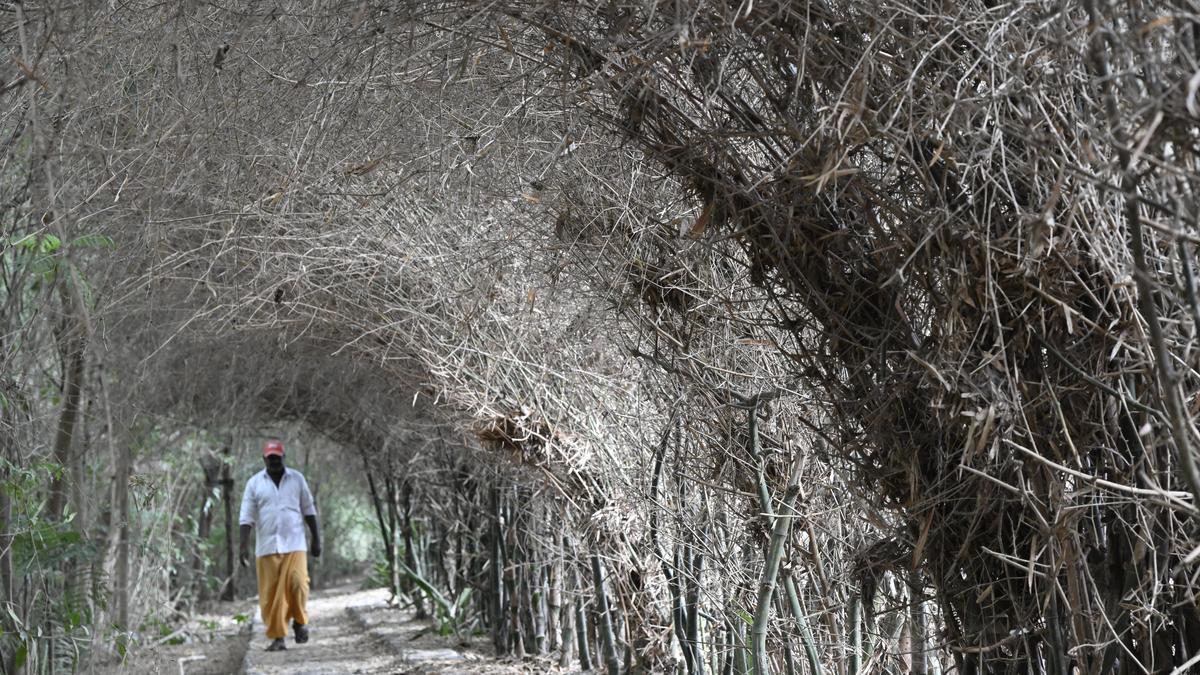
At the 90-acre Vellalore Lake butterflies bask in sunshine, ducks glide along the still waters, while pelicans stretch their wing. Along the bund, rows of tall, slender, and woody bamboo stalks sway, standing guard to this fragile ecosystem.A thriving bamboo fence project has been launched at two prominent water bodies in the city, the 20-acre Kolarampathy that surrounds iconic Perur temple like a necklace and picturesque 90-acre Vellalore Lake, home to city’s first butterfly park. The natural barrier aims to protect the tanks from encroachments and dumping of waste while reviving the bio-diversity of the lake. The picturesque 90-acre Vellalore Lake | Photo Credit: PERIASAMY M “Why not bamboo?” asks R Manikandan of Kovai Kulangal Padhukaapu Amaippu that restores neglected water bodies in Coimbatore. Coimbatore Tamil Nadu 29/07/2026: (for MetroPlus) The picturesque 90-acre Vellalore Lake in Coimbatore is a biodiversity hotspot with a thriving population of birds and butterflies. Photo: Periasamy M/ The Hindu. | Photo Credit: PERIASAMY M The NGO has implemented the project along with the support of the district administration and CSR initiative of JDFS Business Solutions LLP. “While tall palmyra trees lining lakes is a familiar sight even now, bamboo has completely disappeared. We are bringing it back,” he says adding that the choice is backed by research.“The bamboo root system grows into a dense ‘mat’ of fine roots which is shallow but wide spread. This means that its ability to hold soil together along fragile river banks (where erosion is possible) is excellent. A mature bamboo plant generates a higher output of oxygen. The green barrier discourages encroachments and illegal dumping of wastes while restoring bio-diversity by building a habitat for birds, rodents and other wildlife,” explains Manikandan. The bamboo fence serves as a biod-versity corriodr for birds, butterflies, and reptiles | Photo Credit: PERIASAMY M During the first phase, over 300 bamboo saplings of as many as 16 bamboo species including Burmese bamboo, giant bamboo, Taiwan giant bamboo, Travancore reed, Buddha belly, yellow bamboo and more have been planted along the lakes. “All the 16 species are highly effective in soil conservation, as they are clumping bamboos that grow close to each other featuring short root systems that expand slowly in tight clusters. It serves as living net under the soil and hold the earth together,” explains Dr Kannan CS Warrier, director of Kerala Forest Research Institute in Thrissur, which is home to Asia’s largest bambusetum with 72 species. He adds, “More than three lakh bamboo saplings are ready at our nursery for distribution across India. We will soon add new species to the collection and increase the number to more than 80.” Baburj’s bamboo house in Wayanad | Photo Credit: Special Arrangement M Baburaj, an environmentalist who lives in a three-storey ‘bamboo house’ in Meppadi, Wayanad says it has also emerged as a “magic material” for construction and interior design. Baburaj is the director of World of Bamboo, a craft village in Wayanad and has been promoting bamboo for the past three decades. Bird life at Vellaore Lake | Photo Credit: PERIASAMY M “Besides conservation, it’s time to look at eco-friendly industrial applications. Bamboo can serve as raw material in as many as 10 industries including sustainable architecture, lumbering, furniture, bioplastic making, ethanol production, bamboo fibre to name a few. We haven’t been able to develop the bamboo industry and tap its potential in areas such as architecture,” he says, drawing attention to bamboo biochar, which effectively improves the carbon content of soil by adding stable fixed carbon, boosting soil organic matter, and driving long-term carbon sequestration. Baburaj draws attention to global warming and climate change as realities staring at us in the face now. “. Beyond capturing carbon, it helps reduce greenhouse gas emissions, creates cooler microclimates, and improves groundwater recharge,” he says, adding, “One of the solutions to combating climate change may just lie in bamboo.” Bamboo nursery at Kerala Forest Research Institute in Thrissur | Photo Credit: Special Arrangement D Saravanan, an environmentalist who transformed 100 acres of barren wasteland in Poothurai village, near Villupuram district and Puducherry into the lush Aranya Forest and Sanctuary over a period of nearly 30 years says that the material, often referred to as ‘green gold’ and ‘poor man’s timber’, can replace wood in many applications. Besides native plants and water conservation methods, he used hundreds of bamboo trees to revive the local ecosystem, groundwater levels, and microclimate. Bamboo regulates oxygen and carbon dioxide in the atmosphere | Photo Credit: Special Arrangement Bamboo comes from the Dutch word ‘Mambu’ and in India there are 168 species, of which 106 are native and 42 are cultivated. It finds a mention in Kautalya’s Arthasastra as an important source of income. He adds, “It is the fastest growing biomass, reaching up to three feet daily. It can be harvested in three to five years and thrives in a wide range of environments. It holds a special place in crafts and can also be used to create biodegradable plastic.” Saravanan also explains how bamboo regulates oxygen and carbon dioxide in the atmosphere: “A hectare of bamboo plantation absorbs 17 tonnes of carbon in one year. Each bamboo plant absorbs 3.5 kilograms of carbon.” As many as 16 bamboo species are planted along Vellalore Lake in Coimbatore | Photo Credit: PERIASAMY M Dr Kannan picks the Taiwan giant bamboo as the most versatile and economically viable species while the Travancore reed bamboo is a key, endemic species of the Western Ghats that serves as a bio-diversity corridor. “Giant bamboo varieties form towering groves creating dense forest canopies. Burmese bamboo grows as a tall, dense clumping grass forming major mid-story layer in mixed deciduous forests. Others like multiplex or green bamboo, bush bamboo and needle bamboo build the under-story of forest, a perfect foraging ground for reptiles and rodents,” he says adding that the mid layer is ideal for nesting of song birds, tree frogs, and insects while the upper canopy attracts larger birds. Birds glide by at Vellalore Lake | Photo Credit: PERIASAMY M The restoration plan in Coimbatore includes clearing invasive vegetation and shrubs along a thousand-foot stretch of the tank bund, installing a 1,150-foot GI diamond mesh fence for protection, and providing drip irrigation to ensure the long-term survival of the bamboo plantation. Manikandan says the project is expected to stabilise the tank bund, improve biodiversity, provide shelter for birds and small animals, and also serve as a model for protecting other waterbodies. Bamboo nursery at Kerala Forest Research Institute in Thrissur | Photo Credit: Special Arrangement As it turns out, one of the most effective ways to protect a lake is to let nature do most of the work.
Why Coimbatore is planting bamboo around its lakes
Full Article
Original Source
Read the full article at Thehindu →KhanList aggregates and links to publicly available news content. We do not host full articles from third-party sources. Always verify important information with original sources.