
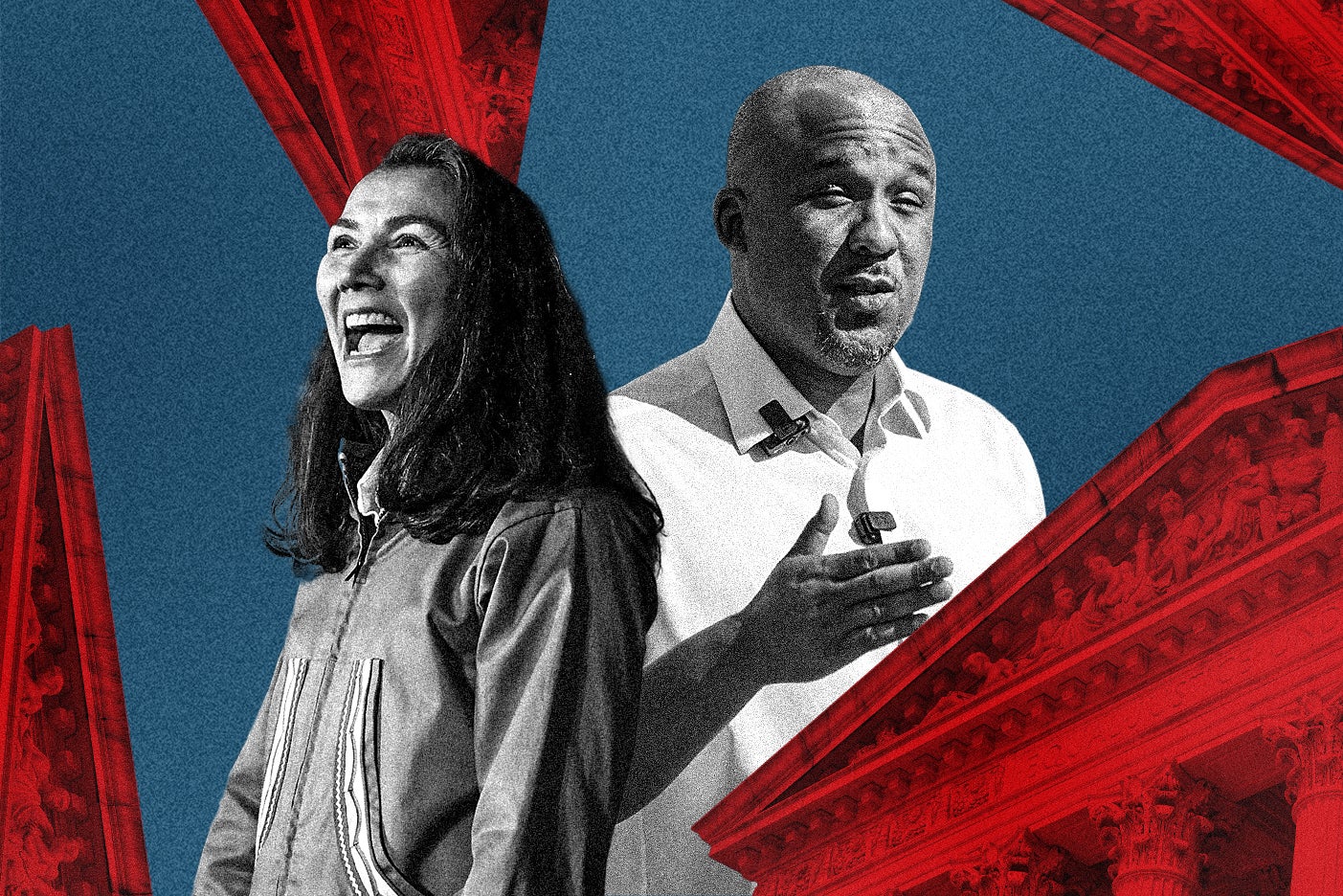
Jurisprudence By Enter your email to receive alerts for this author. Sign in or create an account to better manage your email preferences. Unsubscribe from email alerts Are you sure you want to unsubscribe from email alerts for Shirin Ali? Nov 05, 20265:40 AM Photo illustration by Slate. Photos by Rogelio V. Solis/Getty Images and Charly Triballeau/AFP via Getty Images. This is Executive Dysfunction, a newsletter that highlights one under-the-radar story about how Trump is changing the law—and how the law is pushing back—and keeps you posted on the latest from Slate’s Jurisprudence team. Click here to receive it in your inbox each week. Tensions were high going into Election Day, not only because control of Congress was up for grabs but also because President Donald Trump and his administration had spent months attempting to interfere with states’ electoral processes. Lawsuits were filed, letters were sent, and threats were made, yet in the end Democratic candidates across the country notched definitive wins with margins that, in the words of Trump, were simply “too big to rig.” Even Texas Attorney General Ken Paxton—and Trump himself—was forced to concede defeat. The judiciary played a major role in tamping down frivolous legal challenges before the vote, and now Democrats, with their handsome majorities in both the House and Senate, have a mandate to fulfill. Consequentially, the two biggest legal challenges that consumed the days leading up to the midterms have effectively been shut down. The Department of Justice’s lawsuit against California election officials, which argued that they must set aside some 20,000 mail ballots the federal government suspected of being cast by noncitizens, was shut down by the U.S. Supreme Court on Monday. And the day before, a federal judge dismissed the DOJ’s lawsuit in Alaska, which sought to separate and preserve certain ballots cast in the state’s Senate election in the event that Republican Dan S. Sullivan lost his race. Across the country, in almost every instance of the DOJ suing states for access to their voter rolls, the federal government lost its case. With all of that said, it’s worth looking at what the state of play is for any ongoing election challenges with a pair of major Senate races and a number of House seats yet to be called. The AFL-CIO, one of the largest national labor unions, sued the DOJ to stop it from demanding that state and local election officials separate disputed ballots and threatening prosecution if those ballots were counted. The case has been ping-ponging between judges at the 9th U.S. Circuit Court of Appeals, and on Election Day, the AFL-CIO asked the full court to weigh in—all 29 federal judges—and it remains to be seen where that may take this case. Over in Alaska, there was also new DOJ activity; this time, the agency sent 20 Democrats letters informing them that they may be targets of a federal investigation over donor fraud and conspiracy charges and that they should preserve certain records. Among those who received the letters was Marc Elias, a well-known elections lawyer who has represented Democratic Senate candidate Mary Peltola, whose Alaska race has yet to be called. It’s not clear yet where this investigation will go, if anywhere, though Joyce Vance, a former U.S. attorney for the Northern District of Alabama, noted in her Substack: “The idea of prosecuting these people is odd since the Alaska Supreme Court has already determined that both Dan Sullivans could be on the ballot.” These legal challenges, though significant, are not exactly to the tune of what was happening in the aftermath of the 2020 presidential election. In fact, the tone and temperature of the president and his allies have been markedly subdued since Tuesday night, with Vice President J.D. Vance putting out a surprisingly candid assessment of the Republican Party’s losses, while House Speaker Mike Johnson publicly acknowledged that the party had lost control of the House. Come Wednesday morning, Johnson also informed his staff that he does not intend to stay on as leader in the new Congress. To Charles Stewart III, a political scientist and professor at the Massachusetts Institute of Technology, this more muted reaction is likely because there is a realization setting in that “these intellectual wars, election administration wars, are not getting them what they’re trying to achieve, either on the political side or on the strategic side.” Even if a worst-case scenario breaks out in which the Trump administration or Republican candidates challenge election results or processes in tight Senate races in Alaska or Mississippi, “the heavy hitters of both the Democratic and Republican parties, with respect to legal talent, will not be spread thin,” Stewart told me. “I think it will be much easier for attacks on the democratic process to be beaten back.” That is especially true when considering Democrats’ margins of victory in certain states, like Texas and Georgia, where their candidates earned double-digit wins. Even in races that were closer, Democratic candidates secured comfortable vote counts that largely fall outside margins of error. This gives way to a math problem that Republicans simply cannot solve for; Democrats have so far earned 54 seats in the Senate, a body that confirms election results, and the Trump administration does not have a meaningful enough majority of Republicans to pressure its legal shenanigans onto this time around. “The margins last night are too big for DOJ meddling to make any sense, and it definitely won’t work,” Ankush Khardori, a former federal prosecutor, wrote. Harry Litman, a former U.S. attorney and deputy assistant attorney general, also expressed skepticism about meddling: “The most important defense/pushback/insurance policy against attempted election interference always has been a Democratic rout, which takes away the Trumpian bogus premise of a close election decided by illegal votes.” The bigger question now is if and how Democrats will use their congressional majorities. They will take over as chairs of the most powerful congressional committees capable of subpoenaing every single administration official, ally, or donor and deciding whether to penalize—or even possibly impeach—any of them for actions they’ve undertaken since Trump began his lawless second term. We hope you learned a thing or two from this edition of Executive Dysfunction. If you enjoyed reading it, please consider supporting our legal journalism by becoming a Slate Plus member! Elsewhere in Jurisprudence Catch up on Slate’s midterm coverage, with sharp analysis from Richard Hasen on democracy prevailing and the work that still remains. Plus, read about the dramatic rise and fall of Republican Sen. Susan Collins of Maine and how Republican Vivek Ramaswamy’s cruel campaign for Ohio governor came to a satisfying conclusion Tuesday night.On this week’s episode of Amicus, Dahlia Lithwick is joined by Ari Berman, the national voting rights correspondent for Mother Jones. They talk through the legal state of play heading into Election Day: the Alaska Senate race, California’s ballot segregation case.On the Amicus bonus episode, Dahlia is joined by Madiba K. Dennie to break down the latest Trump-Epstein news, the House Judiciary Committee’s latest report on the president’s ties to Epstein, and the legal strategy behind an LGBTQ+ case that was in front of the Supreme Court this week.Amicus’ “By the People” series concluded last month with a live conversation with a spectacular panel of heavy hitters: political organizer Stacey Abrams, constitutional law scholar Daphna Renan, and movement strategist Ilyse Hogue. Together, they discussed what happens when SCOTUS ceases to function as a backstop for democracy.Shana M. Broussard, the commissioner and acting chair of the Federal Election Commission, explains in Slate just how much money is being let into America’s federal elections. She breaks down the Supreme Court’s recent decisions around campaign donations and how the justices misunderstand the critical ways donations fuel political races. She argues that the FEC’s remaining rules and tools are ill-equipped to handle the corrupt levels of money being poured into races. Thank you for reading Executive Dysfunction! We’re thrilled to be in your feeds and will be back with more dysfunction analysis next week. Donald Trump Elections Jurisprudence Republicans Senate Voting Voting Rights Mississippi Alaska 2026 Midterms Executive Dysfunction
Why Challenges to a Fair Count in Mississippi and Alaska Will Fall Flat
Full Article
Original Source
Read the full article at Slate →KhanList aggregates and links to publicly available news content. We do not host full articles from third-party sources. Always verify important information with original sources.