
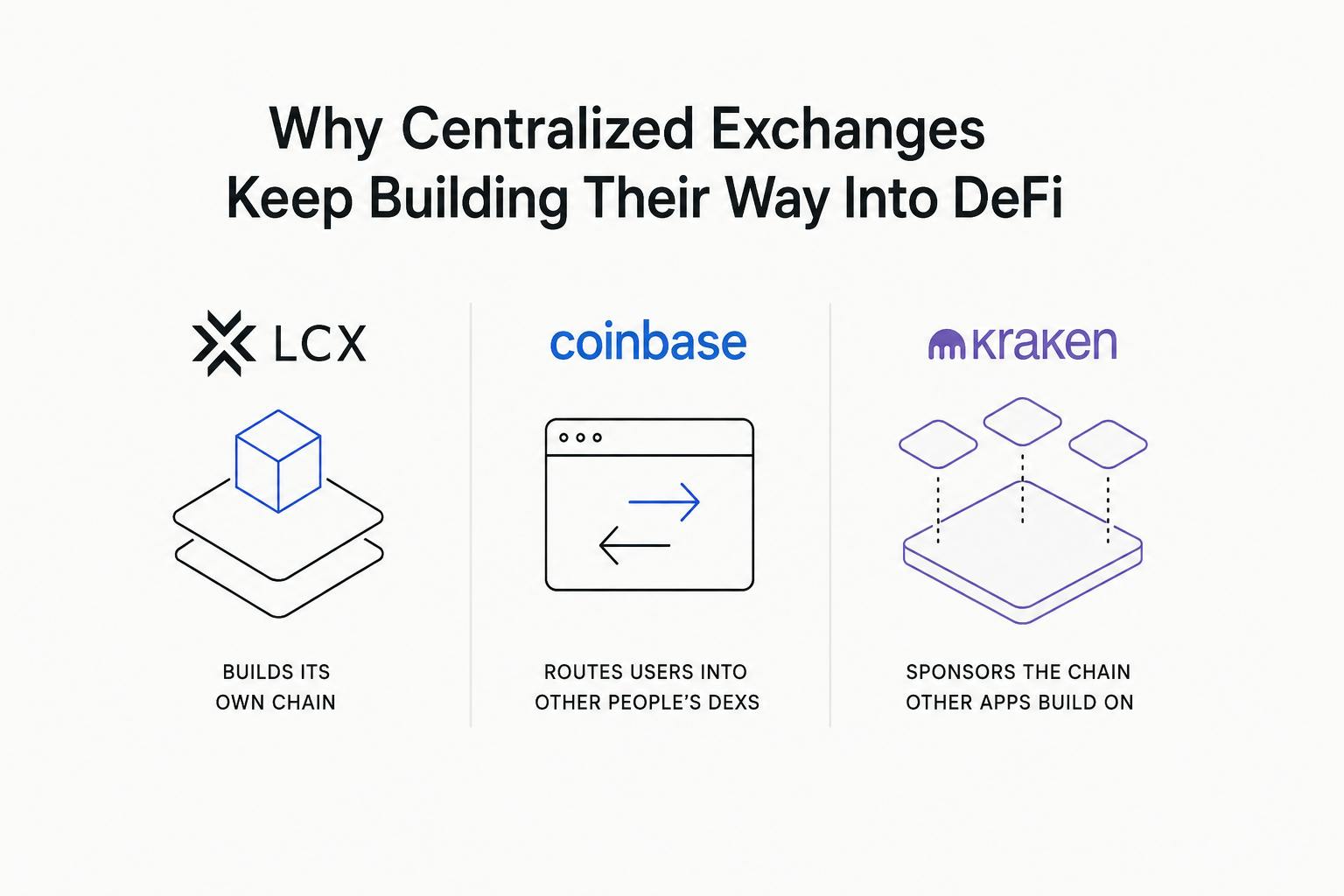
For most of the last decade, centralized exchanges (CEXs) and decentralized finance sat on opposite sides of a line. One side custodied your funds and asked for KYC; the other handed you a seed phrase and told you not to lose it. That line has been getting blurrier for a while, and 2026 is shaping up to be the year several major exchanges stop treating DeFi as a feature request and start treating it as core infrastructure. Three examples worth looking at side by side: LCX, Coinbase, and Kraken. Each is approaching the same problem: how does a licensed, centralized business plug into non-custodial, on-chain finance from a different angle? LCX: building its own chain LCX, a Liechtenstein-based exchange operating under Liechtenstein's Blockchain Act and pursuing MiCA authorization in the EU, recently consolidated its on-chain efforts under a single banner called LCX Liberty, hosted at defi.lcx.com. Rather than a single product, it's positioned as a product line, a hub page describing what's live, what's coming, and what the LCX token is for. Two things are running today, both still on testnet: LCX Liberty Chain, an OP Stack Layer 2 secured by Ethereum, EVM-compatible, and part of the wider Superchain. LCX is pitching it specifically at real-world asset tokenization, registering, verifying, and trading tokenized assets, rather than as a general-purpose DeFi playground. On its Meridian testnet, LCX cites roughly one-second block times and sub-cent transaction fees. LCX Liberty Explorer is a public, no-login block explorer for that chain. The framing throughout the announcement post leans on non-custodial design, keys stay on the user's device, and the idea that a growing product line will be added to over time rather than launched all at once. It's also notably a U.S.-incorporated entity (LCX Liberty Labs Inc., under the wider LCX Group) building the chain itself, which is a different bet than the two exchanges below: LCX isn't integrating with someone else's DeFi rails; it's trying to build and operate its own. Worth flagging plainly: both products are testnet-only right now, so none of the throughput or fee numbers above are backed by live mainnet economics yet, and LCX itself says mainnet timing will come through its own official channels rather than external commentary. Coinbase: routing users into other people's DEXs Coinbase's approach, visible at coinbase.com/dex, is less about building new infrastructure and more about surfacing existing on-chain liquidity inside a familiar app. Coinbase's DEX trading feature lets users trade tokens on Base and Solana directly from the regular Coinbase interface, without needing to open a separate wallet app or bridge into a different product. Practically, this means access to a much larger and faster-moving set of assets than Coinbase's traditionally vetted listings; tokens can become tradable within hours of launching on-chain, but with a clear trade-off Coinbase itself is upfront about in its FAQ: DEX assets aren't reviewed or held by Coinbase. They sit in a self-custodial wallet, and Coinbase's role is closer to a filter-and-display layer (flagging known scams via a third-party vendor, surfacing risk signals like holder concentration) than a custodian or curator. Fees stack a standard Coinbase trading fee with a separate DEX service fee, waived in part for Coinbase One subscribers. It's a hybrid model: centralized front-end and account experience, decentralized settlement and asset custody. Kraken's play is a third variation. Rather than building its own chain in-house the way LCX has, or piping users into third-party DEXs the way Coinbase does, Kraken helped launch Ink, an Ethereum Layer 2 built on the OP Stack, where Kraken itself acts as sequencer. Ink doesn't have its own gas or governance token tied to the L2, ETH is the gas token, though a separate utility token, INK, issued by an independent Ink Foundation, is intended to incentivize liquidity and DeFi activity across the ecosystem, with distribution still unfolding through Kraken-run programs and a broader airdrop. The DeFi activity itself lives with third-party protocols building on Ink, a perpetuals DEX (Nado), a lending market (Tydro), and integrations from established names like Velodrome and Curve, rather than products Kraken operates directly. Kraken has also layered a "DeFi Earn" product on top, routing user funds into yield strategies on protocols like Aave, Morpho, and Sky, and taking a cut of the rewards rather than the principal. According to third-party trackers, Ink had grown into a top-15 chain by total value locked within months of its 2025 launch. Same instinct, three different structures Line these up and a pattern emerges. All three exchanges are responding to the same pressure: trillions of dollars a year now settle on decentralized exchanges, and users increasingly expect access to on-chain assets without leaving a familiar app but they're solving it structurally differently: LCX builds and operates the chain itself, betting on tokenization as the wedge use case. Coinbase builds a discovery and execution layer on top of chains and DEXs it doesn't control. Kraken seeds and sequences a chain, then lets independent DeFi protocols build the actual applications on it. None of these fully resolves the underlying tension between custody and convenience. LCX's chain is still testnet-only. Coinbase's own FAQ is candid that DEX assets carry risks the exchange doesn't vet the way it vets its regular listings. Kraken doesn't custody the DeFi protocols its Wallet routes users into, and its Wallet's swap functionality doesn't yet cover every network it lists. What's changed is less about any single product and more about positioning: exchanges that spent years pointing users toward their own order books are now, in different ways, pointing at least some of that traffic on-chain. Whether that's a genuine shift toward self-custody or a more convenient wrapper around it is likely to stay a live debate for a while yet.
Why Centralized Exchanges Keep Building Their Way Into DeFi
Full Article
Original Source
Read the full article at Hackernoon →KhanList aggregates and links to publicly available news content. We do not host full articles from third-party sources. Always verify important information with original sources.