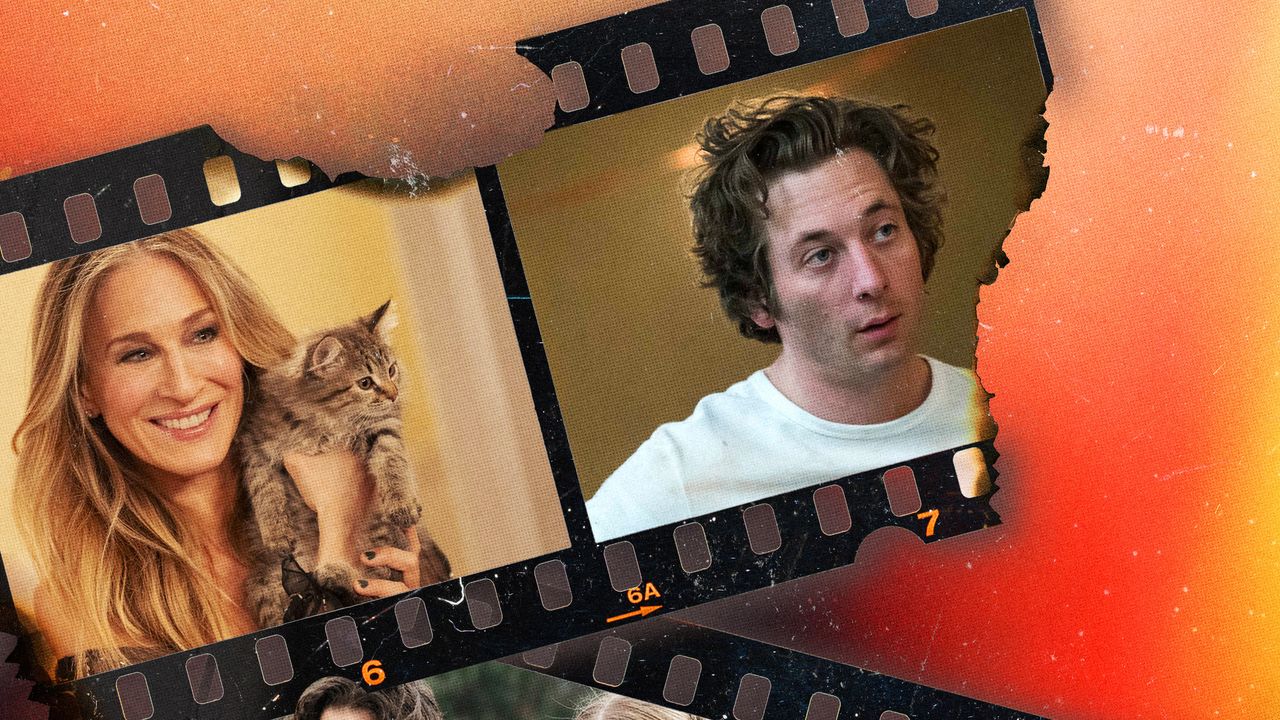
This story contains major spoilers for the final episodes of many different TV shows.Curb Your Enthusiasm was never particularly strict about its production schedule: Larry David and his team took more than two decades to produce the show’s dozen seasons. That 12th season became more of an event after David announced, in late 2023, that it would be the show’s last.In the Season 12 premiere, Larry visits Atlanta and runs afoul of a Georgia state law after handing a bottle of water to Leon Black’s Aunt Rae while she waits in line to vote. This sets in motion a full season of legal wrangling that culminates with Larry in a courtroom, where a variety of characters he’s tangled with over the years take the stand to help and hinder his defense—a riff, of course, on the widely reviled series finale of Seinfeld. Though David has consistently stood by the Seinfeld finale, the chance to take another crack at it is a quiet luxury few TV show creators will ever get. Knowing this, it’s kind of shocking how often series finales—even in the age of the auteur showrunner—leave viewers unsatisfied, tainting the cultural memory of a beloved series. And though each flop finale is its own special snowflake of disappointment, they can be sorted into a few broad categories.The Lore LetdownArguably, this is the most common finale fail, whether it’s the unsatisfying resolution to a show built around a thrilling mystery or paranormal investigation, or a capital-E Event that doesn’t land, like the Seinfeld finale. Even if a showrunner on a puzzle box show has a clear idea how many episodes it should take to get from series premiere to series finale, success on TV often means making more episodes, even when delaying the ending may not ultimately be what best serves the story. Some Lost fans speculated as early as the first season that the characters had died in the series premiere’s plane crash, and that the island they had found themselves on was Purgatory, where they would undergo tests to earn their places in Heaven. Series co-creator J.J. Abrams acknowledged and debunked this fan theory in an interview on 20/20—only for the final run of episodes to confirm those viewers had essentially been right all along, and leave the viewers who had kept watching feeling like they’d cynically been jerked around.Netflix/Everett CollectionLost’s sci-fi successor, Stranger Things, may have written itself into a mythology corner no one could have escaped (while dragging out its run for so long that some of its stars, who had débuted on the show as children, were married parents by the end). Still, when the “crushing disappointment” of a series finale is being covered by the business press and the show’s actors have to respond publicly to fans’ widespread fantasy of a surprise post-finale finale that would redeem the disaster Netflix had already dropped, it’s hard to argue something hasn’t gone awry.An excess of serialized mythology can afflict sitcoms, too. CBS’s How I Met Your Mother puts its central mystery right in its title: even though Robin (Cobie Smulders) is seemingly the perfect woman for narrator Ted (Josh Radnor), it’s revealed in the pilot that Robin is not the titular Mother. The show then took a preposterous eight seasons to reveal the actual Mother (Cristin Milioti); after the ninth and final season took 24 episodes, set entirely over a wedding weekend, to convince us that Milioti’s character was worth waiting for, the show kills her off and puts Ted and Robin together after all. (Maybe the most unlikely aspect of this show is that it’s about a dad taking 208 episodes to tell a story; most of the ones I know don’t even like to say “Hi” on the phone.)Since FX’s The Bear was less about plot than vibes, it might feel counterintuitive that its series finale should fall into this category. But it does! Even though I counted just 25 jokes across all 10 episodes of its fourth season, The Bear is officially classed as a comedy; count its nominations and wins in entertainment award bodies’ comedy categories as proof. And like its (official) genre-mate How I Met Your Mother, most of its final season is an excruciatingly slow march through what is, for its characters, a single day. Whereas the show’s previous season finales left too much unfinished, the series finale is overstuffed in a way no meal at The Bear, with its microscopic portions, could ever leave any guest: Carmy’s (Jeremy Allen White) really leaving fine dining, and Richie’s (Ebon Moss-Bachrach) is taking his first-ever plane flight to a hospitality conference in Japan (and his crush is going with him!), and The Beef is getting franchised, AND The Bear is getting two Michelin stars, AND it’s Richie’s daughter’s birthday party and they’re throwing her a surprise party at the restaurant, where the guest list seems to consist primarily of adults? There are so many characters we know by their first and last names to wrap that the abundance of fan service feels like it might turn out to have been a dream.Showrunner SadismOf course, we all understand that a story requires conflict. But some series finales make you wonder what kind of offscreen beef could inspire an ending so savage. The recent end of Euphoria is one such example. Every time this trailer started playing on HBO in the run up to the Season 3 premiere, what I saw wasn’t Rue running from unknown pursuers but Zendaya herself—who’d fully established herself as a generational movie star in the long gap after season 2—trying to escape the butterfly net Sam Levinson was chasing her with to drag her back to this oppressive morass of a show. But the last few episodes of the series are breathtaking in their cruelty: kidnappings, sexual humiliation, mutilations, multiple characters buried alive. Finally, Rue takes a Percocet, not knowing it’s been laced with fentanyl, and unceremoniously dies. Her seeming reincarnation as a calf (yes, really) is what passes for a happy ending—and hell, maybe trying life on earth again as livestock would be a relief after what Levinson put Rue through.HBO/Everett CollectionIn The Boys, suffering was impossible to avoid: the “previously” segment of the show’s penultimate episode is a supercut of anti-supe vigilante Hughie (Jack Quaid) being present and/or responsible for superhuman explosions over the years. But in the course of its run, the show—and its extremely thinly-veiled satire of our current neo-fascist reality—began to feel like a psychic attack on viewers. By the time Homelander (Antony Starr) creates a new religious sect enshrining himself as its Messiah, the show had been beaten to the punch by the notorious Truth Social post in which President Donald Trump shared an AI-generated image of himself as Jesus. I get why series creator Eric Kripke drew out the when-it-happens fantasy of Homelander’s assassination as long as he did. But if you were hoping to turn on an entertainment program to try not to think about an extremely unpleasant individual for one goddamn hour of the day, seeing his avatar evading consequences as easily in fiction as he does in reality could feel punitive. (And while we’re here: Kripke’s very public delight over Elon Musk decrying the murder of his fictionalized avatar makes Kripke seem less like an artist than a troll.)The Regrettable Rug-PullWe’ve all had the experience of falling in love with a show prevented from telling its whole story by early cancellation. In NBC’s original Quantum Leap, protagonist Sam Beckett (Scott Bakula) travels through time, “leaping” into a different body in every episode, striving—as the series’ opening narration put it—“to put right what once went wrong…hoping each time that his next leap will be the leap home.” The assumption was that at some point we’d see Sam resume his old life. Instead, the Season 5 finale—designed by creator Donald P. Bellisario to function as either a season or series finale, depending on the show’s fate—closes with a black screen abruptly informing the viewer that “Dr. Sam Becket never returned home,” the misspelled character name a final insult to everyone who’d hung with the show through 97 episodes. (Belisario was presumably leaving the door open for further adventures, which never materialized; although the 2022 NBC revival, with Raymond Lee as a new time traveler, was technically in continuity with the original, Bakula’s Beckett never showed up.)HBO/Everett CollectionWinning Time: The Rise Of The Lakers Dynasty was another instance of ambitious creators failing to find the audience to sustain their concept to its fullest. A scripted series adaptation of Jeff Pearlman’s nonfiction book Showtime: Magic, Kareem, Riley, And The Los Angeles Lakers Dynasty Of The 1980s, the show was peppered with direct address from multiple characters’ perspectives, and Adam McKay’s propulsive mixed-format directing on the series premiere (carried through the series by other helmers) made it fast-moving, soapy, and irresistible. Despite these strengths—plus a cast that included Oscar winner Adrien Brody and Tony and Pulitzer Prize winner Tracy Letts—the second season was such a ratings dud that Pearlman ended up basically begging people to watch it.The show opened with Magic Johnson (Quincy Isaiah) receiving his HIV diagnosis, then backed up to tell the story of Jerry Buss (John C. Reilly) acquiring the team in 1979; although these two timelines were obviously meant to converge, the second season only got as far as the 1984 NBA finals, before closing on a shot of Jerry and his daughter/heir Jeannie Buss (Hadley Robinson) sitting center court at the Forum, where Jerry tells Jeannie everything’s going to be okay. As a substitute for the seven years of basketball history the show wouldn’t get the chance to dramatize for us, it was a huge bummer. (Don’t tell me what happens: I still haven’t finished Pearlman’s book and there’s no other way I’m ever going to find out.)A disputed member of this class is HBO Max’s Sex & The City sequel And Just Like That…, whose third season started on a downbeat note—storylines about infidelity, unplanned pregnancy, and cancer—even before Sarah Jessica Parker announced, a couple of weeks ahead of the season finale, that the show was ending for good. Wrapping up a storied pop-culture franchise (six seasons and two movies, plus the revival) was never going to be easy—but the the AJLT… finale didn’t even deliver a satisfying conclusion to the season; it fails to pay off any ongoing storylines, mostly keeps its leads apart even though it revolves around a Thanksgiving dinner at Miranda’s (Cynthia Nixon) that everyone was invited to attend, and rewards one guest who does make it (Marcus, played by Victor Garber) with a toilet overflowing with turds. Creator Michael Patrick King has insisted that the show ended exactly the way he wanted it to, but given how messy it is in (literally) every way, it’s almost impossible to believe him.Last year, AppleTV brought viewers two seasons of sci-fi TV that had the fan-theory community roiling—the second season of Severance, about compartmentalizing one’s consciousness in order not to experience one’s working hours, and the first season of Pluribus, creator Vince Gilligan’s Breaking Bad follow-up, about the one woman left in America who hasn’t had her consciousness absorbed into a hive mind of alien origin. Severance had returned after a nearly three-year break; Gilligan isn’t even pretending he knows when fans will get more Pluribus, but it will probably be a matter of years, not months. As the TV landscape contracts and episode orders shrink accordingly, the pressure on showrunners to deliver series finales keeps growing. When network shows were delivering 22 episodes every year, it was easier to forgive episodes that were only okay; when a show drops a new season once per Presidential administration, expectations are naturally much higher, especially around series finales. Everyone watching today’s high-concept TV gems hopes their creators will bring them to a satisfying close. Those of us who are still alive whenever Pluribus and Severance wrap up can meet back here and see if that bet paid off.
Why Can't TV Finales Stick a Landing?
Full Article
Original Source
Read the full article at Gq →KhanList aggregates and links to publicly available news content. We do not host full articles from third-party sources. Always verify important information with original sources.