
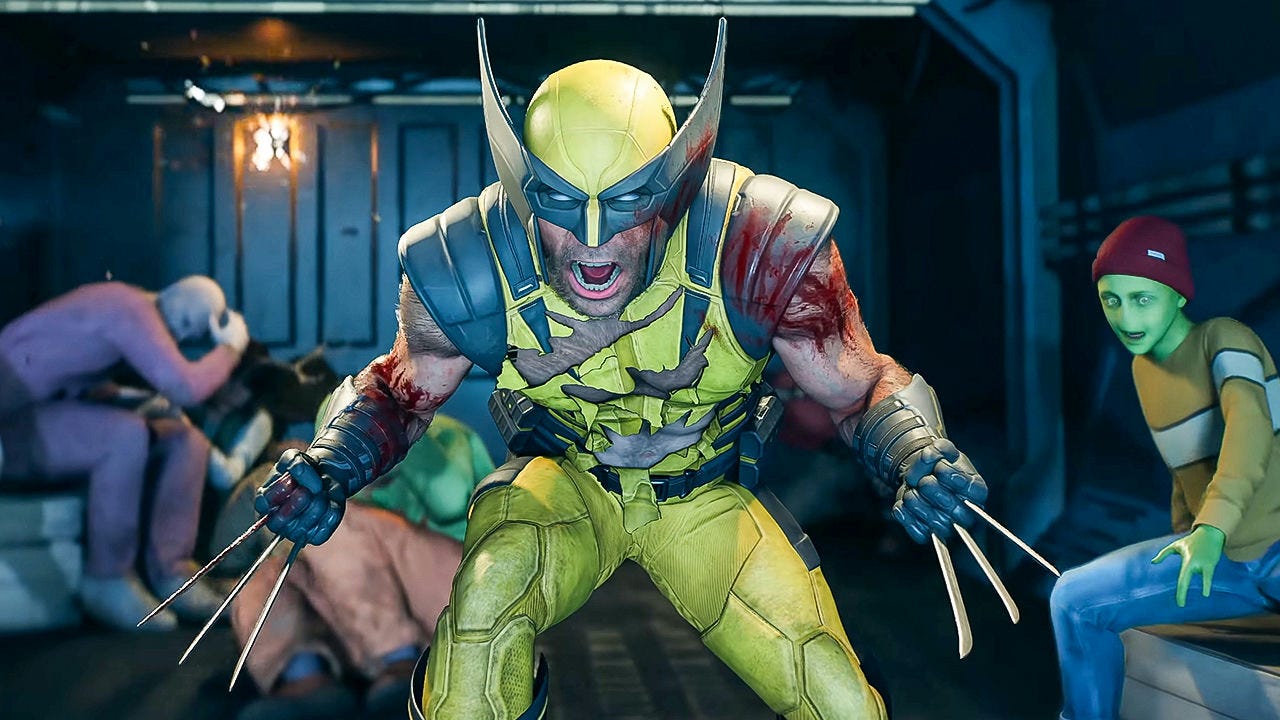
There’s one thing that immediately jumps out when you watch even just a few seconds of Marvel’s Wolverine in action: it’s jaw-droppingly violent. There is so. Much. Blood. After a fight with a single enemy, Wolverine is drenched in gore and his own flesh is cut to ribbons. By a comfortable distance, Insomniac’s follow-up to its Spider-Man series is looking like the most violent superhero game we’ve ever seen.While there will be a suite of violence customization settings for more squeamish players, it’s important to recognise that the immense violence on show here is not overkill. It’s actually completely in keeping with the character. The more you know about Wolverine, born as James Howlett, the more the hard-hitting bloodshed makes sense. This is not just violence for violence's sake. Let’s explore Wolverine’s complex comic book history to see why brutality is key to making the ultimate Wolverine game. Comics (and particularly Marvel’s output) have a reputation for being kid-friendly, but most issues focused on Wolverine are hyper-violent and intended for more adult readers. There are staggering amounts of blood and death within those pages. In fact, one of Wolverine’s in-game abilities, “Rage Mode,” appears to be directly inspired by Logan’s antics in the 2020 comic series Wolverine: Black, White & Blood. Wolverine: Black, White & Blood. Cover artists: Russell Dauterman and Adam Kubert.If your only experience of Logan comes via the X-Men films, then this may come as a surprise. While many of them are excellent, the movies present a much more family-friendly version of Wolverine. Hugh Jackman delivers plenty of the character’s trademark smart talk and attitude, but the majority of his appearances lack the visceral, cover-your-eyes kind of violence the character has delivered time and time again in the comics. Logan and Deadpool & Wolverine, both R-rated, get the closest to exploring his true nature, but even they still come in a few notches below the comics – yes, even that decapitation of Sabretooth is comparatively tame.Stripping the violence way back makes sense from a film perspective (and a box-office one), but it robs the character of a core part of what makes him tick. Sanitizing the violence sanitizes the man himself. The comics are about a character who doesn’t just fight when necessary to protect his friends – there is rage in Wolverine. Violence isn’t just something he’s capable of, it’s an intrinsic part of him that he cannot live without. This is the guy who tore Hulk open from the inside (WOLVERINE: OLD MAN LOGAN GIANT SIZED 2009 #1), and that kind of untamed brutality is what a great Wolverine game needs—it must explore his extreme relationship with extreme violence.The OriginThat relationship began early. In Wolverine: Origin (2001), young James Howlett is described as “frail and sickly.” His father, John, is kind and loving, but his mother has become a recluse since her eldest son died of illness. You can practically feel the heartbreak in his face as John looks up at his mother’s balcony, hoping to catch even a glimpse of her. He’s a sweet, loving kid who wouldn’t hurt a fly – a far cry from the clawed killer he’ll one day become. One moment changes everything: James watches a man called Logan kill his father with a shotgun. It’s a moment he can never return from. Completely and utterly overcome by rage, bone claws emerge from his hands for the first time, and he leaps at Logan, tearing apart his abdomen. It’s a natural, swift movement, as if James had been training for this his whole life. No longer the meek, sickly child: now, he is a brutal killer, so overpowered by grief that violence becomes the only answer. In the last frame of the story’s second issue, he kneels over the carnage he’s created, letting out a primal roar, a toxic mixture of grief and rage. He is no longer James. Now, he is Wolverine. The innocence he’s lost is gone for good.Wolverine: Origin. Artist: Adam KubertThis is an essential moment in understanding why Wolverine is prone to brutality. He’s predisposed to violence; when bad things happen, he doesn’t hesitate or hide, he gets brutal. He throws himself into action and doesn’t look back. This has remained consistent since he first appeared in Marvel comics in 1974. While many heroes refuse to kill, Wolverine has no issues taking a life. And so any game featuring Logan must channel a character that leaps into violence as an innate response. There’s another layer to the moment in the comics, one that may just confirm that Wolverine’s violence is, in fact, innate. The man who murdered James’ father looks exactly like the adult Wolverine. Even his hair is identical. It’s never confirmed, but it’s highly insinuated that Logan is actually James’ biological father. This means that not only did young Wolverine kill his own father, but Wolverine’s violence isn’t just a physical response to tough situations. It’s a genetic one; brutality is embedded into his very DNA. It is, essentially, what makes Wolverine Wolverine.Weapon XIn the 1960s, Wolverine found himself part of Team X, a black-ops military unit run by Weapon Plus and the C.I.A. Under their command, Wolverine is nothing more than a contract killer. He slices and dices his way through foes, being riddled with bullets and losing buckets of blood in one savage fight after the next. What’s most disturbing about Wolverine’s time with Team X isn’t how many gallons of blood he’s spilled—that’s incalculable—but how he’s treated by those who run the team. Wolverine Origins (Issues #6-7, 2006) shows how, after each mission, soldiers would riddle him with bullets and then wait for his healing factor to revive himWeapon X only served to exacerbate Wolverine’s already frail psyche and violent behaviour.“Wolverine would also be forced to swallow pills containing Carbonadium, a highly radioactive metal that blocks his healing powers. That mutation doesn’t just knit Wolverine's flesh and bones back together and ensure his long life; as something of a survival mechanism, the healing factor also suppresses his memories. But Weapon Plus doesn’t want Wolverine’s memories suppressed: they want them completely erased. And so they torture the subdued mutant in an electric chair until he no longer remembers anything. They even attempt to strip Wolverine of his identity, referring to him as Experiment X. No longer a person in their eyes, Experiment X is designed to be the ultimate killing machine.Weapon X. Artist: Barry Windsor-SmithMarvel Presents explored the Weapon X program in great detail, depicting the countless painful tests Wolverine endured. The images within the comic’s pages are nearly as disturbing as the experiments themselves. Panels are drenched in bold oranges, pinks, reds, and purples, creating a nauseating feeling. Barry Windsor-Smith’s artwork oozes that raw, edgy quality of Marvel’s late 80s/early 90s aesthetic, augmented with elements of body horror maestro David Cronenberg – we see Wolverine submerged in tanks with endless tubes and needles stuck in him. An experience like this would haunt anyone for life. But when you torture someone who’s already lived so many violent lives, Weapon X only served to exacerbate Wolverine’s already frail psyche and violent behaviour. Weapon X is the reason Wolverine has adamantium claws – the metal is bonded with his skeleton and thus his claws It’s an unbearably painful operation, but Weapon X presses on, unconcerned for Logan’s well-being and exclusively interested in making a super weapon. During the procedure, Wolverine wakes up, skin peeled off his body, screaming in agony, “What have you done to me?” It’s pure nightmare fuel, but it’s also perhaps the single image that best exemplifies why Wolverine is the way he is. Here is a man so tortured that he’s literally unrecognizable as a human being, stripped down to his savage bones.Because everyone treats him like a savage beast capable exclusively of brutality, that’s exactly how Wolverine sees himself.“In Wolverine’s world, violence consistently begets more violence. Eventually, the man who was once James Howlett finally snaps into his own consciousness and breaks out of the facility, utilising a level of violence we’d previously never seen from him. There’s a particular ruthlessness to his escape, tearing through soldiers to such a degree that blood saturates one panel after another.. He does it without a word – Weapon X has reduced him to nothing more than a feral beast. Even when he later regains consciousness and starts to recall his memories, that feral feeling never truly leaves him.Because everyone treats him like a savage beast capable exclusively of brutality, that’s exactly how Wolverine sees himself. This is precisely what a Wolverine game needs to explore. What does it feel like to control a man who only sees himself as a savage brute, capable of killing men with the blink of an eye? What does it feel like to leap from one person to the next, claws extended, with the sole purpose of taking their life away? This is what Insomniac needs to examine for Wolverine’s story (and, by extension, gameplay) to be successful.MemoriesWolverine’s saving grace comes when he joins Charles Xavier to become one of the X-Men. That’s where Logan truly begins to understand he’s more than just a killing machine. As part of the X-Men, he can finally serve the greater good, and he would start to become more of the warm, loving person he is—though not without his trademark edge. But Insomniac’s game takes place before Wolverine ever joined the X-Men. At this point in his life, all he knows is aggression. Because Marvel comics have multiple timelines, it’s impossible to say at this point exactly where Insomniac’s Wolverine fits. What we do know is that the game finds Wolverine returning to Team X after three years away. The game’s version of the taskforce appears to include Jean Grey, who is not part of the team in the comics, so there will certainly be key differences. Wolverine also has adamantium claws, so it seems likely that it’ll touch on his experience with Weapon X, too. But since the game takes place before Wolverine ever joined the X-Men, at this point in his life, all he knows is aggression. That’s why the game’s violence is so necessary.For better or worse, brutality is woven into Wolverine’s identity. And Insomniac’s latest appears to understand that better than any Wolverine or X-Men game we’ve played in the past. We can’t wait to see how it all unfolds on September 15.
Why Brutality Is the Key to Making the Ultimate Wolverine Game
Full Article
Original Source
Read the full article at Ign →KhanList aggregates and links to publicly available news content. We do not host full articles from third-party sources. Always verify important information with original sources.