
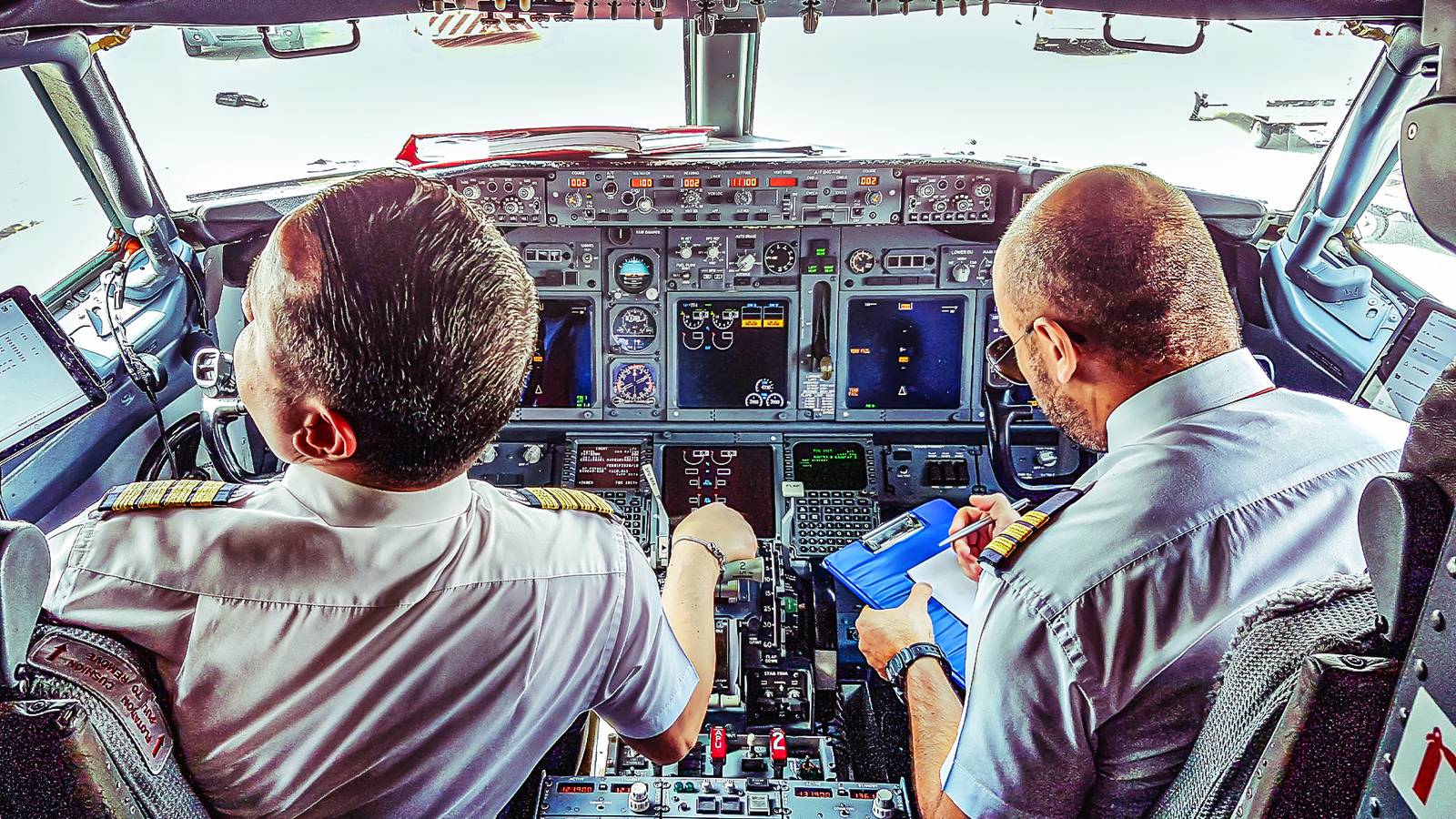
Published Jul 27, 2026, 11:00 AM EDT Airline and Airport Management Graduate, Student Commercial Pilot and Commercial Aviation Writer. Based in London & Nagoya Passengers looking closely at the timing of a commercial flight might notice a subtle change in the cabin environment during the final stages of a climb or descent. This guide introduces the concept of the micro-sterile cockpit window, explaining its vital role in modern aviation safety and what readers can expect when discovering how flight crews manage high-workload transitions. The foundation of the strict behavioral discipline in the flight deck comes from a deep focus on mitigating human error during critical phases of flight automation. Standard regulations mandate absolute focus during low-altitude operations, though progressive air carriers enforce an additional layer of absolute quiet right before capturing a targeted altitude. Change Drawn From Disaster Credit: Shutterstock Before specific restrictions were codified, pilots frequently engaged in casual conversations during critical flight regimes, treating low-altitude arrivals with a dangerous level of complacency. The lack of a structural boundary came to a tragic end following the crash of Eastern Air Lines flight 212 in 1974, an accident that fundamentally altered the human factors doctrine of global airlines. During the fatal instrument approach into Charlotte, North Carolina, the flight crew of the twin-engine McDonnell Douglas DC-9 jet became deeply entangled in non-pertinent discussions. The profound breakdown in situational awareness occurred while the aircraft was actively descending through its critical altitude layers, completely distracting the two pilots from monitoring their altimeters and rate of descent. The aircraft struck the ground miles short of the runway, resulting in 72 fatalities and giving the aviation industry little time to confront the lethal cost of casual cockpit chatter. In direct response to the safety findings of the National Transportation Safety Board, the Federal Aviation Administration enacted the famous sterile cockpit rule in 1981 under Federal Aviation Regulation 121.542. The landmark regulation strictly prohibits crew members from performing any non-essential duties or engaging in casual conversation during critical phases of flight, traditionally defined as operations below 10,000 feet (3,048 meters). What came was a legal boundary around pilot focus which successfully targeted the leading causes of landing and takeoff accidents, establishing a baseline of operational discipline that has saved countless lives over the subsequent decades. Adding Further Layers Of Protection Credit: Shutterstock Although the statutory boundary at 10,000 feet (3,048 meters) successfully protected terminal operations, modern data quickly revealed that altitude errors remained highly prevalent in the smooth, high-altitude cruise bands. To counteract this remaining operational vulnerability, forward-thinking airline operators and training captains began quietly implementing voluntary behavioral protocols that sit directly on top of the federal baseline. Having a refined procedure establishes a secondary, highly targeted micro-sterile cockpit environment during the final 1,000 feet (305 meters) of any vertical transition. During this critical vertical window, the flight crew enters an operational phase known as the Altitude Critical Area, where all non-safety communication is completely suspended. The primary purpose of this self-imposed protocol is to ensure that both the pilot flying and the pilot monitoring possess absolute cognitive clarity as the aircraft transitions its massive kinetic energy into a stable level-off. Flight crews will deliberately suppress internal communications, refuse non-essential radio transmissions, and completely eliminate public address announcements to the passenger cabin, creating an atmosphere of intense internal focus that alert passengers can often identify as a sudden drop in ambient cabin activity. Keeping strict environmental management is always calibrated to match the rapid rate of closure typical of modern commercial widebody and narrowbody transports. When a jet climbs or descends at a high vertical rate, the safety margin dissolves with astonishing speed, leaving no room for human distraction. Through extending the sterile cockpit ethos to every single level-off altitude regardless of geographic location or barometric pressure, airlines have successfully transformed NASA safety data into an actionable, minute-by-minute behavioral habit. Spacing Out In The Cruise Credit: Shutterstock The necessity for absolute silence increases dramatically when commercial aircraft operate within the highly congested high-altitude cruise sectors of global airspace. In these upper flight layers, airplanes are directed through a tightly controlled environment where vertical margins are squeezed to their absolute limits to maximize airspace capacity. Managing an aircraft within these high-density corridors needs an exceptional level of precision, as the traditional safety buffers used at lower altitudes are not the same. Narrow operational margins are structurally defined by the Reduced Vertical Separation Minimum framework, which governs the skies between Flight Level 290 and Flight Level 410. Within this specific airspace band, the mandatory vertical buffer separating opposing streams of heavy commercial jets rushing toward each other at Mach 0.80 is restricted to just 1,000 feet (305 meters). Consequently, any vertical deviation exceeding 300 feet (91 meters) is legally classified as a level bust, an operational failure that immediately threatens the integrity of the entire regional traffic flow. When a distracted flight crew accidentally breaches this vertical boundary, the safety nets of the aircraft are instantly pushed into high-stress activation. The onboard Traffic Collision Avoidance System ( TCAS) will immediately trigger a resolution advisory, issuing urgent, automated verbal commands to both flight decks to execute immediate evasive vertical maneuvers. Sometimes, aggressive pilot inputs can result in structural stress to the airframe, occupant injuries in the passenger cabin, and a cascading wave of tactical interventions by air traffic control as multiple aircraft are forced to rapidly clear the compromised sector. Battling Complacency Credit: Shutterstock This tactical focus on vertical boundaries is also an indispensable defense mechanism against the subtle traps embedded within advanced autopilot flight management systems. Modern flight guidance computers seamlessly control the vertical path of an airplane, but they can simultaneously cultivate an environment of dangerous complacency among the crew. If a flight deck team blindly assumes that the computer will always capture the target altitude flawlessly, they may lower their mental guard right at the most critical juncture of the climb or descent. It is not entirely straightforward to prevent this automation complacency from manifesting as a major safety incident, as slips are still a regular occurrence. However, airline operating procedures offer help by relying on a rigorous visual cross-check of the Flight Mode Annunciator located at the top of the primary flight displays. When the pilot monitoring verbalizes the mandatory 'one thousand to go' callout, all non-essential conversation must instantly drop away so that both individuals can focus on the status changes on their instrumentation. They are looking specifically for a critical mode transition, verifying that the autopilot actively shifts from a dynamic vertical rate mode into a dedicated capture status. If a crew remains deeply engaged in a casual conversation during this vertical transition, the subtle shift in text color or mode placement on the glass display can easily go completely unnoticed. A failure of the autopilot to switch from a high-rate climb mode into a dedicated capture status means the jet will continue its vertical trajectory, rapidly invading adjacent flight paths. The standard operating procedures are therefore designed to ensure that four eyes are fixed on the primary displays during the exact three seconds where automation anomalies are most likely to manifest. Behavior Patterns Noticed In Pilots Credit: Shutterstock A common scenario that crops up in incident investigations and frequently puzzles safety investigators is how two highly experienced pilots can perfectly read back an explicit altitude clearance from air traffic control and then completely fail to level off at that designated height. The persistent operational breakdown is heavily driven by a psychological phenomenon known as expectation bias, where the human brain defaults to processing what it anticipates based on past routine rather than reality. When a flight crew routinely climbs to a specific cruise level on a daily route, their minds are naturally primed to expect that identical clearance from the controller. When a controller issues an unexpected restriction instead, a distracted crew might nod and read back the words correctly while their hands mechanically program the familiar, incorrect altitude into the flight guidance panel. Enforced silence during this critical phase strips away the competing auditory noise, leading the conscious mind to actively engage with the specific digits delivered by air traffic control. Cognitive Threat Type Psychological Mechanism Operational Impact Flight Deck Countermeasure Expectation Bias Brain substitutes routine for actual instructions Misdialed altitude windows based on past flights Silent cross-verification of programmed inputs against the actual ATC clearance. Cognitive Tunneling Intense fixation on a single technical problem Total loss of overall flight path awareness Immediate suspension of secondary tasks to prioritize vertical flight monitoring. Auditory Overload Competing speech patterns jam working memory Delayed processing of critical radio transmissions Micro-sterile window eliminates internal chatter to prioritize external control inputs. The targeted quiet period also directly combats cognitive tunneling, a state where a pilot becomes so intensely focused on a single technical task or minor system message that they completely lose awareness of the broader flight path. If an unexpected radio call or caution light illuminates within the final 1,000 feet (305 meters), the immediate suspension of conversation prevents processing delays within the cockpit. Silence Conveys The Message Credit: Shutterstock The practical implementation of these minute-by-minute behavioral rules has quietly become a hallmark of premier international air carriers operating across global networks. Legacy operators have integrated these micro-sterile protocols deep into their standard operating manuals, recognizing that standard regulatory baselines represent the bare minimum of safe operation rather than the gold standard. From a passenger perspective, the sudden quiet is most definitely for a reason. It demonstrates a flight deck that deliberately isolates itself from the cabin during the most dynamic windows of the journey. Flight attendants are trained to respect this operational boundary, completely withholding non-urgent cabin notifications and ensuring that the public address system remains entirely clear of superficial announcements as the aircraft approaches its level-off. As a result, the final stages of a climb or descent are handled with the identical professional sanctity reserved for landings and takeoffs. Turning attention to the future of aviation safety, the integration of real-time flight data monitoring and predictive human factors tracking will likely automate these silent windows even further. Next-generation flight decks may feature adaptive instrumentation that dynamically declutters secondary screens and highlights altitude capture tracking as the closure rate accelerates. Technology can never replace proper training, and the self-imposed discipline of the flight crew still remains the final, absolute defense line keeping the global airways safely separated.
Why Both Pilots Stop Talking For The Final 1,000 Feet Of Every Climb & Descent
Full Article
Original Source
Read the full article at Simpleflying →KhanList aggregates and links to publicly available news content. We do not host full articles from third-party sources. Always verify important information with original sources.