
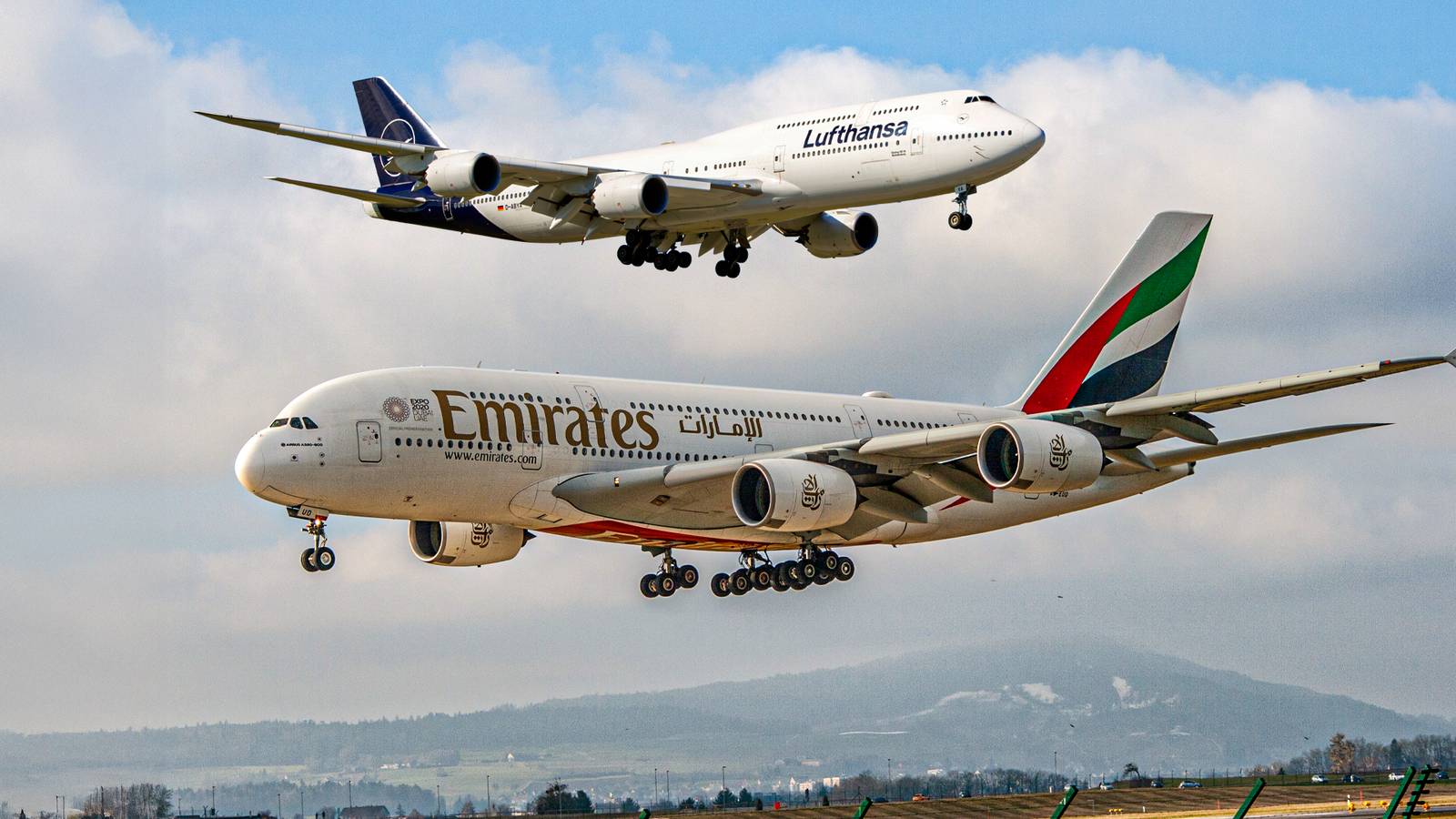
Published Nov 12, 2026, 9:00 PM EST Luke Diaz is a freelance military writer with experience with active duty experience in the US Navy as well as defense and industrial engineering. He is a former Naval Flight Officer who performed tactical air control on the carrier-based E-2 Hawkeye. Sign in to your Simple Flying account Airbus built the A380 as a completely clean-sheet, brand-new design, whereas Boeing designed the 747-8 as an evolution of its existing 747-400 platform. The European planemaker's design enabled the maker to incorporate unproven, cutting-edge hybrid materials into a newly designed factory infrastructure; Boeing chose traditional aluminum for the 747-8's fuselage to maintain production compatibility, minimize development costs, and speed up its time-to-market. Boeing reused the same manufacturing jigs, tools, and fuselage cross-section geometry as older 747 models for its final iteration of the iconic jumbo jet. Changing the primary material to a hybrid or composite would have forced Boeing to completely redesign the production line. Opting for traditional aluminum ensured production continuity and structural designs, adhering to proven standards and avoiding billions of dollars in infrastructure costs. For a niche, low-volume superjumbo market, Boeing could not financially justify building a brand-new factory line. This choice reflects the challenges faced when modifying an existing aircraft's design, which limits flexibility and necessitates adherence to historical practices. Boeing chose to spend its engineering and material budget where it mattered most, which was the wings. The 747-8 features advanced alloys and carbon-fiber composites, applying engineering breakthroughs borrowed from the 787 Dreamliner. What GLARE Is & Why Airbus Wanted It But Boeing Walked Away Credit: Karlis Miksons | Shutterstock While carbon fiber composites (CFRP) would have provided even higher weight savings, aluminum avoided billions in infrastructure costs that would have come with a 747-8 made with advanced hybrid materials. CFRP and other composites require billions of dollars in specialized molds, tape-laying robotics, and colossal autoclaves. Because the superjumbo market for the 747-8 was projected to be a low-volume, niche segment, Boeing could justify the manufacturing infrastructure costs. Airbus was also forced to curtail much of its composite use in the A380 due to limited market demand for the superjumbo. Thus, the A380 uses Glass Laminate Reinforced Aluminum (GLARE) selectively, applying roughly 5,382 square feet (500 square meters) of it strictly to the upper shell of the front and rear fuselage sections. Airbus chose this layout because the top of a double-decker passenger cabin is under constant high-tensile stress from internal pressurization. Over thousands of flights, this pressure cycles up and down, causing traditional aluminum to form tiny microscopic cracks. Boeing encountered complications when using new aluminum-lithium alloys, which cracked during production, leading to additional weight and financial repercussions. Meanwhile, the internal glass-fiber layers inside GLARE act as microscopic firewalls. If a fatigue crack forms in the aluminum layer, it hits the glass fibers and stops dead, allowing Airbus to shave thousands of pounds off the upper fuselage weight while making the cabin safer. Credit: Parkdolly | Shutterstock During the development of the A380 and the 747-8, engineers advanced third-generation aluminum-lithium (Al-Li) extrusions for internal fuselage structures such as stringers, floor beams, and seat tracks. Lithium is the lightest metallic element, and adding it to aluminum reduces density while significantly increasing stiffness, offering an attractive way to shed weight without switching to CFRP. The Airbus A380 is a massive, full double-decker leviathan built with an optimized cabin volume, whereas the Boeing 747-8 is a sleek, stretched evolution of a classic platform designed with a tighter cross-section and a wing footprint optimized for speed over sheer bulk. Despite this massive difference in physical scale, where the Airbus operates with vastly more structural dead weight, both engineering teams smashed into the exact same metallurgical and financial barriers when trying to step into next-generation materials. Early implementation of Al-Li ran into severe structural issues, specifically micro-cracking and stress corrosion cracking along the grain boundaries created during the extrusion process. The table below illustrates the scale of the massive jets: Specification Airbus A380-800 Boeing 747-8I Typical 3-Class Seating 525 passengers 410 passengers Maximum Certified Seating 853 passengers 605 passengers Overall Length 238 feet 7 inches (72.72 meters) 250 feet 2 inches (76.25 meters) Wingspan 261 feet 8 inches (79.75 meters) 224 feet 7 inches (68.45 meters) Maximum Takeoff Weight (MTOW) 1,268,000 pounds (575,155 kg) 987,000 pounds (447,696 kg) Operating Empty Weight (OEW) 610,000 pounds (276,691 kg) 485,300 pounds (220,128 kg) Maximum Structural Payload 185,400 pounds (84,100 kg) 168,100 pounds (76,249 kg) Maximum Fuel Capacity 85,472 gallons (323,546 liters) 63,034 gallons (238,610 liters) Maximum Range (Design Payload) 8,000 nautical miles (14,800 km) 7,730 nautical miles (14,310 km) Total Production Count 254 aircraft 155 aircraft The physical realities of shear loads and bending stresses around major openings forced both companies to abandon advanced materials in high-stress zones, requiring Airbus to strip GLARE off the aircraft belly to prevent compression buckling and forcing Boeing to keep traditional monolithic aluminum around its massive cargo doors to endure industrial freight operations. Simultaneously, the manufacturing process of GLARE necessitated advanced factory equipment. Fokker employed a technique of rolling thin aluminum sheets over glass fiber layers, using a high-capacity autoclave for curing. This innovative assembly method permitted the creation of larger panels than traditional processes would normally allow, as the glass fiber effectively bridges the seams between metal layers. The Assembly Stress Crisis: Why Aerospace Giants Reverted To Conventional Alloys Credit: Markus Mainka | Shutterstock Early assembly work on the first 747-8 to commence flight testing, RC501, revealed significant metallurgical issues, with parts exhibiting thermal warping, low fracture toughness, and stress corrosion cracking. The cracking crisis forced engineers to immediately abandon or pull back on advanced lightweight extrusions and execute a quick reversion to heavier, conventional aerospace alloys like standard aluminum. In an identical parallel, the internal wing ribs and brackets of the Airbus A380 experienced similar structural fracturing under assembly stress, prompting Airbus to spend hundreds of millions of dollars retrofitting early-production aircraft with standard, heavier aluminum components to ensure structural safety. Meanwhile, cargo carriers saw the complex maintenance of a material like GLARE as a liability and potential failure point. Milestone Airbus A380 Program Boeing 747-8 Program Official project launch December 19, 2000 (Launched as the A3XX program) November 14, 2005 (Launched as the 747 Advanced) First factory rollout January 18, 2005 November 12, 2009 (Freighter) / February 13, 2011 (Passenger) Maiden flight April 27, 2005 February 8, 2010 (Freighter) / March 20, 2011 (Passenger) First commercial delivery October 15, 2007 (Delivered to Singapore Airlines) October 12, 2011 (Freighter to Cargolux) / May 5, 2012 (Passenger to Lufthansa) Commercial entry into service October 25, 2007 October 12, 2011 (Freighter) / June 1, 2012 (Passenger) End of commercial production December 16, 2021 (Final delivery made to Emirates) January 31, 2023 (Final delivery made to Atlas Air) Boeing chose to stick entirely with aluminum for the 747-8 fuselage to keep operations simple, 'bulletproof,' and easy to patch anywhere in the world. Even Airbus followed this approach when configuring the lower fuselage sections of the A380 where cargo doors are located. In places where heavy bending stresses occur, GLARE and other composites were entirely removed in favor of advanced monolithic aluminum alloys to resist buckling and shear loads. Enter Fokker: Making Giants Fly Through Collaboration Credit: Mariusz Klarowicz | Shutterstock The historical collaboration between Fokker Aerostructures and the development of the Airbus A380 and Boeing 747-8 helps illustrate the ongoing challenge of weight reduction in both programs. Fokker, in the latter half of the 20th century, advanced the science of structural metal bonding by replacing mechanical riveting with specialized adhesive techniques. This technique evenly distributed internal stresses across aerospace-grade aluminum layers, creating exceptionally fatigue-resistant structures. By the late 1980s, Fokker enhanced this technology through a research partnership with the Delft University of Technology to develop GLARE, a hybrid material featuring ultra-thin sheets of glass-fiber epoxy sandwiched between aluminum layers. Airbus utilized this lightweight laminate across the massive upper fuselage of the A380 to absorb high-altitude pressurization loads and shed thousands of pounds of empty weight. In contrast, the Boeing 747-8 could not accommodate Fokker's advanced material because the program relied strictly on a derivative design strategy that reused legacy tooling. Integrating GLARE into the 747-8 supply chain would have required Boeing to abandon its existing assembly lines and invest billions in specialized cleanrooms and autoclave infrastructure, destroying the financial logic of the program. Ultimately, both manufacturers had to retreat to conventional aluminum alloys in high-stress zones, reaffirming Fokker’s early technical warnings that lightweight hybrid materials remain structurally limited when subjected to severe, multi-axial operating forces. The Sunset Of Quadjet Aluminum Widebodies Closed An Industrial Epoch Credit: Edu Perez | Shutterstock The commercial decline of the quadjet era is perfectly epitomized by the severe structural and financial challenges that plagued the 747-8. Launched in 2005 as the 747 Advanced, the program aimed to merge the next-generation cockpit and engine technologies of the 787. Initial production models suffered from drastic weight growth and excessive fuel burn, prompting launch customer Cargolux to flatly reject its first deliveries in late 2011 until steep financial compensations and emergency engine upgrades were secured. The passenger version, introduced by Lufthansa in 2012, also struggled with engineering issues, including emissions mandates that compromised its performance. By 2023, only 155 units were produced, largely freighters, highlighting a market shift towards efficient twinjet designs like the 787 and A350. When the final 747-8 Freighter rolled off the line and was delivered to Atlas Air on January 31, 2023, it brought a definitive end to a historic 54-year production span, coming just over a year after Airbus closed its own A380 assembly line in December 2021.
Why Boeing Chose Traditional Aluminum For The 747-8's Fuselage When Airbus Used Hybrid Material On The A380
Full Article
Original Source
Read the full article at Simpleflying →KhanList aggregates and links to publicly available news content. We do not host full articles from third-party sources. Always verify important information with original sources.